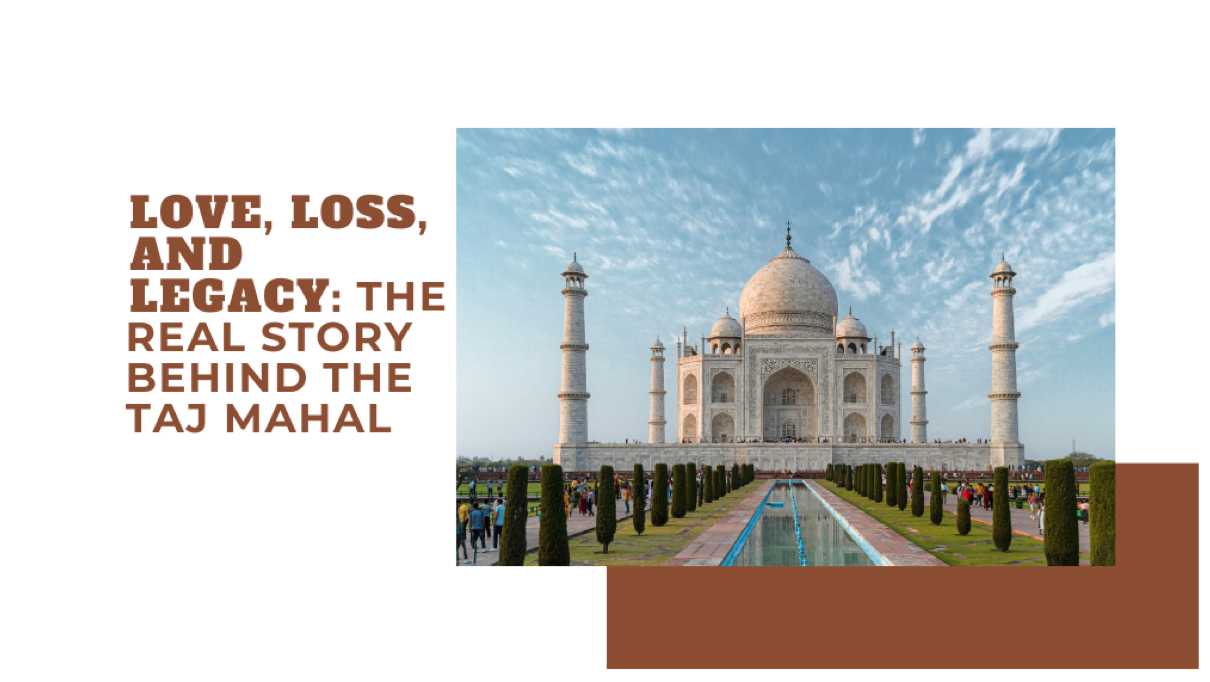
If you are dreaming of iconic getting away, then checking out Taj Mahal Tour from Delhi is basically opening a door to an everlasting love story. However, the Taj Mahal is more than just a great picture spot, or a place filled with tourists, it’s basically a human story of love, heartbreak, and the beauty that lasts forever, which makes a mere visit into a deeply moving journey of the soul.
The eternal love that created the wonder of an empire
The year is 1631. The Mughal Empire radiates majesty under Emperor Shah Jahan. His adored wife, Mumtaz Mahal, has just passed away during the birth of their child after 19 years of marriage and 14 children.Shah Jahan, deeply upset, promises to make her memory everlasting. What comes next is not merely architecture but deep emotions intricately depicted in marble.The Taj Mahal, which stands majestically on the river bank of Yamuna in Agra, required 22 years, 20, 000 craftsmen, and precious stones from all over Asia to finish in 1653.
The whole thing was not just about luxury; it was the healing of a shattered heart. Shah Jahan witnessed its building very often and each inlaid pietra dura flower was a source of comfort to him. Mumtaz’s grave is located right in the middle, thus, indicating that she was the center of his universe.Having been a guide for many travelers who have visited these gates, I can affirm that being there at sunrise when the first light falls on the domes, one experiences that love as if it was a warm hug.
A story of heartbreak and hidden sacrifices
Shah Jahan and Mumtaz’s tale is like a Bollywood musical but on steroids. When they met she was only 14, her real name was Arjumand Banu Begum and she was a Persian princess. He used to call her “the jewel of the palace, ” and their relationship went against the royal tradition Shah Jahan even postponed his wedding for 5 years to be able to conquer her heart in the right way.
During the Deccan campaign tragedy came upon them. Mumtaz, who was pregnant with their 14th child, followed him on the journey that was full of hardships for her. She died in his arms after telling him some final words that broke him totally. It is said that his hair turned white overnight and he secluded himself in grief for two years. The Taj was his way of defiance to deathan edifice where the perfect union of the two lovers is reflected by the symmetry but the small asymmetries acknowledge the imperfections of life.
So what’s really going on behind this grand love story? The workers were forced to work in the blazing sun, some were even blinded so that they wouldn’t be able to make another Taj Mahal. Shah Jahan’s son Aurangzeb later incarcerated him in the Agra Fort’s upper chamber where he was only allowed to look at the Taj from a distance until he died in 1666. Father and wife could only be together in the afterlife, their tombs having been placed side by side. To delve into each of these facets means that a Taj Mahal Tour by Train from Delhi is more than just stepping into a living drama, it is an experience that is far more engrossing than any history book that you have read.
Marvels of Architecture Whisper Secrets of Devotion
Explore the maze, and the Taj uncovers its genius. The central dome, 73 meters high, seems to float without support and uses an optical illusion, it gets smaller as you get closer, so that the proportions look perfect from a distance. Each of the four minarets leans slightly away from the main building, this being a clever anti, earthquake feature to protect the central mausoleum.
Prayer texts composed stylishly from the Quran chant along the sides and they get bigger as your eyes go up to imitate the distance. From afar the stones of jasper, jade, and lapis lazuli glisten like a sky full of stars. The parks, made in the Charbagh pattern, are a representation of paradise, the water bodies act as a mirror reflecting the Taj and the afterlife.
- MORNINGS: Once first light breaks over the horizon, rosy shades of pink quickly turn to gold, the best time for self, reflection.
- MOONLIGHT: On the nights of the full moon, the dreamlike fragrance of the night is doubled, with the exception of absence of crowds.
- RAINY SEASON: The misty cloaks of rain add the dramatics and act as a veil of secrets.
Legends and myths that add to the charm
No epic is complete without whispers. One story goes that the Taj has a black version hidden across the river, reserved for Shah Jahan’s tomblater destroyed by Aurangzeb to fund his wars. Another is about a door sealed with Mumtaz’s last breath, which can only be opened at the end of the world.
British viceroy Lord Curzon almost took it apart in the 1800s to bring it to London, but the locals protested so hard that he had to change his mind. After being restored at the beginning of the 1900s, it now attracts 8 million visitors annually. These legends make the place irresistible, and a Taj Mahal Tour by Train becomes an adventure in myth, busting.
Having worked for many years in the travel content optimization field for international audiences, I understand that exposing falsehoods while still incorporating elements of wonder makes readers want to know more. Shah Jahan did not ruin the countrythe Taj was worth only about 32 million rupees at that time (which was only a small part of the total military expenditure). However, its value in the eyes of the world has always been, and still is, beyond measure.
Shah Jahan’s last years: imprisonment and reflection
Shah Jahan was locked up by Aurangzeb in 1658 and stayed in the Musamman Burj, a marble pavilion at Agra Fort, which overlooks the Taj, for eight years. Servants secretly passed messages in and out, and he drew plans for the expansion. When he was dying at the age of 74, his corpse was taken to the other side of the river by bonfirelight for interment next to Mumtazwithout any grandeur, just a quiet reunion.
Nowadays, a walk down the fort balcony shows the view which he had a daily glance at, his heritage laughing at his imprisonment. It is an emotional touch that even empires decline, love’s monuments last forever.
Heritage: Why the Taj still fascinates the world
UNESCO declared it a Wonder back in 1983, but its impact goes far beyond any list. It is the very embodiment of a love that transcends death, a source of inspiration for all kinds of art, movies, and love vows on a global scale. Rabindranath Tagore famously called it “a teardrop on the cheek of time.”
Today, for the average tourist, this place is a kind of spiritual healing. Some couples get married again; individuals walking solo mend broken hearts. I’ve witnessed people from all over the world, authorized Britons from London, Emiratis from Dubai, and Americans from New York, leave the place changed. Less obsessed with selfies, more with the feeling.
Now climate change is posing a threat, pollution is making the marble yellow and the river Yamuna is drying up. Conservation champions such as the ASI continue this battle, using techniques like mud packs and laser treatments. Even your visit helps support and sustain these preservation efforts.
Planning Your Trip: Tips from an Insider
Choose the early trains from Delhi’s Hazrat Nizamuddin station to save three hours to Agra and get there fresh. Make a reservation for walking tours to discover tales that are hardly told; stay away from the time when the sun is at the highest point.
Observe the regulations: no eating inside the premises, and your shoulders/knees must be covered. Combine with Agra Fort and Fatehpur Sikri for a complete trail of the Mughals.
- The climate of the best seasons: October, March for fresh air.
- Pro Packing: Comfortable shoes, a hat, a water bottle you can fill again.
- Mindful Moments: Write in a journal at the reflecting pool, your story is waiting to be captured.
Such small changes have the power to turn ordinary tours into epic personal stories.
Finally, Taj Mahal is not a monument; it is the heartbeat of a great love eternally conquering death, the voice of heritage echoing through time. Being Himanshu Mulani, I have experienced these stories on many trips, and they always remain fresh in my mind. Allow it to transform you as well. What is your conclusion from this story of everlasting love?