Stress and anxiety have reached epidemic levels.
The American Psychological Association reports that stress levels in adults have been rising consistently — with work, finances, health, and global events topping the list of stressors. In 2026, with constant digital connectivity, information overload, and economic uncertainty, managing stress and anxiety has never been more important.
The good news? Science has given us highly effective, evidence-based techniques to reduce both stress and anxiety — most of which cost nothing and can be started today.
In this complete guide, you’ll learn:
- The difference between stress and anxiety
- Why chronic stress is dangerous
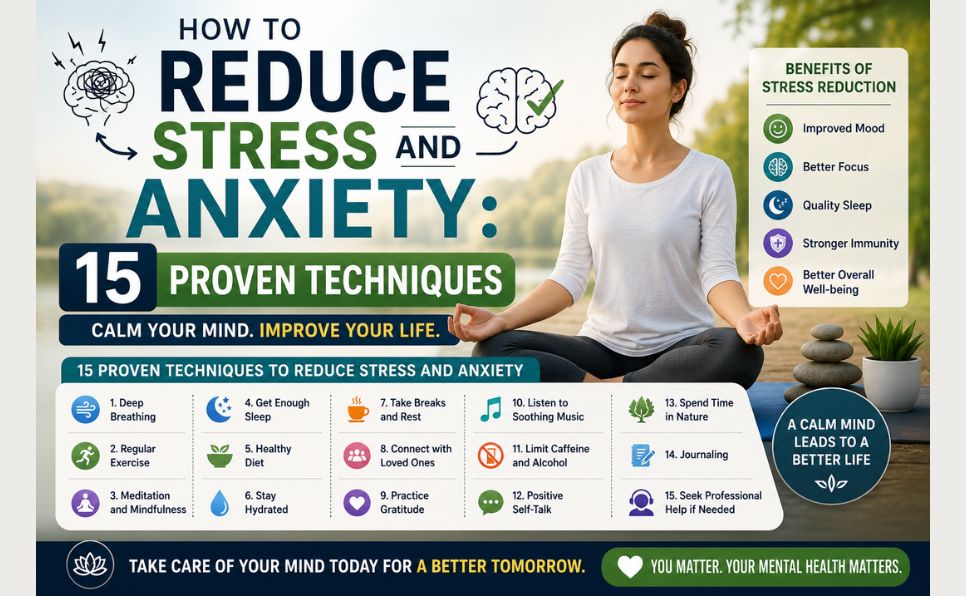
- 15 proven techniques to reduce stress and anxiety
- What to avoid when stressed
- When to seek professional help
Let’s get started. 👇
Stress vs. Anxiety — What’s the Difference?
Before diving into solutions, it helps to understand what you’re dealing with:
| Stress | Anxiety | |
|---|---|---|
| Cause | External trigger (deadline, conflict) | Internal worry (often without clear cause) |
| Duration | Usually temporary | Can persist even after trigger resolves |
| Physical symptoms | Headaches, muscle tension, fatigue | Racing heart, breathlessness, dizziness |
| Mental symptoms | Overwhelm, irritability | Excessive worry, fear, rumination |
| Resolves when | Stressor is removed | May persist regardless of circumstances |

Both stress and anxiety activate your body’s fight-or-flight response — flooding your system with adrenaline and cortisol, elevating heart rate, and preparing your body for perceived danger. The techniques in this guide address both.
Why Chronic Stress Is So Dangerous
Short-term stress is normal and even beneficial — it sharpens focus and boosts performance. Chronic stress, however, is a serious health threat.
Long-term elevated stress hormones are linked to:
- Weakened immune system
- Increased risk of heart disease and high blood pressure
- Digestive problems (IBS, acid reflux)
- Weight gain (especially around the abdomen)
- Sleep disorders
- Depression and anxiety disorders
- Memory and concentration problems
💡 Important connection: Chronic stress is one of the leading causes of poor sleep quality. Improving your stress management and sleep quality together produces compoundedly better results. Read our guide: How to Improve Sleep Quality: 15 Proven Tips
15 Proven Techniques to Reduce Stress and Anxiety
1. Deep Breathing Exercises
Deep breathing is the fastest way to activate your parasympathetic nervous system — your body’s “rest and digest” mode — and counteract the stress response.
Why it works: Slow, controlled breathing directly signals your nervous system to calm down, reducing heart rate, lowering blood pressure, and decreasing cortisol levels within minutes.
The 4-7-8 Technique:
- Inhale through your nose for 4 seconds
- Hold your breath for 7 seconds
- Exhale completely through your mouth for 8 seconds
- Repeat 3–4 times
Box Breathing (used by Navy SEALs):
- Inhale for 4 seconds
- Hold for 4 seconds
- Exhale for 4 seconds
- Hold for 4 seconds
- Repeat 4–5 times
When to use it: During acute stress moments, before a difficult conversation, before bed, or whenever anxiety spikes.
2. Regular Physical Exercise
Exercise is one of the most powerful stress-reduction tools available — and it’s free.
Why it works: Physical activity reduces stress hormones (cortisol and adrenaline), stimulates the production of endorphins (natural mood elevators), and provides a constructive outlet for tension and frustration.
Best exercises for stress relief:
- Aerobic exercise (walking, running, cycling) — 30 minutes, 5 days/week
- Yoga — combines physical movement with breath awareness
- Strength training — 2–3 sessions/week
- Swimming — highly effective for stress due to rhythmic movement and water
Important: Even a 10–15 minute brisk walk can produce measurable stress reduction. You don’t need a gym membership — consistency matters more than intensity.
3. Mindfulness Meditation
Mindfulness meditation trains your brain to stay present rather than ruminating on the past or worrying about the future — directly addressing the cognitive component of anxiety.
Why it works: Regular mindfulness practice reduces activity in the amygdala (the brain’s fear center) and strengthens the prefrontal cortex (responsible for rational thinking and emotional regulation), according to research published by Harvard Medical School.
How to start:
- Sit comfortably, close your eyes
- Focus on your breath — the sensation of air entering and leaving
- When your mind wanders (it will), gently return attention to your breath
- Start with 5 minutes daily and gradually increase
Free resources: Headspace, Insight Timer, and Calm all offer guided meditation — many with free tiers.
4. Progressive Muscle Relaxation (PMR)
PMR involves systematically tensing and relaxing muscle groups throughout your body — releasing physical tension that stress creates.
Why it works: Stress causes muscle tension that many people don’t even notice accumulating. PMR breaks the cycle of physical tension and mental stress, each of which feeds the other.
How to do it:
- Find a quiet place and lie down or sit comfortably
- Starting with your feet, tense the muscles tightly for 5 seconds
- Relax completely for 30 seconds, noticing the difference
- Move up through your body: calves, thighs, abdomen, chest, arms, hands, neck, face
- Full session takes 15–20 minutes
5. Limit News and Social Media Consumption
Constant exposure to negative news and social media comparison is a significant driver of anxiety in 2026.
Why it works: News is deliberately designed to capture and hold attention — often by triggering threat responses. Social media comparison activates feelings of inadequacy. Both create a state of low-level chronic arousal that fuels anxiety.
How to implement:
- Set specific times for news (morning and evening only — not before bed)
- Remove social media apps from your phone’s home screen
- Use app timers to limit daily social media usage
- Unfollow accounts that consistently make you feel worse about yourself
- Institute a “news-free” weekend once a month
6. Journaling and Expressive Writing
Writing about your thoughts and feelings provides an outlet for stress and creates cognitive distance from your worries.
Why it works: Expressive writing helps process emotions, identify recurring stress patterns, and transform vague anxieties into concrete, manageable concerns. Research from the American Psychological Association shows expressive writing reduces both psychological distress and physical health symptoms.
Effective journaling approaches:
Worry journaling:
- Write down everything you’re anxious about before bed
- For each item, ask: “Is this in my control?” → Yes: write one action step. No: let it go.
Gratitude journaling:
- Write 3 specific things you’re grateful for each morning
- Focus on specifics (“my colleague helped me with a difficult project today”) rather than generalities (“my family”)
Brain dump:
- Set a timer for 5 minutes and write everything on your mind without editing or judgment
7. Time Management and Prioritization
Much workplace and daily stress stems from feeling overwhelmed by too many demands competing for limited time.
Why it works: Poor time management creates a constant state of urgency and falling-behind that maintains chronic stress. Effective prioritization reduces the sense of overwhelm.
The Eisenhower Matrix:
| Urgent | Not Urgent | |
|---|---|---|
| Important | Do it now | Schedule it |
| Not Important | Delegate it | Eliminate it |
Practical tips:
- Start each day identifying your top 3 most important tasks
- Batch similar tasks together to reduce mental switching costs
- Learn to say “no” to commitments that don’t align with your priorities
- Build buffer time into your schedule — don’t schedule back-to-back commitments
8. Social Connection and Support
Strong social connections are one of the most powerful buffers against stress and anxiety.
Why it works: Social support activates the release of oxytocin — a hormone that counteracts cortisol and promotes feelings of calm and connection. Isolation, conversely, amplifies stress responses.
How to strengthen social connections:
- Schedule regular time with people who energize you
- Reach out to someone you haven’t spoken to in a while
- Join a community group, class, or club aligned with your interests
- Consider volunteering — helping others is a proven mood booster
9. Spend Time in Nature
Exposure to natural environments has measurable, scientifically documented effects on stress reduction.
Why it works: Research consistently shows that time in nature reduces cortisol levels, lowers heart rate and blood pressure, and improves mood — a phenomenon sometimes called “attention restoration theory.” Even looking at images of nature has measurable calming effects.
How to implement:
- Take a daily 20-minute walk in a park, garden, or natural area
- Bring plants into your home or workspace
- Eat lunch outside when possible
- Plan regular weekend outdoor activities
10. Reduce Caffeine Intake
While caffeine can enhance focus and energy, excessive intake directly amplifies anxiety symptoms in many people.
Why it works: Caffeine stimulates adrenaline release and blocks adenosine — the chemical that promotes calm. For anxiety-prone individuals, caffeine can trigger or worsen symptoms like racing heart, restlessness, and heightened alertness.
How to adjust:
- Notice if your anxiety worsens after caffeine
- Experiment with cutting back to 1–2 cups of coffee per day
- Switch to lower-caffeine alternatives (green tea contains L-theanine, which has calming properties)
- Avoid caffeine after 12–2pm (also helps sleep quality)
11. Practice the “5-4-3-2-1” Grounding Technique
This simple sensory awareness technique is highly effective for interrupting acute anxiety spirals and panic.
Why it works: Grounding techniques redirect your attention from anxious thoughts to immediate sensory experience — engaging your prefrontal cortex and reducing amygdala activity.
How to do it: Identify and name out loud or in your head:
- 5 things you can SEE
- 4 things you can TOUCH (and feel the texture)
- 3 things you can HEAR
- 2 things you can SMELL
- 1 thing you can TASTE
This takes about 60–90 seconds and can interrupt a panic response almost immediately.
12. Establish Clear Work-Life Boundaries
Blurring the lines between work and personal time — especially with remote work — is a major contributor to chronic stress in 2026.
Why it works: Without clear boundaries, your brain never fully transitions from “work mode” to “rest mode” — maintaining a low-level stress state even during supposed downtime.
How to establish boundaries:
- Set a specific end time for work and honor it daily
- Turn off work notifications after hours
- Create a physical transition ritual (changing clothes, short walk) between work and home time
- Communicate your boundaries clearly to colleagues and managers
- Have a dedicated workspace if working from home — don’t work from your bedroom
13. Cold Water Exposure (Controlled)
Brief cold water exposure — such as ending your shower with 30–60 seconds of cold water — has been shown to reduce stress and improve mood.
Why it works: Cold water exposure activates the vagus nerve (which regulates the parasympathetic nervous system), triggers norepinephrine release (which improves mood and focus), and creates a controlled stress response that builds resilience to other stressors over time.
How to start:
- End your regular shower with 30 seconds of cold water
- Gradually increase to 60–90 seconds as you become comfortable
- Breathe slowly and steadily during the cold exposure
14. Cognitive Reframing
Cognitive reframing is a technique from Cognitive Behavioral Therapy (CBT) that helps you challenge and change unhelpful thought patterns that fuel anxiety.
Why it works: Much anxiety is driven not by events themselves but by our interpretation of those events. Reframing helps you identify cognitive distortions (catastrophizing, black-and-white thinking, mind reading) and replace them with more balanced perspectives.
Common cognitive distortions to watch for:
- Catastrophizing — “This will be a complete disaster”
- All-or-nothing thinking — “If it’s not perfect, it’s a failure”
- Mind reading — “Everyone thinks I’m incompetent”
- Fortune telling — “I know this is going to go wrong”
How to reframe:
- Identify the anxious thought
- Ask: “What evidence supports this? What contradicts it?”
- Ask: “What would I tell a good friend thinking this?”
- Create a more balanced, realistic alternative thought
15. Professional Support — Therapy and Counseling
For persistent or severe anxiety, professional support is the most effective intervention — and seeking it is a sign of strength, not weakness.
Evidence-based therapy approaches:
- Cognitive Behavioral Therapy (CBT) — most extensively researched, highly effective for anxiety
- Acceptance and Commitment Therapy (ACT) — focuses on accepting difficult feelings rather than fighting them
- EMDR — particularly effective for anxiety rooted in past trauma
- Exposure Therapy — gradual, supported exposure to anxiety triggers
Finding help:
- Talk to your primary care physician for a referral
- Use the SAMHSA National Helpline — free, confidential treatment referrals
- BetterHelp and Talkspace offer online therapy with licensed therapists
- Many therapists offer sliding scale fees for those with financial constraints
What to Avoid When Stressed
These common coping mechanisms feel helpful in the short term but worsen stress and anxiety long-term:
❌ Alcohol and Substance Use
Alcohol is a depressant that disrupts sleep architecture and depletes neurotransmitters that regulate mood — temporarily reducing anxiety while increasing it long-term.
❌ Avoidance and Procrastination
Avoiding stressful situations provides brief relief but amplifies anxiety by allowing problems to grow and adding the stress of avoidance itself.
❌ Excessive Scrolling
Using social media or news as distraction maintains your nervous system in an activated state rather than allowing it to properly down-regulate.
❌ Emotional Eating
Stress eating provides brief comfort but creates additional stress through guilt, energy crashes, and long-term health consequences.
❌ Isolating Yourself
While alone time for introverts is healthy, prolonged isolation removes the social support that buffers stress and feeds anxious rumination.
Building a Complete Stress Management Routine
You don’t need to implement all 15 techniques at once. Here’s a practical starter routine:
Morning (10 minutes):
- 5 minutes gratitude journaling
- 5 minutes mindfulness meditation or deep breathing
During the day:
- Use the 5-4-3-2-1 grounding technique during stressful moments
- Take a 15-minute walk at lunch
- Limit news to specific check-in times
Evening (20 minutes):
- 30 minutes before bed: worry journal — write and release
- Progressive muscle relaxation or gentle yoga
- No screens in the final 60 minutes before sleep
📖 For better results, pair stress management with quality sleep — the two work together powerfully: How to Improve Sleep Quality: 15 Proven Tips
When to Seek Professional Help
Self-help techniques are effective for everyday stress and mild to moderate anxiety. Seek professional support if:
- Anxiety is persistent for more than 2 weeks despite self-help efforts
- Anxiety significantly interferes with work, relationships, or daily functioning
- You’re experiencing panic attacks
- You’re using alcohol or substances to cope
- You’re having thoughts of self-harm or suicide
If you’re in crisis: Contact the 988 Suicide and Crisis Lifeline by calling or texting 988 (US) — available 24/7 for mental health crises.
Complete Stress & Anxiety Reduction Checklist
- Daily deep breathing practice (4-7-8 or box breathing)
- Regular exercise — at least 30 min, 5 days/week
- 5–10 minutes daily mindfulness meditation
- Limit news to 2 specific daily check-ins
- Daily journaling (worry or gratitude)
- Time management system in place (Eisenhower Matrix)
- Regular social connection scheduled
- Time in nature weekly
- Caffeine reduced or eliminated after noon
- Clear work-life boundaries established
- Screen time limited before bed
- Sleep quality optimized (crucial — stress and sleep are interconnected)
Conclusion — Stress Management Is a Skill You Can Build
Reducing stress and anxiety isn’t about eliminating all difficulty from your life — it’s about building your capacity to respond to difficulty without being overwhelmed by it.
Start with 2–3 techniques that feel most accessible to you right now:
For immediate relief: Deep breathing (4-7-8) + 5-4-3-2-1 grounding For long-term change: Regular exercise + mindfulness + consistent sleep For cognitive patterns: Journaling + cognitive reframing
With consistent practice, stress management becomes natural. Your stress response doesn’t disappear — but your ability to move through it and recover from it grows stronger every week.
You have more control over your stress and anxiety than you might think. Start today.
Frequently Asked Questions (FAQ)
What is the fastest way to reduce anxiety in the moment?
Deep breathing techniques — particularly the 4-7-8 method or box breathing — can produce measurable calm within 60–90 seconds by directly activating the parasympathetic nervous system. The 5-4-3-2-1 grounding technique is equally effective for interrupting acute anxiety episodes.
Is stress the same as anxiety?
Not exactly. Stress is typically a response to an external trigger that resolves when the trigger is removed. Anxiety involves persistent worry that often continues even when the original stressor is gone. Both activate the body’s fight-or-flight response, but anxiety has a stronger cognitive/mental component.
How long does it take for stress management techniques to work?
Deep breathing and grounding techniques work within minutes. Exercise, meditation, and journaling typically produce noticeable benefits within 2–4 weeks of consistent daily practice. For anxiety disorders, CBT typically produces significant improvement within 8–16 sessions.
Can exercise really help with anxiety?
Yes — extensively. Multiple large-scale studies show regular aerobic exercise is as effective as medication for mild to moderate anxiety in many individuals, with the additional benefits of improved physical health, better sleep, and no side effects. The key is consistency over intensity.
Is it possible to be too stressed to use stress management techniques?
Very high stress can make it difficult to remember or use techniques — this is why practicing them during calm periods is important. Building them into daily routines means they become automatic and accessible even when stress peaks. Start with the simplest techniques (deep breathing) that require minimal mental effort.
When should I see a doctor about anxiety?
See a doctor if: anxiety persists for more than 2 weeks despite self-help, significantly impairs daily functioning, causes panic attacks, or is accompanied by physical symptoms like persistent chest pain, dizziness, or difficulty breathing. These could indicate an anxiety disorder or a medical condition that warrants professional evaluation.
This article is for informational purposes only and is not a substitute for professional medical or mental health advice. If you are experiencing a mental health crisis, please contact a qualified healthcare professional or crisis service immediately.
Found this guide helpful? Share it with someone who could use support. Have a question? Drop it in the comments — we answer every one!