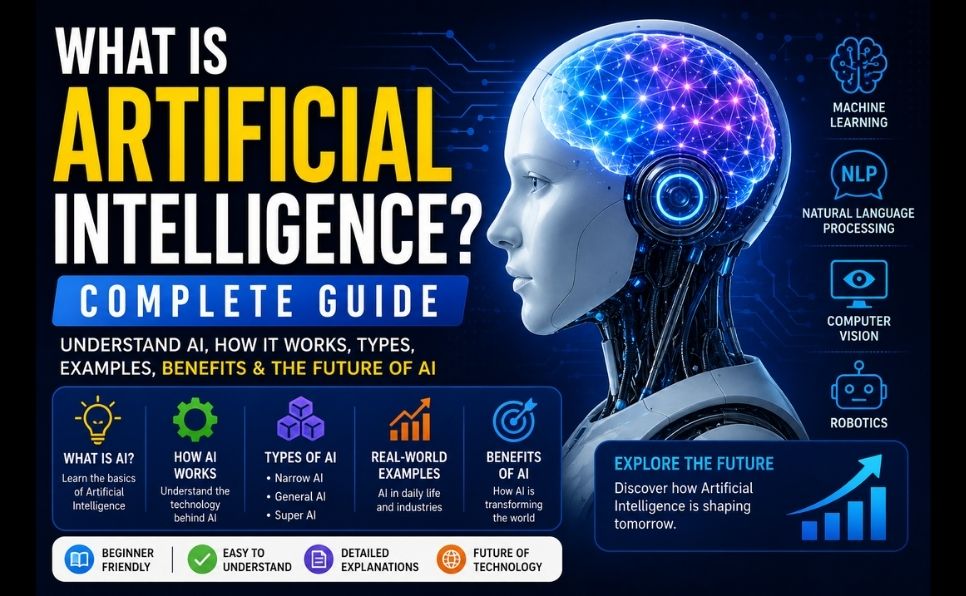
Artificial Intelligence is no longer science fiction.
It writes emails, diagnoses diseases, drives cars, recommends movies, detects fraud, and powers the chatbots millions of people use every single day.
Yet most people still have only a vague idea of what AI actually is — and how it actually works.
In this complete beginner’s guide, you’ll learn:
- What artificial intelligence really is (in plain English)
- How AI actually works behind the scenes
- The different types of AI
- Real-world examples you encounter every day
- The benefits and risks of AI
- How AI is changing every major industry
- Where AI is headed in 2026 and beyond
No technical background required. Let’s dive in. 👇
What Is Artificial Intelligence? (Simple Definition)
Artificial Intelligence (AI) is the simulation of human intelligence processes by computer systems — enabling machines to perform tasks that normally require human intelligence, such as learning, reasoning, problem-solving, understanding language, and recognizing patterns.
In simpler terms: AI is technology that can think, learn, and make decisions — similar to how humans do — but faster and at massive scale.
The Key Word: “Intelligence”
Human intelligence involves:
- Learning from experience
- Understanding language
- Recognizing patterns
- Solving problems
- Making decisions
- Adapting to new situations
AI systems are designed to replicate these abilities — using data, algorithms, and computing power instead of a biological brain.
A Simple Analogy
Think of AI like teaching a child:
- You show a child thousands of pictures of cats and dogs
- The child learns to recognize the difference
- Now show them a new picture — they can identify it correctly
AI works similarly:
- You feed an AI system millions of cat and dog images
- The AI learns the patterns that distinguish them
- Show it a new image — it identifies it correctly
The difference? AI can process millions of examples in hours — and never forgets what it learned.

A Brief History of Artificial Intelligence
| Year | Milestone |
|---|---|
| 1950 | Alan Turing proposes the “Turing Test” — can a machine think? |
| 1956 | The term “Artificial Intelligence” coined at Dartmouth Conference |
| 1997 | IBM’s Deep Blue defeats world chess champion Garry Kasparov |
| 2011 | IBM Watson wins Jeopardy! against human champions |
| 2012 | Deep learning breakthrough — AI dramatically improves at image recognition |
| 2016 | Google DeepMind’s AlphaGo defeats world Go champion |
| 2022 | ChatGPT launches — AI goes mainstream with 100M users in 60 days |
| 2023–2024 | AI integrated into Microsoft Office, Google Workspace, Adobe, and thousands of apps |
| 2026 | AI used by billions daily — writing, coding, diagnosing, designing, driving |
How Does Artificial Intelligence Work?
AI works through a combination of three core technologies:
1. Machine Learning (ML)
Machine Learning is the most important branch of AI. Instead of being explicitly programmed with rules, ML systems learn from data.
How it works:
- Feed the system large amounts of data (examples)
- The system identifies patterns in the data
- It builds a mathematical model based on those patterns
- Use the model to make predictions on new, unseen data
Example: A spam filter learns from millions of spam and non-spam emails. Over time it learns the patterns that indicate spam — and filters them automatically.
2. Deep Learning
Deep Learning is a subset of Machine Learning that uses neural networks — systems loosely inspired by the human brain’s structure.
Neural networks consist of layers of interconnected “nodes” (like neurons) that process information:
- Input layer receives data
- Hidden layers find complex patterns
- Output layer produces the result
Deep learning powers the most impressive AI applications:
- Image recognition
- Voice assistants (Siri, Alexa)
- Language models (ChatGPT, Gemini)
- Self-driving cars
3. Natural Language Processing (NLP)
NLP is the branch of AI that enables computers to understand, interpret, and generate human language.
It powers:
- ChatGPT and other AI chatbots
- Google Search understanding your queries
- Real-time translation (Google Translate)
- Voice assistants understanding spoken commands
- Sentiment analysis (understanding if a review is positive or negative)
How They Work Together:
Raw Data (text, images, video, audio)
         ↓
Machine Learning — finds patterns
         ↓
Deep Learning — understands complex patterns
         ↓
NLP (for language) / Computer Vision (for images)
         ↓
AI Application (ChatGPT, Face ID, self-driving car)
Types of Artificial Intelligence
AI is classified in two main ways — by capability and by functionality.
Classification by Capability:
1. Narrow AI (Weak AI) — Current Reality
What it is: AI designed to perform one specific task very well — but nothing outside that task.
Examples:
- Chess-playing AI (only plays chess)
- Spam filter (only filters email)
- Face recognition (only identifies faces)
- ChatGPT (only processes and generates language)
- Netflix recommendation engine (only recommends content)
Status: This is ALL AI that currently exists. Every AI system today is Narrow AI.
2. General AI (AGI — Artificial General Intelligence) — Near Future
What it is: AI with human-level intelligence across ALL tasks — able to learn anything, reason about anything, and apply knowledge across domains.
Status: Does not yet exist. Researchers debate whether it’s 5, 20, or 50+ years away — or even possible.
3. Super AI (Superintelligence) — Theoretical
What it is: AI that surpasses human intelligence in every dimension — creativity, wisdom, social skills, scientific ability.
Status: Purely theoretical. Does not exist and may never exist in the way science fiction portrays it.
Classification by Functionality:
| Type | What It Does | Examples |
|---|---|---|
| Reactive AI | Responds to inputs without memory | Chess engines, spam filters |
| Limited Memory AI | Uses past data to make decisions | Self-driving cars, ChatGPT |
| Theory of Mind AI | Understands human emotions and intentions | In development — not fully realized |
| Self-Aware AI | Has consciousness and self-awareness | Theoretical — does not exist |
Real-World Examples of AI You Use Every Day
AI is already deeply embedded in daily life — often invisibly:
On Your Phone:
| Feature | AI Behind It |
|---|---|
| Face ID / fingerprint unlock | Computer vision + biometric AI |
| Autocomplete and autocorrect | NLP models |
| Voice assistants (Siri, Google) | NLP + speech recognition |
| Photo enhancement | Deep learning image processing |
| App recommendations | Recommendation algorithms |
Online:
| Service | AI Behind It |
|---|---|
| Google Search | NLP + ranking algorithms |
| Netflix recommendations | Collaborative filtering AI |
| Spotify Discover Weekly | Music recommendation AI |
| Amazon product suggestions | Purchase prediction algorithms |
| Gmail Smart Reply | NLP text generation |
| Google Translate | Neural machine translation |
| Facebook/Instagram feed | Content ranking algorithms |
In Business:
| Application | AI Behind It |
|---|---|
| Fraud detection | Anomaly detection algorithms |
| Customer service chatbots | NLP + conversation AI |
| Credit scoring | Predictive ML models |
| Medical diagnosis | Computer vision + diagnostic AI |
| Supply chain optimization | Predictive analytics |
| HR resume screening | NLP classification models |
Types of AI Applications in 2026
1. Generative AI — The Biggest Trend
Generative AI creates new content — text, images, video, audio, and code — rather than just analyzing existing data.
Most popular tools in 2026:
| Tool | Company | What It Creates |
|---|---|---|
| ChatGPT | OpenAI | Text, code, analysis |
| Claude | Anthropic | Text, analysis, reasoning |
| Gemini | Text, images, code | |
| DALL-E 3 | OpenAI | Images from text |
| Midjourney | Midjourney | Artistic images |
| Sora | OpenAI | Video from text |
| GitHub Copilot | Microsoft/OpenAI | Code completion |
| ElevenLabs | ElevenLabs | Voice synthesis |
2. Computer Vision
AI that can “see” and understand images and video:
- Medical imaging (detecting cancer in X-rays)
- Self-driving car navigation
- Facial recognition
- Quality control in manufacturing
- Satellite image analysis
3. Robotics AI
Physical robots guided by AI:
- Amazon warehouse robots
- Surgical robots (Da Vinci system)
- Agricultural harvesting robots
- Boston Dynamics humanoid robots
4. Predictive AI
AI that forecasts future outcomes:
- Weather prediction
- Stock market analysis
- Disease outbreak prediction
- Equipment failure prediction (industrial IoT)
How AI Is Transforming Every Industry
Healthcare
- Diagnosis: AI detects cancer, diabetic retinopathy, and other conditions from medical images with accuracy matching or exceeding specialists
- Drug discovery: AI reduces drug development time from 10+ years to 2–3 years
- Personalized medicine: AI tailors treatment plans to individual patients based on genetics and history
- Mental health: AI-powered therapy tools provide 24/7 support
Education
- Personalized learning: AI adapts content difficulty and pace to each student
- Tutoring: AI tutors available 24/7 for any subject
- Grading: AI assists teachers with essay and assignment evaluation
- Language learning: Apps like Duolingo use AI to personalize lessons
Finance
- Fraud detection: AI analyzes thousands of transactions per second to flag suspicious activity
- Algorithmic trading: AI executes trades in microseconds
- Credit decisions: AI evaluates loan applications more accurately and faster
- Personal finance: AI-powered apps analyze spending and provide advice
Transportation
- Self-driving vehicles: Tesla Autopilot, Waymo, and others use AI for autonomous driving
- Traffic optimization: AI manages traffic signals to reduce congestion
- Logistics: AI optimizes delivery routes, reducing fuel costs and delivery times
- Aviation: AI assists pilots and manages air traffic control
Content and Media
- Content creation: AI writes articles, generates images, creates videos
- Personalization: Netflix, Spotify, YouTube use AI to keep you engaged
- Translation: Real-time AI translation breaks language barriers
- Accessibility: AI generates captions, descriptions for visually impaired users
Benefits of Artificial Intelligence
| Benefit | Explanation |
|---|---|
| Efficiency | AI performs tasks 24/7 without fatigue — faster than humans |
| Accuracy | AI reduces human error in repetitive, data-intensive tasks |
| Scale | AI can process billions of data points simultaneously |
| Cost reduction | Automates expensive manual processes |
| Personalization | Tailors experiences to individual users at massive scale |
| Discovery | Finds patterns in data humans would never notice |
| Accessibility | Makes expert-level assistance available to everyone |
Risks and Challenges of Artificial Intelligence
AI brings significant benefits — but also serious risks that must be addressed:
1. Job Displacement
AI and automation are replacing certain jobs — particularly repetitive, routine tasks. While AI creates new jobs, the transition can be disruptive for workers in affected industries.
2. Bias and Discrimination
AI systems trained on biased data produce biased outputs. This has led to discriminatory outcomes in hiring, lending, criminal justice, and healthcare — disproportionately affecting marginalized groups.
3. Privacy Concerns
AI systems collect and analyze massive amounts of personal data. Facial recognition, behavioral tracking, and data mining raise serious privacy concerns.
4. Misinformation and Deepfakes
Generative AI makes it easy to create convincing fake images, videos, and text — enabling misinformation campaigns, fraud, and manipulation at unprecedented scale.
5. Lack of Transparency (Black Box Problem)
Many AI systems — especially deep learning models — make decisions that even their creators cannot fully explain. This “black box” problem makes it difficult to identify errors or biases.
6. Security Risks
AI can be used to create more sophisticated cyberattacks, phishing emails, and malware. It also introduces new attack surfaces through AI systems themselves.
7. Concentration of Power
AI development is concentrated among a small number of large tech companies — raising concerns about monopolistic control over transformative technology.
AI vs Human Intelligence — Key Differences
| Factor | AI | Human Intelligence |
|---|---|---|
| Speed | Millions of calculations per second | Much slower |
| Memory | Perfect recall of all training data | Imperfect, fades over time |
| Learning | Requires massive data | Learns from few examples |
| Creativity | Combines existing patterns | Generates truly novel ideas |
| Common sense | Often lacks contextual understanding | Natural common sense |
| Emotions | None (currently) | Central to decision-making |
| Adaptability | Limited to trained domain | Generalizes across all domains |
| Energy | Uses significant electricity | Uses ~20 watts (brain) |
How to Use AI in Your Daily Life (2026)
You don’t need to be a developer to benefit from AI. Here are practical ways to use it right now:
For Writing and Content:
- ChatGPT / Claude — write blog posts, emails, social media content
- Grammarly — AI-powered writing assistant
- Jasper — marketing copy generation
For Images:
- DALL-E 3 / Midjourney — generate images from text descriptions
- Adobe Firefly — AI image editing
For Productivity:
- Microsoft Copilot — AI in Word, Excel, PowerPoint, Outlook
- Google Gemini — AI in Gmail, Docs, Sheets
- Notion AI — AI-powered notes and project management
For Learning:
- Khan Academy’s Khanmigo — AI tutor for any subject
- Duolingo — AI-personalized language learning
- Coursera AI courses — Learn AI fundamentals for free
For Developers:
- GitHub Copilot — AI code completion
- Cursor — AI-powered code editor
- AWS SageMaker — Build and deploy ML models
📖 Learn how AI tools like ChatGPT compare to cloud infrastructure: ChatGPT vs Cloud Computing: Key Differences
AI and SEO — What Bloggers Need to Know
AI is transforming SEO in 2026:
- Google’s AI (RankBrain, BERT, MUM) understands the meaning and intent behind search queries — not just keywords
- AI-generated content must be helpful and accurate — Google penalizes low-quality AI content
- AI tools like ChatGPT can help research, outline, and draft content — but human editing and expertise are essential
- Search Generative Experience (SGE) — Google’s AI-powered search results are changing how content gets traffic
📖 Stay ahead of Google’s AI with proper on-page optimization: On-Page SEO Complete Guide 2026
📖 Make sure your content gets indexed properly: How to Get Your Website Indexed Faster on Google
Conclusion — AI Is Not the Future. It’s the Present.
Artificial Intelligence is no longer something coming in the future — it’s here, it’s powerful, and it’s changing every aspect of how we live and work.
Understanding AI gives you a significant advantage — whether you’re a student, professional, business owner, or curious individual.
The key takeaways:
- AI simulates human intelligence using data, algorithms, and computing power
- All current AI is Narrow AI — excellent at specific tasks, not general intelligence
- Machine learning and deep learning are the core technologies
- Generative AI (ChatGPT, DALL-E) is the most transformative recent development
- AI brings enormous benefits — but also real risks that must be managed
- You can use AI today — to write faster, work smarter, and learn more efficiently
The people who understand and embrace AI will have a massive advantage over those who ignore it. Start learning today.
Frequently Asked Questions (FAQ)
Is artificial intelligence dangerous?
AI has both beneficial and potentially harmful applications. Current AI systems (Narrow AI) pose risks around bias, privacy, misinformation, and job displacement — but not the existential risks often portrayed in movies. Responsible development, regulation, and oversight are essential to ensure AI benefits humanity.
Is AI the same as machine learning?
No — machine learning is a subset of AI. AI is the broad field of creating intelligent machines. Machine learning is one specific approach to AI — where systems learn from data rather than being explicitly programmed. Deep learning is a further subset of machine learning.
Will AI replace human jobs?
AI will automate many tasks — particularly repetitive, data-intensive work. Some jobs will be displaced, but AI also creates new jobs and transforms existing ones. The most affected roles involve routine cognitive tasks; jobs requiring creativity, empathy, and complex judgment are more resilient.
How do I learn artificial intelligence?
Start with free online resources: Google’s free AI courses at ai.google, Andrew Ng’s Machine Learning course on Coursera, and fast.ai for practical deep learning. Python programming is the most important skill to develop alongside AI theory.
What is the difference between AI and automation?
Automation follows fixed, pre-programmed rules to perform repetitive tasks. AI can learn, adapt, and make decisions based on data — handling situations it wasn’t explicitly programmed for. All AI involves some automation, but not all automation is AI.
How accurate is AI?
It depends entirely on the application and training data. In narrow tasks with abundant training data — like image recognition, chess, or language translation — AI can match or exceed human accuracy. In complex, nuanced situations requiring common sense and contextual understanding, AI still makes significant errors.
Found this guide helpful? Share it with someone curious about AI. Have a question? Drop it in the comments — we answer every one!