A growing number of people no longer start their research on Google — they open ChatGPT, Claude, or Gemini and simply ask. When someone asks an AI chatbot “what’s the best hosting provider for beginners” or “how do I fix a WordPress migration,” the AI answers directly, often citing a small handful of sources it trusts. If your content isn’t structured to earn that citation, you’re invisible to this entire, fast-growing segment of your audience.
This guide walks through exactly how LLMs decide what to cite, and the practical, step-by-step process for optimizing your content so ChatGPT, Claude, Gemini, and Perplexity recognize it as a trustworthy source.
Related reading: This guide focuses specifically on optimizing for direct AI chatbot conversations. If you’re looking to rank inside Google’s AI-powered search results instead, see our guides on What Is Generative Engine Optimization (GEO)?, GEO vs SEO, and How to Rank in Google AI Mode.
What Is LLM Optimization?
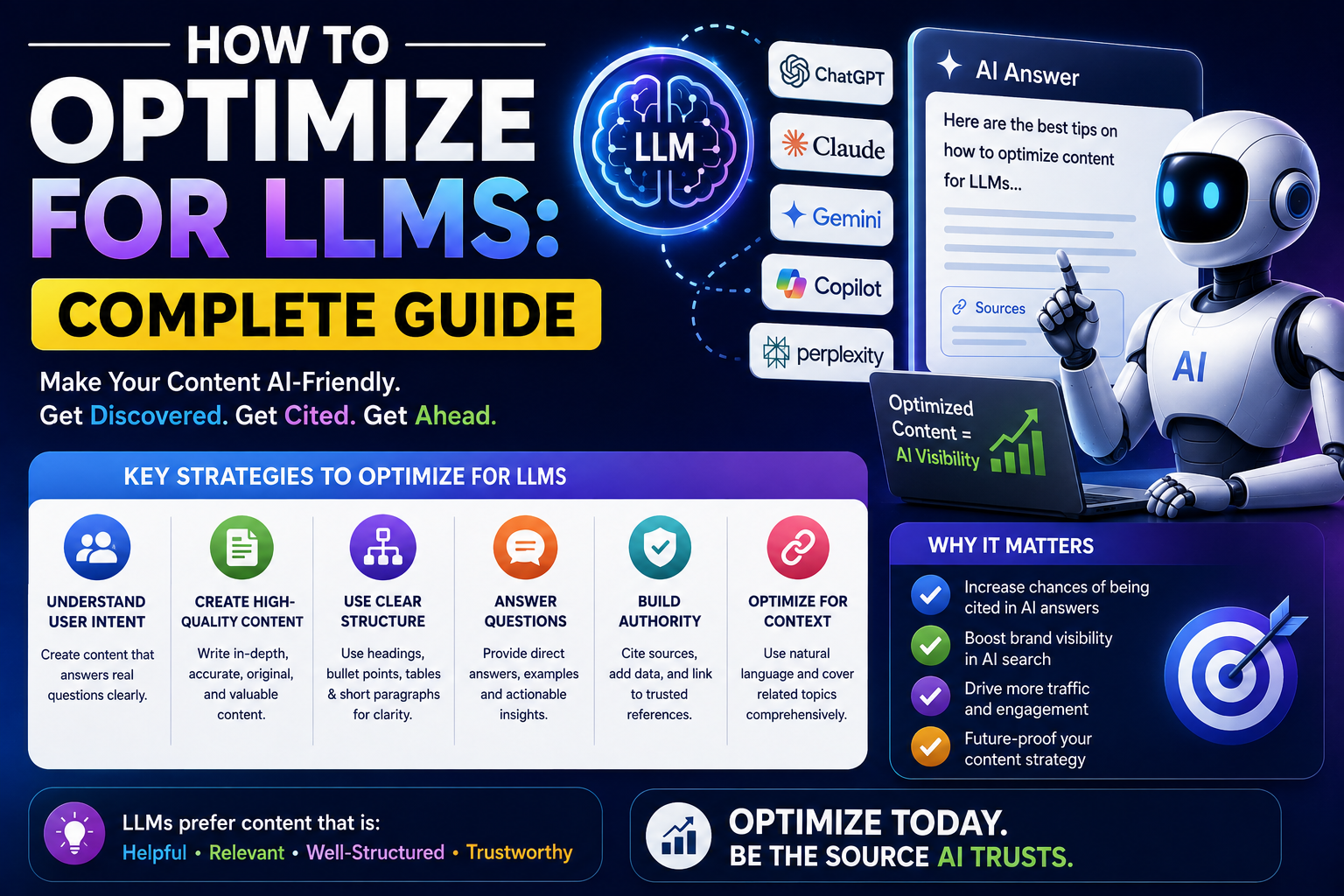
LLM optimization is the practice of structuring your content so large language models — like ChatGPT, Claude, and Gemini — can easily retrieve, understand, and cite it when responding to a user’s question. Unlike traditional SEO, which targets search engine ranking algorithms, LLM SEO focuses on becoming a trusted source within the training data and retrieval systems that AI models draw from. Marketer’s Choice
It’s closely related to Generative Engine Optimization (GEO) and Answer Engine Optimization (AEO) — in fact, many practitioners use these terms interchangeably. The distinction that matters most in practice: LLM optimization specifically targets the moment a user is having a direct conversation with an AI assistant, rather than using a traditional search engine.
How Do LLMs Actually Decide What to Cite?
Understanding the mechanics behind LLM citation is the foundation everything else builds on.
LLMs Read in Chunks, Not Whole Pages
When an LLM retrieves information to answer a question, it doesn’t process your entire article at once. Instead, it works with small, self-contained sections of text — a separate, logically complete text fragment of roughly 100–300 tokens (about 75–225 words) that an LLM can extract, analyze, and use when generating its response. Even models with enormous context windows still work with individual semantic parts, not the entire text, when deciding what to pull into an answer. Wizible BlogWizible Blog
This single fact should shape how you write: every section of your content needs to work as a standalone unit that makes complete sense without requiring the paragraphs before or after it.
Different Platforms, Different Retrieval Systems
Each major AI model uses a different retrieval mechanism, so optimizing for one platform does not guarantee visibility across all five major AI systems. For more complex questions, Claude in particular can run several rounds of search calls before composing a final answer, which means thorough, well-organized content has more chances to get pulled in during that research process. Marketer’s Choice
Authority Signals Matter — Because LLMs Can’t “Judge” Quality Directly
LLMs cannot evaluate the quality of your writing the way a human editor would. Instead, they rely on external authority signals as trust proxies — meaning backlinks from credible sources, consistent brand mentions across the web, and clear entity recognition all play a real role in whether your content gets treated as trustworthy. Marketer’s Choice
Step-by-Step: How to Optimize Your Content for LLMs
1. Fix Technical Access First
Before any content strategy matters, make sure AI crawlers can actually reach your site. A blocked crawler makes every other optimization effort pointless. Check your robots.txt file and confirm you’re not accidentally blocking the crawlers that matter for citation. According to OpenAI’s official crawler documentation, OAI-SearchBot and GPTBot can be controlled independently — allowing OAI-SearchBot lets you appear in ChatGPT search results while still disallowing GPTBot if you don’t want your content used for training. Similarly, Anthropic’s official crawler documentation explains that Claude-SearchBot and Claude-User can be allowed for citation and retrieval purposes even while ClaudeBot (the training crawler) is blocked.

2. Write Direct, Self-Contained Answers
For each core topic or question your audience asks, write a single paragraph that answers it cleanly and completely. This paragraph should be self-contained — a reader, or an LLM, should be able to extract it and understand the full answer without needing surrounding context. Place this answer near the top of the relevant section, not buried after several paragraphs of setup. Sight AI
3. Structure Content Into Clean, Logical Chunks
Break your content into short sections built around a single idea each — roughly 75–225 words per chunk is a useful target. Use descriptive subheadings phrased as real questions, since this naturally aligns with how users phrase their prompts to AI chatbots.
4. Research Real Prompts, Not Just Keywords
Instead of relying only on traditional keyword tools, open ChatGPT or Claude yourself and ask what questions people in your niche typically ask. Use those actual prompt patterns to shape your headings and FAQ sections — this gives you content ideas sourced directly from the systems you’re trying to get cited in.
5. Build Genuine Topical Depth
According to research from Princeton and Georgia Tech studying generative engine optimization, how you structure content directly determines whether LLMs extract and cite it, with formatting choices like clear headers, defined entities, and quotable factual statements acting as critical optimization levers. Publishing a connected cluster of articles on one core subject — rather than isolated, disconnected posts — reinforces the topical authority LLMs look for. Marketer’s Choice
6. Strengthen Your Site’s Technical Foundation
Server-side rendering matters here, since most AI crawlers do not execute JavaScript the way a browser does — if your key content only loads after JavaScript runs, many AI crawlers will simply miss it. This is another area where reliable web hosting becomes a genuine prerequisite rather than an afterthought; slow, unstable servers can quietly prevent your content from ever being crawled and considered in the first place. If you’re evaluating hosting options with this in mind, our Shared vs VPS vs Cloud Hosting comparison can help you choose a plan that supports fast, reliable crawler access.
7. Add Schema Markup and Clean HTML
Structured data, clear headings, and clean semantic HTML all make it substantially easier for AI systems to parse and correctly interpret your content, reducing the chance your key facts get misread or skipped entirely.
8. Track Your AI Citation Performance
Set a regular cadence — weekly or biweekly works well for most teams — to run test prompts relevant to your niche across ChatGPT, Claude, and Perplexity. Document whether your brand or content appears, what context surrounds the citation, and how that changes over time. This gives you a practical, ongoing read on whether your optimization efforts are actually working.
LLM Optimization Is a Compounding Effort
One encouraging pattern worth knowing: citation behavior tends to reinforce itself over time. Pages that are consistently retrieved and cited are more likely to keep being retrieved, since their structure has already proven to work well with a given model’s extraction logic. This means early, consistent effort compounds — the sooner you start structuring content this way, the sooner you build a lasting advantage.
Frequently Asked Questions
What is LLM optimization?
LLM optimization is the practice of structuring content so large language models like ChatGPT, Claude, and Gemini can easily retrieve, understand, and cite it when generating answers to user questions.
How is LLM optimization different from GEO or SEO?
SEO targets traditional search engine rankings, GEO generally refers to optimizing for AI-powered search experiences (like Google AI Mode), and LLM optimization specifically targets direct conversations with AI chatbots. In practice, all three overlap heavily and share many of the same best practices.
Do LLMs read my entire webpage before citing it?
No. LLMs typically process content in small, self-contained chunks of roughly 75–225 words rather than evaluating an entire page as one unit, which is why each section of your content needs to stand on its own.
Does my site need to block AI crawlers to protect its content?
That depends on your goals. You can selectively allow crawlers used for citation and retrieval while blocking crawlers used purely for AI model training, giving you a way to remain visible in AI answers without necessarily contributing your content to a model’s training data.
How long does it take to start getting cited by LLMs?
There’s no fixed timeline, since citation depends on your existing authority, technical accessibility, and how well your content is structured for extraction. Sites with strong topical depth and clean technical foundations tend to see results faster than sites starting from scratch.
Do backlinks still matter for LLM optimization?
Yes. Since LLMs can’t directly judge content quality, they lean on external signals like backlinks and consistent brand mentions as trust proxies, so backlink building remains relevant even in an LLM-first optimization strategy.
Final Thoughts
Optimizing for LLMs isn’t a separate discipline you build from scratch — it’s a natural extension of solid content and technical fundamentals, tuned specifically for how AI models retrieve and reuse information. Focus on clear, self-contained answers, genuine topical depth, and a technically reliable website, and you’ll be building visibility across ChatGPT, Claude, Gemini, and traditional search all at once.
Related reading: What Is Generative Engine Optimization (GEO)? · GEO vs SEO · How to Rank in Google AI Mode · What Is Web Hosting · Shared vs VPS vs Cloud Hosting