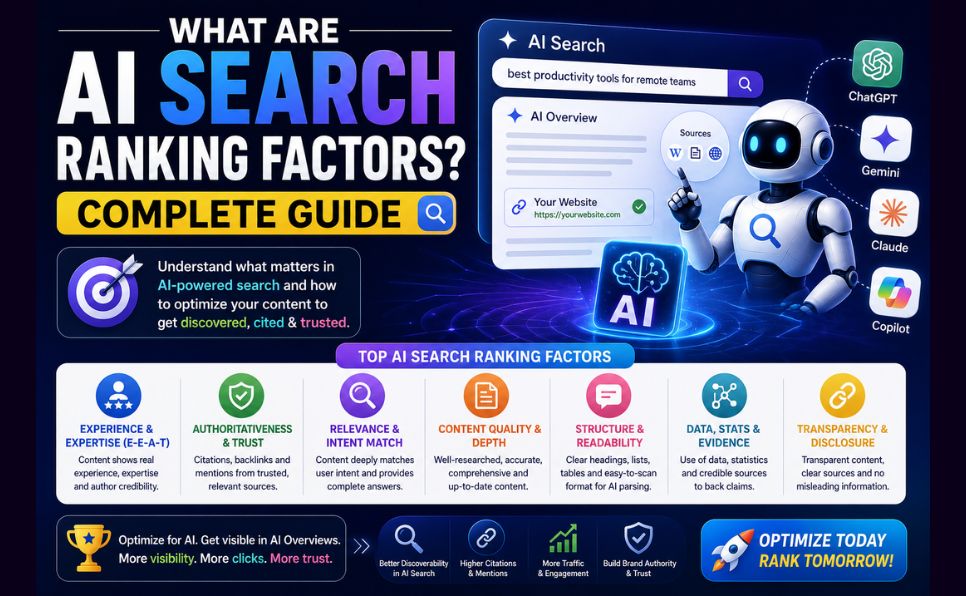
Google is no longer just a keyword-matching machine.
In 2026, artificial intelligence sits at the core of how search engines discover, evaluate, and rank content. From RankBrain in 2015 to BERT, MUM, and now Gemini-powered search — AI has fundamentally changed what it takes to rank.
The old playbook — stuff your keywords, build some links, wait for rankings — no longer works. Today, ranking requires understanding how AI thinks, what signals it evaluates, and how to create content that satisfies both machine intelligence and human intent.
In this complete guide, you’ll learn:
- How AI changed search engine ranking forever
- The 12 key AI search ranking factors in 2026
- How Google’s AI models actually evaluate content
- What E-E-A-T means and why AI prioritizes it
- Practical steps to optimize for AI-driven search
- What the future of AI search looks like
Let’s get started. 👇
How AI Transformed Search Ranking
To understand AI ranking factors, you need to understand how search evolved.
The Old Way (Pre-2015)
Early search engines ranked pages primarily through:
- Keyword density — how often a word appeared on a page
- Meta tags — keyword stuffing in hidden fields
- Backlink quantity — more links = higher ranking
- Exact match domains — keywords in domain names
This system was easy to manipulate — which led to an internet flooded with low-quality, keyword-stuffed content.
The AI Revolution
Google began integrating machine learning and AI to understand content the way humans do — not just matching keywords, but understanding meaning, context, and intent.
Key AI milestones in Google Search:
| Year | AI Update | What Changed |
|---|---|---|
| 2015 | RankBrain | First ML system — interprets ambiguous queries |
| 2019 | BERT | Understands natural language and context |
| 2021 | MUM | Multimodal — processes text, images, video |
| 2023 | Search Generative Experience (SGE) | AI-generated answers in search results |
| 2024 | Gemini Integration | Google’s most advanced AI model in search |
| 2026 | AI Overviews + Deep Research | AI summarizes, synthesizes, and answers directly |
Today, AI doesn’t just influence search rankings — it is the ranking system. Every query is processed, interpreted, and matched by machine learning models trained on billions of data points.

The 12 Key AI Search Ranking Factors in 2026
1. Search Intent Match — The Most Critical Factor
AI’s primary job is understanding why someone is searching — not just what they typed.
Google classifies search intent into four categories:
| Intent Type | Example Query | What Google Wants to Show |
|---|---|---|
| Informational | “what is intermittent fasting” | Comprehensive educational content |
| Navigational | “YouTube login” | The specific site/page |
| Commercial | “best web hosting 2026” | Comparison and review content |
| Transactional | “buy Hostinger plan” | Product/service pages |
Why AI prioritizes intent: If your page is an informational blog post but the search intent is transactional, AI will not rank it — regardless of how well optimized it is technically.
How to optimize for intent:
- Search your target keyword on Google
- Study the top 5 results — what format are they?
- Match that format exactly
- Never assume intent — always verify against actual search results
📖 Intent-matching starts with proper keyword research: Keyword Research for Beginners: Complete Guide
2. E-E-A-T — Experience, Expertise, Authoritativeness, Trustworthiness
E-E-A-T is Google’s framework — documented in its Search Quality Rater Guidelines — for evaluating the credibility of content and its creators.
| Component | What It Means | How to Demonstrate It |
|---|---|---|
| Experience | First-hand, lived experience with the topic | Personal examples, case studies, original photos |
| Expertise | Deep knowledge and skill in the subject | Credentials, detailed analysis, accurate information |
| Authoritativeness | Recognition as a leader in the field | Mentions, citations, links from authoritative sites |
| Trustworthiness | Accuracy, transparency, and reliability | Sources cited, author bios, clear contact info, HTTPS |
Why AI prioritizes E-E-A-T: AI models are trained to identify signals of genuine expertise versus generic, surface-level content. YMYL (Your Money Your Life) topics — health, finance, legal — face the strictest E-E-A-T scrutiny.
How to improve E-E-A-T:
- Add detailed author bios with credentials and expertise
- Cite authoritative sources for every claim
- Include original research, data, or personal experience
- Maintain an “About Us” page with clear information about your site
- Build backlinks from recognized authorities in your field
3. Content Quality and Depth
AI evaluates content quality far beyond keyword presence. It assesses:
Comprehensiveness: Does the content fully answer the query? AI identifies topic gaps — sections a competing page covers that yours doesn’t.
Accuracy: Factual errors are increasingly detectable by AI systems trained on vast knowledge bases. Inaccurate content signals low quality.
Originality: AI can detect thin content that simply rephrases existing information without adding new value.
Readability: Content that’s difficult to parse — long sentences, poor structure, no headings — scores lower on user experience signals.
What “quality” looks like to AI in 2026:
- Covers the topic exhaustively — leaves no important question unanswered
- Uses correct, up-to-date information
- Written for humans first — not optimized for bots
- Organized clearly with logical heading structure
- Includes examples, data, and practical application
📖 Learn how to write content that satisfies both readers and AI: How to Write an SEO-Friendly Blog Post
4. Page Experience and Core Web Vitals
Google’s Core Web Vitals are AI-monitored performance metrics that directly affect rankings:
| Metric | What It Measures | Good Score |
|---|---|---|
| LCP (Largest Contentful Paint) | How fast main content loads | Under 2.5 seconds |
| INP (Interaction to Next Paint) | How fast page responds to clicks | Under 200ms |
| CLS (Cumulative Layout Shift) | How stable the layout is | Under 0.1 |
Why AI prioritizes page experience: AI systems can now process real user behavior data — bounce rates, dwell time, scroll depth — at scale. Pages that load slowly or shift unexpectedly lose visitors faster, signaling poor quality.
How to improve:
- Use a fast hosting provider and CDN (like Cloudflare)
- Compress all images to under 100KB
- Use a lightweight WordPress theme (Astra, GeneratePress)
- Minimize JavaScript and CSS files
- Test regularly at Google PageSpeed Insights
📖 Complete page speed optimization guide: Page Speed Optimization: Complete Guide
5. Backlink Profile Quality
Despite AI advancements, backlinks remain one of the strongest ranking signals — but AI now evaluates them with far more sophistication than simple link counting.
What AI looks for in backlinks:
| Signal | What It Means |
|---|---|
| Domain relevance | Do linking sites cover related topics? |
| Domain authority | How trusted are the linking sites? |
| Link placement | Editorial in-content links vs. footer/sidebar |
| Anchor text variation | Natural mix vs. over-optimized anchors |
| Link velocity | Natural growth vs. sudden spike |
| Link diversity | Many unique domains vs. same site repeatedly |
AI can now detect patterns that indicate link manipulation — sudden spikes in links, unnatural anchor text distributions, links from irrelevant sites — and discount or penalize them.
📖 Learn ethical, AI-safe backlink building strategies: What Is a Backlink and How to Build Them
6. Semantic Relevance and Topic Authority
Modern AI doesn’t just read individual pages — it understands your entire website as a thematic entity.
Topic Authority means demonstrating deep, comprehensive coverage of a subject across multiple related pages — signaling to AI that your site is a genuine expert on that topic.
Topic clusters: The most effective structure for building topic authority:
PILLAR ARTICLE: Complete SEO Guide 2026
        ↓
├── Keyword Research Guide ✅
├── On-Page SEO Guide ✅
├── Technical SEO Checklist ✅
├── Link Building Guide ✅
├── Google Search Console Guide ✅
└── AI Search Ranking Factors ← (This article)
When all these articles are internally linked and cover a topic comprehensively, AI recognizes your site as authoritative on SEO — boosting all related pages.
Semantic keywords (LSI): AI understands synonyms and related concepts. A high-quality article on “intermittent fasting” naturally includes related terms like “fasting window,” “insulin sensitivity,” “autophagy,” and “16:8 protocol” — without keyword stuffing.
📖 Build proper topic clusters with effective internal linking: Internal Linking Strategy for SEO: Complete Guide
7. User Engagement Signals
AI systems now process behavioral signals from real users to evaluate content quality:
| Signal | What It Indicates |
|---|---|
| Dwell time | How long visitors stay on your page |
| Bounce rate | Do visitors immediately return to search results? |
| Scroll depth | Do visitors read through the content? |
| Click-through rate (CTR) | Do people choose your result in search? |
| Return visits | Do users come back to your site? |
| Pages per session | Do visitors explore multiple pages? |
Pogo-sticking is particularly damaging — when a user clicks your result, immediately returns to search results, and clicks a competitor’s result instead. AI interprets this as your content failing to satisfy the query.
How to improve engagement signals:
- Write compelling introductions that hook readers immediately
- Use clear headings so visitors can quickly find what they need
- Include visuals, tables, and lists that make content easier to consume
- Add internal links to keep visitors exploring your site
- Ensure your content fully delivers on the promise of your title
8. Mobile-First Optimization
Google uses mobile-first indexing — meaning the mobile version of your page is what Google’s AI primarily uses for ranking evaluation.
With over 60% of searches happening on mobile devices, this is not optional.
Mobile ranking checklist:
- Responsive design that adapts to all screen sizes
- Text readable without zooming (minimum 16px font)
- Buttons and links easy to tap (minimum 48x48px target size)
- No horizontal scrolling required
- Fast load time on mobile connections (3G/4G)
- No intrusive pop-ups or interstitials
Test your mobile experience at Google’s Mobile-Friendly Test.
9. Structured Data and Schema Markup
Schema markup helps AI understand your content’s context explicitly — rather than inferring it. This enables rich results in search — star ratings, FAQ dropdowns, article info, How-To steps.
Most valuable schema types in 2026:
| Schema Type | Rich Result | Impact |
|---|---|---|
| FAQ | Expandable Q&A in results | High CTR boost |
| Article | Author, date, image in results | Trust signals |
| HowTo | Step-by-step in results | Featured snippet |
| Review | Star ratings in results | Very high CTR |
| Breadcrumb | Clean path in results | Better navigation display |
Rich results increase click-through rates significantly — more clicks signal to AI that your result is preferred by users.
📖 Complete guide to implementing schema markup: Schema Markup: What It Is and How to Add It
10. Content Freshness and Update Frequency
AI search systems evaluate how current your content is — particularly for time-sensitive topics.
Freshness signals AI monitors:
- Last modified date of page content
- How recently new links were earned
- Whether content references current events and data
- Frequency of site-wide content updates
When freshness matters most:
- News and current events
- Technology topics (rapidly evolving)
- Financial and market information
- Health and medical research
- SEO and digital marketing (algorithm changes)
Best practice: Review and update your most important articles every 6–12 months. Update statistics, add new sections, refresh examples — then update the publish date.
11. Site Architecture and Technical SEO
AI crawlers evaluate your entire site’s technical health — not just individual pages.
Technical factors AI evaluates:
| Factor | Why It Matters |
|---|---|
| XML Sitemap | Helps AI discover all pages efficiently |
| Robots.txt | Tells AI which pages to crawl |
| HTTPS/SSL | Security signal — ranking factor since 2014 |
| Crawl depth | Important pages reachable within 3 clicks |
| Broken links | Signal of poor site maintenance |
| Duplicate content | Confuses AI about which page to rank |
| Canonical tags | Tells AI the preferred version of duplicate pages |
📖 Complete technical SEO audit checklist: Technical SEO Checklist
📖 Make sure Google can find and index all your important pages: XML Sitemap: Complete Guide
12. AI-Generated Content Detection and Quality
In 2026, AI-generated content is everywhere — and Google’s AI has become sophisticated at detecting low-quality, mass-produced AI content.
Google’s official position: AI-generated content is not inherently penalized — but content that lacks original insight, accuracy, and genuine value is, regardless of how it was produced.
What Google’s AI penalizes:
- Generic content that says nothing new
- Factual errors common in poorly prompted AI output
- Content clearly written for search engines, not humans
- Thin content that covers a topic superficially
- Mass-produced pages with no unique perspective
What passes AI quality evaluation:
- Content with original research, data, or perspectives
- Accurate, well-sourced information
- Clear demonstration of real expertise
- Content that fully satisfies user intent
- Human-edited AI content with genuine added value
The standard in 2026: The question isn’t “was this written by AI?” — it’s “does this genuinely help the person searching?” Pass that test and AI search systems will reward your content.
How Google’s AI Models Work Together
Understanding which AI models affect your rankings helps you optimize more precisely:
RankBrain
Google’s first ML ranking system — still active. Handles queries it hasn’t seen before by interpreting context and meaning. Rewards content that matches user intent even when keywords don’t exactly match.
BERT (Bidirectional Encoder Representations from Transformers)
Understands the relationship between words in a query — particularly prepositions and context. “Python for beginners” vs “beginners for Python” are interpreted differently.
MUM (Multitask Unified Model)
1,000x more powerful than BERT. Processes text, images, and video simultaneously. Understands nuanced, complex queries across multiple languages.
Gemini Integration (2024–2026)
Google’s most advanced AI — now deeply integrated into search. Powers AI Overviews (formerly SGE), which summarizes information directly in search results.
Impact of AI Overviews on rankings:
- Featured content in AI Overviews often comes from pages already ranking in top 10
- Comprehensive, well-structured content is more likely to be cited
- FAQ sections and structured data increase AI Overview inclusion chances
- Being cited in AI Overviews can drive significant traffic even without a top-3 ranking
Optimizing for AI Search vs. Traditional Search
| Factor | Traditional SEO | AI Search Optimization |
|---|---|---|
| Keyword use | Exact match density | Natural, semantic integration |
| Content length | Longer = better | Right length for the topic |
| Backlinks | Quantity matters | Quality and relevance matter most |
| Structure | H1, H2, H3 basics | Comprehensive topic coverage |
| User signals | Less direct impact | Major ranking factor |
| E-E-A-T | Nice to have | Essential |
| Schema | Optional | Highly recommended |
| Freshness | Periodic updates | Regular, meaningful updates |
The Future of AI Search Rankings (2026 and Beyond)
Search ranking is evolving rapidly. Here’s what’s coming:
Multimodal Search AI search is moving beyond text — images, voice, and video are becoming primary search inputs. Optimizing image alt text, video transcripts, and podcast content will become increasingly important.
Personalization at Scale AI will increasingly personalize search results based on individual user history, location, preferences, and behavior — making universal rankings less meaningful than personalized relevance.
Answer Engine Optimization (AEO) As AI Overviews become the primary search interface for many queries, optimizing to be cited as a source in AI-generated answers becomes as important as ranking in position 1.
Real-Time Information AI search systems are connecting to live data sources — making freshness and real-time accuracy more important than ever for time-sensitive topics.
Voice Search Expansion AI assistants (Google Assistant, Siri, Alexa) increasingly handle search queries through voice. Conversational, question-answer formatted content performs better for voice search.
Complete AI Search Ranking Optimization Checklist
Content and Intent:
- Search intent identified and matched for every target keyword
- Content is comprehensive — covers all related subtopics
- E-E-A-T signals demonstrated (author bio, credentials, sources cited)
- Original insights, data, or examples included
- FAQ section added for featured snippet opportunities
- Content reviewed and updated within last 6 months
Technical:
- Core Web Vitals passing (LCP, INP, CLS)
- Mobile-friendly design confirmed
- HTTPS enabled
- XML sitemap submitted to Google Search Console
- Schema markup implemented (Article, FAQ minimum)
- No significant crawl errors in Google Search Console
Authority:
- High-quality backlinks from relevant sites
- Internal linking connects related content
- Topic cluster structure implemented
- No toxic backlinks in profile
Monitoring:
- Google Search Console checked weekly
- Core Web Vitals report monitored monthly
- Keyword rankings tracked for key pages
- User engagement metrics reviewed monthly
Conclusion — AI Search Rewards Genuine Quality
The most important thing to understand about AI search ranking factors is this: AI systems are getting better — every day — at distinguishing genuinely helpful content from content designed to manipulate rankings.
The sites that will thrive as AI search evolves are the ones built on:
- Real expertise — genuine knowledge, experience, and insight
- User focus — content that actually helps the people searching
- Technical excellence — fast, accessible, well-structured pages
- Earned authority — backlinks and recognition from trusted sources
Gaming AI search systems is increasingly impossible. The algorithm is getting smarter faster than manipulative tactics can keep up.
The good news: if you focus on genuinely serving your audience, AI search will increasingly surface your content to the people who need it.
Your action plan starting today:
- Audit your top 10 pages for search intent alignment
- Add or strengthen author bios with genuine credentials
- Test Core Web Vitals — fix any failing metrics
- Implement FAQ and Article schema on key pages
- Build one high-quality backlink this week through HARO or guest posting
The future of search belongs to sites that deserve to rank. Build one of those.
Frequently Asked Questions (FAQ)
What is the most important AI search ranking factor in 2026?
Search intent match is the most critical factor. If your content doesn’t satisfy why someone is searching — regardless of how technically optimized it is — AI will not rank it above content that does. Matching intent correctly is the foundation everything else builds on.
Does AI-generated content affect rankings negatively?
Not inherently. Google’s systems evaluate content quality — not how it was produced. However, low-quality AI content (generic, inaccurate, thin) is penalized the same as low-quality human-written content. High-quality, accurate, expert-level content is rewarded regardless of production method.
How has AI changed SEO compared to 5 years ago?
Five years ago, keyword optimization and backlink quantity were dominant factors. Today, AI has shifted the emphasis to semantic relevance, search intent satisfaction, E-E-A-T signals, and user engagement metrics. Technical manipulation is less effective; genuine quality and expertise matter more than ever.
What is E-E-A-T and why does AI prioritize it?
E-E-A-T stands for Experience, Expertise, Authoritativeness, and Trustworthiness. AI systems are trained to identify these signals because they correlate with content that’s genuinely helpful and accurate. For YMYL topics (health, finance, legal), E-E-A-T signals are particularly heavily weighted.
Will AI Overviews reduce organic search traffic?
AI Overviews do capture some clicks that previously went to organic results — particularly for simple informational queries. However, complex topics, commercial intent queries, and long-form research needs still drive significant organic traffic. Sites cited within AI Overviews often receive quality referral traffic.
How often should I update content for AI search?
For evergreen topics, review and update content every 6–12 months. For rapidly evolving topics (technology, finance, health), quarterly updates maintain freshness signals. Always update when the information becomes inaccurate or when competitors have significantly improved their coverage of the topic.
Found this guide helpful? Share it with your SEO team or fellow digital marketers. Have a question about AI search ranking factors? Drop it in the comments — we answer every one!