Most people spend 47% of their waking hours thinking about something other than what they’re currently doing — according to research from Harvard University. This “mind wandering” is directly linked to unhappiness, stress, and anxiety.
Mindfulness meditation is the antidote.
It’s one of the most extensively researched wellness practices in modern science — with documented benefits ranging from reduced stress and anxiety to better focus, improved sleep, and even physical health improvements.
Yet most people either don’t know what mindfulness actually is, or they think it requires sitting still for hours and “emptying your mind” — which is both wrong and off-putting.
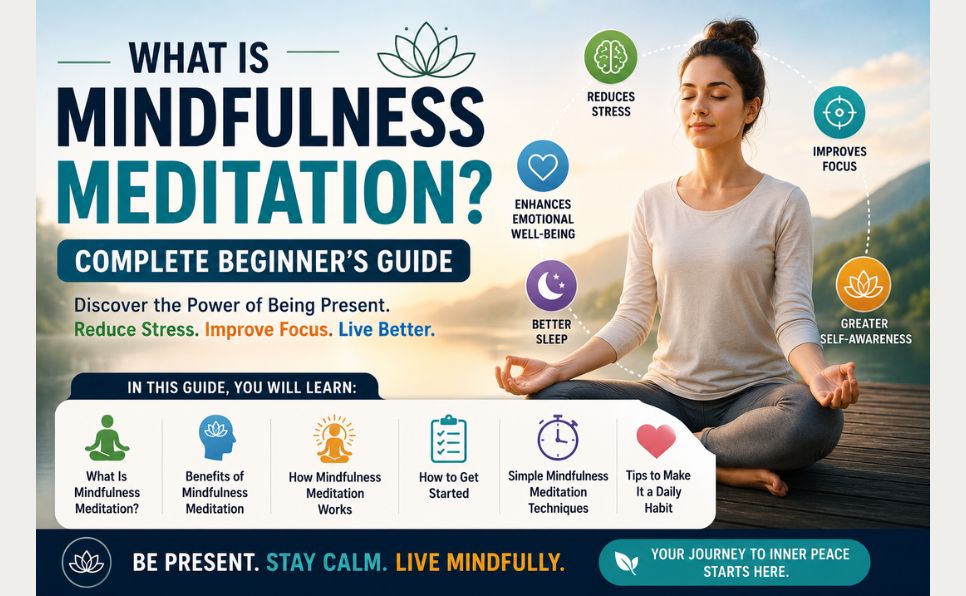
In this complete beginner’s guide, you’ll learn:
- What mindfulness meditation actually is (and what it isn’t)
- The science behind why it works
- Proven health benefits backed by research
- 6 different mindfulness techniques to try
- How to start a meditation practice from scratch
- Common mistakes beginners make — and how to avoid them
No experience needed. Let’s begin. 👇
What Is Mindfulness Meditation? (Simple Definition)
Mindfulness is the practice of paying deliberate, non-judgmental attention to the present moment — noticing your thoughts, feelings, body sensations, and surrounding environment without getting caught up in them.
Mindfulness meditation is the formal practice of training this skill — typically through structured exercises like breath awareness, body scans, or guided sessions.
Key Word: Non-Judgmental
The “non-judgmental” part is crucial. Mindfulness isn’t about forcing yourself to think positive thoughts or stop thinking altogether. It’s about observing whatever is happening in your mind and body — good, bad, or neutral — without labeling it as a problem or getting swept away by it.

What Mindfulness Is NOT:
| Common Misconception | Reality |
|---|---|
| “Emptying your mind” | Noticing thoughts without getting attached to them |
| Religious practice | Secular, evidence-based mental training |
| Complicated or time-consuming | Can be practiced in 5–10 minutes daily |
| Stopping all thoughts | Thoughts continue — you just relate to them differently |
| Only for stressed people | Benefits everyone regardless of stress levels |
A Brief History of Mindfulness
While mindfulness has roots in Buddhist meditation traditions dating back 2,500 years, its modern secular form was largely developed by Jon Kabat-Zinn at the University of Massachusetts Medical School in 1979.
Kabat-Zinn created Mindfulness-Based Stress Reduction (MBSR) — an 8-week program that stripped mindfulness of its religious elements and adapted it for medical patients dealing with chronic pain, stress, and illness.
Since then, mindfulness has been studied in thousands of scientific studies, integrated into psychotherapy (as Mindfulness-Based Cognitive Therapy, or MBCT), and adopted by major institutions including Google, the US military, and the UK’s National Health Service (NHS).
The Science: Why Does Mindfulness Meditation Work?
Mindfulness isn’t just “feeling calmer” — it produces measurable changes in brain structure and function.
What Happens in Your Brain During Mindfulness:
The Amygdala Shrinks The amygdala is your brain’s alarm system — it triggers the fight-or-flight stress response. Research shows that regular mindfulness practice physically reduces the size and reactivity of the amygdala, meaning you respond less intensely to stressors.
The Prefrontal Cortex Strengthens The prefrontal cortex handles rational thinking, emotional regulation, and decision-making. Mindfulness practice increases gray matter density in this region — improving your ability to think clearly under pressure.
Default Mode Network Quiets Down The Default Mode Network (DMN) is active when your mind wanders — it’s associated with rumination, self-criticism, and anxiety. Mindfulness practice reduces DMN activity, directly reducing the mental chatter that drives stress and unhappiness.
The Insula Becomes More Sensitive The insula processes body awareness and emotional intelligence. Mindfulness strengthens insula function — improving your ability to recognize and respond to your body’s signals before stress becomes overwhelming.
According to research published by the National Institutes of Health, as little as 8 weeks of regular mindfulness practice produces measurable structural changes in the brain.
Proven Benefits of Mindfulness Meditation
Mental Health Benefits:
| Benefit | Research Support |
|---|---|
| Reduced anxiety | Multiple meta-analyses show significant anxiety reduction |
| Lower depression rates | MBCT reduces depression relapse by 50% in recurrent cases |
| Better stress management | Cortisol levels measurably reduced after 8 weeks of MBSR |
| Improved emotional regulation | Greater ability to respond rather than react to situations |
| Reduced rumination | Less repetitive negative thinking patterns |
Physical Health Benefits:
| Benefit | Research Support |
|---|---|
| Lower blood pressure | Consistent finding across multiple studies |
| Improved immune function | Increased antibody production in practitioners |
| Better sleep quality | Reduces sleep-related anxiety and improves sleep onset |
| Reduced chronic pain | MBSR developed specifically for chronic pain management |
| Lower inflammation markers | Reduced C-reactive protein in regular practitioners |
Cognitive Benefits:
| Benefit | Research Support |
|---|---|
| Improved focus and attention | Measurable improvements in sustained attention tasks |
| Better working memory | Enhanced capacity to hold information while processing |
| Greater creativity | Open monitoring meditation supports divergent thinking |
| Enhanced decision-making | Reduced cognitive biases in mindful individuals |
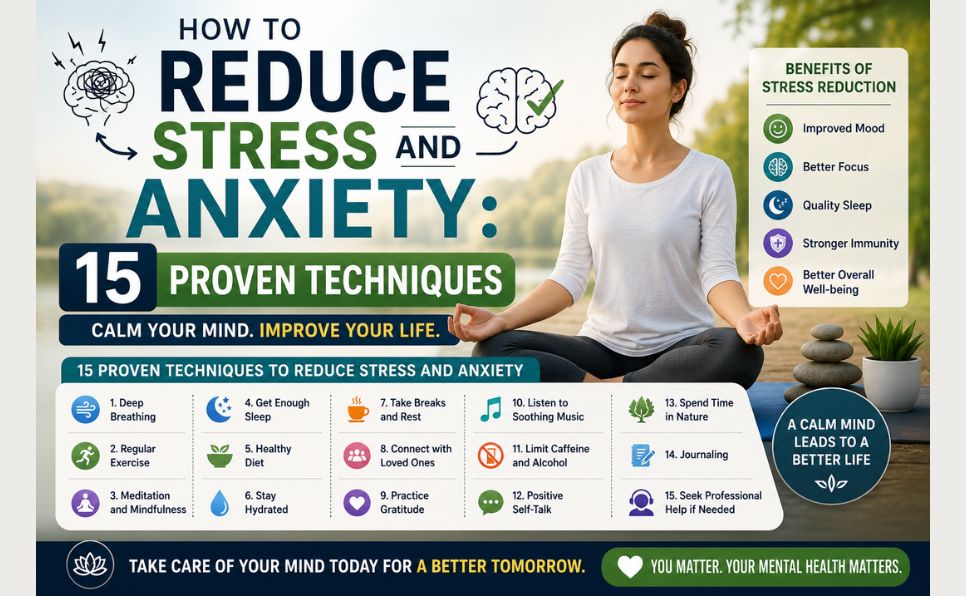
📖 Better sleep and stress management both contribute to the physical benefits above. Read: How to Reduce Stress and Anxiety: 15 Proven Techniques
6 Mindfulness Meditation Techniques for Beginners
Technique 1: Breath Awareness Meditation (Best Starting Point)
What it is: The most fundamental mindfulness practice — simply paying attention to your breath.
How to do it:
- Sit comfortably with your back straight — chair, cushion, or floor
- Close your eyes or soften your gaze toward the floor
- Breathe naturally — don’t try to control your breath
- Focus your attention on the physical sensation of breathing:
- The air entering and leaving your nostrils
- The rise and fall of your chest or belly
- The brief pause between inhale and exhale
- When your mind wanders (and it will — constantly), gently notice this and return your attention to the breath
- Start with 5 minutes and gradually work up to 15–20 minutes
The key insight: Your mind wandering is not a failure — it’s the practice. The moment you notice your mind has wandered and bring it back is the actual exercise, like a bicep curl for your attention.
Technique 2: Body Scan Meditation
What it is: Systematically moving your attention through different parts of your body, noticing sensations without trying to change them.
How to do it:
- Lie down comfortably on your back
- Close your eyes and take a few deep breaths
- Begin at your feet — notice any sensations: temperature, pressure, tingling, or nothing
- Slowly move your attention up through your body: feet → calves → knees → thighs → hips → abdomen → chest → back → shoulders → arms → hands → neck → face → top of head
- At each area, simply observe — don’t try to relax or change anything
- Full body scan takes 15–45 minutes (shorter versions focus on specific areas)
Best for: Deep relaxation, improving body awareness, preparing for sleep
📖 Body scan meditation is particularly effective for improving sleep quality: How to Improve Sleep Quality: 15 Proven Tips
Technique 3: Loving-Kindness Meditation (Metta)
What it is: A practice of cultivating feelings of compassion and goodwill — first toward yourself, then expanding outward to others.
How to do it:
- Sit comfortably, close your eyes
- Begin by bringing to mind someone you love easily — a close friend, family member, or pet
- Silently repeat phrases directed toward them:
- “May you be happy”
- “May you be healthy”
- “May you be safe”
- “May you live with ease”
- Feel the warmth of wishing them well
- Gradually expand: direct these phrases toward yourself → neutral people → difficult people → all beings
Benefits: Particularly effective for reducing self-criticism, improving relationships, and reducing social anxiety.
Technique 4: Walking Meditation
What it is: Bringing mindful awareness to the physical act of walking — ideal for people who struggle with sitting still.
How to do it:
- Find a quiet indoor or outdoor path (10–20 steps is enough)
- Walk slowly and deliberately — much slower than normal
- Focus on the physical sensations of each step:
- Lifting your foot
- Moving it forward
- Placing it on the ground
- Shifting your weight
- When your mind wanders, gently return attention to your feet and body
- Practice for 10–20 minutes
Best for: People who find sitting meditation difficult, those who spend long hours at desks, anyone who wants to bring mindfulness into daily activity.
Technique 5: 5-Senses Mindfulness (Informal Practice)
What it is: A brief mindfulness check-in you can do anywhere, anytime — bringing full attention to your current sensory experience.
How to do it: Pause what you’re doing and deliberately notice:
- 1 thing you can see — really look at it, notice its details, colors, textures
- 1 thing you can hear — listen without labeling or judging
- 1 thing you can feel — physical sensation of clothing, chair, temperature
- 1 thing you can smell — even subtle smells count
- 1 thing you can taste — what is present in your mouth right now
This takes 60–90 seconds and can be done while commuting, waiting in line, eating, or during any routine activity.
Best for: Bringing mindfulness into daily life without formal practice sessions.
Technique 6: Open Awareness Meditation
What it is: Rather than focusing on one specific object (like the breath), you hold a broad, open awareness of everything happening in your field of experience — thoughts, sounds, sensations, without attaching to any of them.
How to do it:
- Sit comfortably and close your eyes
- Instead of focusing on one thing, expand your awareness to include everything:
- Sounds in the room and beyond
- Physical sensations throughout your body
- Thoughts and emotions as they arise and pass
- Imagine your mind as a clear sky — thoughts and feelings are clouds passing through, but you are the sky — spacious, unchanged
- Don’t follow or resist anything — just observe
Best for: Intermediate practitioners, creative work preparation, developing equanimity
How to Start a Daily Mindfulness Practice
The biggest barrier to mindfulness isn’t technique — it’s consistency. Here’s how to build a sustainable daily practice:
Step 1: Start Absurdly Small
Begin with just 5 minutes per day. Five consistent minutes beats sporadic hour-long sessions every time. Once 5 minutes becomes automatic, expand to 10, then 15.
Step 2: Attach It to an Existing Habit
“Habit stacking” — linking your new meditation practice to an existing daily habit — dramatically increases consistency:
- After your morning coffee → meditate
- After brushing your teeth → meditate
- After sitting down at your desk → meditate
Step 3: Use Guided Meditations to Start
Guided meditations provide structure and instruction while you’re learning. Free and paid options include:
| App | Cost | Best For |
|---|---|---|
| Insight Timer | Free (huge library) | Variety, free content |
| Headspace | Free trial, then paid | Structured learning |
| Calm | Free trial, then paid | Sleep, anxiety focus |
| YouTube | Free | Quick sessions, specific topics |
Step 4: Create a Dedicated Space
Having a specific place for meditation creates a physical cue that trains your brain to shift into a calmer state. It doesn’t need to be elaborate — a specific chair or cushion in a quiet corner is enough.
Step 5: Track Your Streak
Many meditation apps track your daily streaks. The psychological motivation to maintain a streak is surprisingly effective at building consistency.
Common Beginner Mistakes (And How to Avoid Them)
❌ Mistake 1: Thinking You’re “Bad at Meditating”
There is no such thing as bad meditation. If your mind wanders 100 times during a session and you bring it back 100 times — that is 100 repetitions of the actual exercise. That’s an excellent session, not a failed one.
❌ Mistake 2: Expecting Instant Results
Mindfulness is a skill that develops over weeks and months of practice. The most significant benefits — structural brain changes, deep emotional regulation — emerge after consistent practice over time. Don’t judge your practice by how you feel during any single session.
❌ Mistake 3: Only Meditating When You Feel Stressed
Waiting until you’re overwhelmed to meditate is like waiting until you’re out of shape to start exercising. Daily practice builds the capacity to handle stress before it becomes overwhelming.
❌ Mistake 4: Forcing It
Mindfulness cannot be forced — and trying to force relaxation is counterproductive. The instruction is simply to observe, not to achieve a particular state. Let your experience be exactly what it is.
❌ Mistake 5: Meditating Lying Down When Sleepy
Body scan and other lying-down practices can be wonderful — but if you fall asleep regularly, switch to sitting practice. Falling asleep isn’t meditation (though it’s fine if it happens occasionally).
Integrating Mindfulness Into Daily Life
Formal meditation sessions are valuable — but mindfulness becomes truly transformative when integrated throughout your day:
Mindful eating: Eat one meal per day without screens, tasting each bite fully Mindful commuting: Instead of listening to podcasts, spend part of your commute in silent sensory awareness Mindful conversations: Practice giving your full attention to whoever you’re speaking with — no phone, no planning your next response Mindful transitions: Take 3 conscious breaths before starting a new task or entering a meeting Mindful exercise: During workouts, bring full attention to physical sensations rather than distracting yourself with music or podcasts
Complete Mindfulness Beginner Checklist
- Choose one technique to start with (breath awareness recommended)
- Commit to 5 minutes daily for 2 weeks
- Download a guided meditation app (Insight Timer free tier is excellent)
- Choose a consistent time (morning recommended)
- Create a dedicated meditation spot
- Stack meditation onto an existing habit
- Remember: mind wandering is normal — returning is the practice
- Add one informal mindfulness moment per day (mindful eating, mindful walking)
- After 2 weeks, extend to 10 minutes
Conclusion — Mindfulness Is the Skill Your Brain Has Been Waiting For
Mindfulness meditation is one of the most extensively studied and validated interventions in modern health science. Its benefits span mental health, physical health, and cognitive performance — and it’s available to everyone, at no cost, starting today.
You don’t need to meditate for hours. You don’t need special equipment. You don’t need to be spiritual or have a particular background.
You need 5 minutes and a willingness to keep returning your attention to the present moment — again and again.
Your starting point:
- Tonight, try 5 minutes of breath awareness meditation
- Tomorrow morning, do it again
- Use the Insight Timer app for guidance if helpful
- Be consistent for 14 days before judging results
The present moment is always available to you. Mindfulness is simply the practice of remembering that — and choosing to be here.
Frequently Asked Questions (FAQ)
How long does it take to see benefits from mindfulness meditation?
Many people notice subtle improvements in mood and stress reactivity within 1–2 weeks of daily practice. More substantial benefits — improved focus, reduced anxiety, better sleep — typically emerge after 4–8 weeks of consistent practice. The landmark MBSR research uses an 8-week program as its standard framework.
Do I need to sit cross-legged to meditate?
No — posture matters only in that you want to be alert and reasonably comfortable. Sitting upright in a chair with feet flat on the floor is perfectly fine. The cross-legged floor position is traditional but not required.
Can mindfulness meditation help with depression?
Mindfulness-Based Cognitive Therapy (MBCT) is an evidence-based treatment specifically developed for recurrent depression, shown to reduce relapse rates by up to 50%. However, for active depression, mindfulness is best used as a complement to professional treatment rather than a replacement.
Is mindfulness the same as relaxation?
Not exactly. Relaxation is a pleasant side effect of mindfulness — but the goal is awareness, not relaxation. In fact, some mindfulness sessions can bring up difficult emotions or uncomfortable sensations as you become more attuned to your inner experience. This is normal and part of the process.
Can children practice mindfulness?
Yes — mindfulness programs for children and adolescents are increasingly common in schools and have shown benefits for attention, emotional regulation, and academic performance. Practices are adapted to be shorter and more playful for younger children.
What’s the difference between mindfulness and other types of meditation?
Mindfulness meditation focuses on present-moment awareness using objects like the breath, body, or sounds. Other meditation types include transcendental meditation (using mantras), visualization meditation, loving-kindness (compassion focus), and concentration practices. All have benefits, but mindfulness has the largest body of scientific research supporting it.
This article is for informational purposes only and is not a substitute for professional mental health advice. If you are experiencing significant mental health challenges, please consult a qualified healthcare professional.
Found this guide helpful? Share it with someone who wants to start meditating. Questions? Drop them in the comments — we answer every one!