Two of the most talked-about technologies right now are ChatGPT and Cloud Computing.
You’ve probably used both — maybe without fully understanding the difference between them. And many people confuse them or think they’re the same thing.
They’re not.
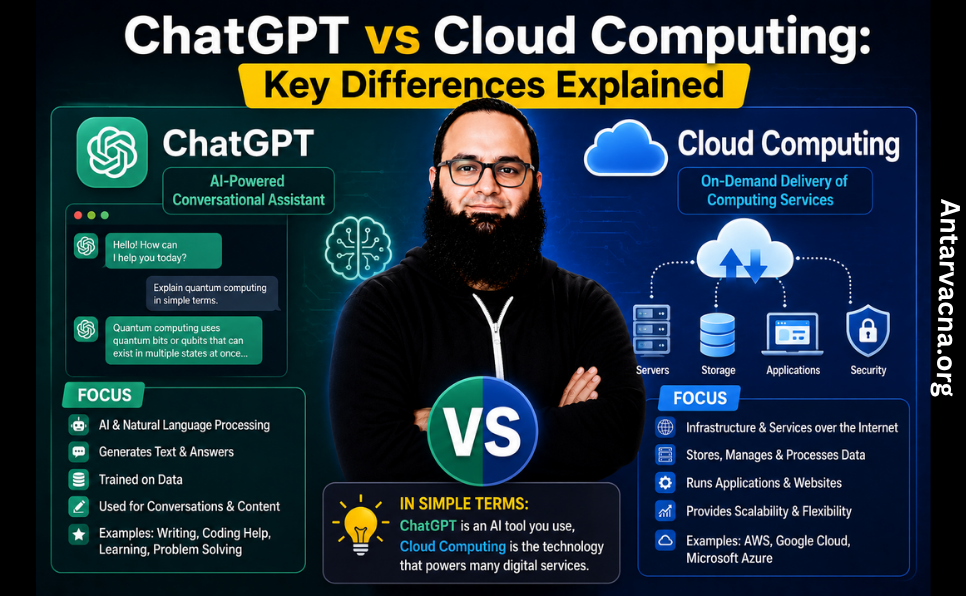
ChatGPT is an AI-powered conversational tool. Cloud computing is the infrastructure that powers the internet. One is a specific application; the other is a fundamental technology platform.
In this complete comparison guide, you’ll learn:
- What ChatGPT and cloud computing actually are
- The key differences between them
- How they relate to each other
- Who uses each one and why
- Which one is more popular right now
- Which one you should use for your specific needs
Let’s clear up the confusion once and for all. 👇
Quick Answer: ChatGPT vs Cloud Computing
Before diving deep, here’s the short answer:
| ChatGPT | Cloud Computing | |
|---|---|---|
| What it is | AI chatbot and productivity tool | Infrastructure platform for delivering computing services |
| Created by | OpenAI | Amazon, Google, Microsoft (and others) |
| What it does | Answers questions, writes content, codes, analyzes | Stores data, runs applications, hosts websites |
| Who uses it | Writers, students, developers, businesses | Businesses, developers, individuals (unknowingly) |
| Users (2026) | 180+ million active users | Used by virtually every internet user daily |
| Relationship | ChatGPT RUNS on cloud computing | Cloud computing POWERS ChatGPT |
The key insight: ChatGPT is an application that runs on top of cloud computing infrastructure. They are not competitors — they work together.
What Is ChatGPT?
ChatGPT is an AI-powered conversational assistant developed by OpenAI. It uses a large language model (LLM) called GPT (Generative Pre-trained Transformer) to understand natural language and generate human-like responses.
What Can ChatGPT Do?
| Task | Example |
|---|---|
| Answer questions | “What is quantum computing?” |
| Write content | Blog posts, emails, product descriptions |
| Write code | Python scripts, HTML, JavaScript |
| Summarize text | Condense long documents into key points |
| Translate languages | Convert text between 50+ languages |
| Analyze data | Interpret spreadsheets, identify patterns |
| Creative writing | Stories, poems, scripts |
| Research assistance | Summarize topics, explain concepts |
| Customer support | Answer FAQs, handle basic queries |
ChatGPT Usage Stats in 2026:
- 180+ million registered users worldwide
- 100 million weekly active users
- Available in over 160 countries
- Used by 92% of Fortune 500 companies
- Most popular AI tool globally as of 2026
ChatGPT Versions Available:
| Version | Cost | Capabilities |
|---|---|---|
| ChatGPT Free | Free | GPT-3.5, basic tasks |
| ChatGPT Plus | $20/month | GPT-4o, faster, image analysis |
| ChatGPT Team | $25/user/month | Business features, more privacy |
| ChatGPT Enterprise | Custom pricing | Maximum security, API access |
| ChatGPT API | Pay per use | For developers building apps |

What Is Cloud Computing?
Cloud computing is the delivery of computing services — servers, storage, databases, networking, software, and more — over the internet from remote data centers.
Instead of owning physical hardware, you rent computing power and storage from massive data centers operated by companies like Amazon, Google, and Microsoft.
What Does Cloud Computing Power?
Almost everything on the internet runs on cloud computing:
| Service You Use | Cloud Provider Behind It |
|---|---|
| Gmail | Google Cloud |
| Netflix | AWS (Amazon Web Services) |
| AWS | |
| Spotify | Google Cloud |
| Microsoft Azure | |
| Airbnb | AWS |
| ChatGPT itself | Microsoft Azure + OpenAI’s own infrastructure |
Cloud Computing Usage Stats in 2026:
- 94% of enterprises use cloud services
- Global cloud market worth $832 billion in 2026
- AWS holds ~31% market share
- Azure holds ~25% market share
- Google Cloud holds ~11% market share
- Used by virtually every internet user — whether they know it or not
📖 Learn cloud computing in detail: What Is Cloud Computing and How Does It Work?
Key Differences: ChatGPT vs Cloud Computing
Now let’s break down the specific differences across every important dimension:
1. Purpose and Function
| ChatGPT | Cloud Computing | |
|---|---|---|
| Primary purpose | Generate text, answer questions, assist with tasks | Store data, run applications, provide computing resources |
| Type of technology | AI application (Large Language Model) | Infrastructure platform |
| What it produces | Text, code, analysis, creative content | Computing power, storage, software delivery |
| Interaction style | Conversational (you chat with it) | Invisible infrastructure (you use apps powered by it) |
Simple analogy:
- Cloud computing = the electricity grid that powers your city
- ChatGPT = a smart appliance (like a robot assistant) that plugs into that grid
2. Who Made It and Who Runs It
| ChatGPT | Cloud Computing | |
|---|---|---|
| Creator | OpenAI (founded 2015) | Amazon (AWS, 2006), Microsoft (Azure, 2010), Google (GCP, 2008) |
| Backed by | Microsoft ($13 billion investment) | Self-funded by tech giants |
| Infrastructure | Runs on Microsoft Azure cloud | IS the infrastructure |
3. How You Use It
Using ChatGPT:
- Go to chat.openai.com
- Type a message or question
- Read the AI-generated response
- Have a back-and-forth conversation
Using Cloud Computing:
- Open Gmail → you’re using Google Cloud (without knowing it)
- Watch Netflix → you’re using AWS (without knowing it)
- Run a website on AWS → you’re directly using cloud infrastructure
- Store files on Google Drive → you’re using Google Cloud storage
Most people use cloud computing passively (through apps) while ChatGPT is used actively (you directly interact with it).
4. Skill Level Required
| ChatGPT | Cloud Computing | |
|---|---|---|
| Basic use | No technical skills needed | No skills needed (using apps) |
| Intermediate use | Prompt engineering skills help | Some technical knowledge helpful |
| Advanced use | API integration, fine-tuning | Requires significant technical expertise |
| Learning curve | Very low for beginners | Low for end users, high for administrators |
5. Cost Comparison
| ChatGPT | Cloud Computing | |
|---|---|---|
| Free tier | ✅ Yes — GPT-3.5 free | ✅ Yes — AWS/Google/Azure free tiers |
| Basic paid | $20/month (Plus) | Varies — can be $5–$50/month |
| Business | $25/user/month | Hundreds to thousands per month |
| Enterprise | Custom pricing | Millions per year for large enterprises |
| Pay model | Subscription | Pay-as-you-go OR subscription |
6. Privacy and Data
| ChatGPT | Cloud Computing | |
|---|---|---|
| Your data | Conversations may be used to train AI (unless opted out) | You control your data |
| Privacy concerns | Don’t share passwords, personal info, confidential data | Depends on provider and configuration |
| GDPR compliance | OpenAI has GDPR measures | AWS, Azure, GCP are fully GDPR compliant |
| Business use | ChatGPT Team/Enterprise offers more privacy | Enterprise cloud offers maximum data control |
7. Reliability and Uptime
| ChatGPT | Cloud Computing | |
|---|---|---|
| Uptime | ~99.5% (occasional outages) | 99.99%+ (AWS, Azure, GCP SLAs) |
| Outages | Occasional, especially during high demand | Rare, but when they happen it’s big news |
| Redundancy | OpenAI’s own infrastructure + Azure | Multiple data centers worldwide |
How ChatGPT and Cloud Computing Work Together
Here’s something most people don’t realize: ChatGPT literally runs on cloud computing.
OpenAI uses Microsoft Azure’s cloud infrastructure to power ChatGPT. When you send a message to ChatGPT:
Your message
     ↓
Internet
     ↓
Microsoft Azure Cloud Servers (thousands of GPUs)
     ↓
GPT-4 AI Model processes your request
     ↓
Response travels back over internet
     ↓
You see ChatGPT's reply
Without cloud computing, ChatGPT could not exist. The AI model requires massive computing power — thousands of specialized processors (GPUs) running in parallel — that only cloud infrastructure can provide at scale.
The Relationship:
- Cloud computing = the foundation, the infrastructure
- ChatGPT = one application built on that foundation
- Similar to: The internet (foundation) vs. Google Search (application built on internet)
Which Is More Popular Right Now? (2026)
This is where it gets interesting:
ChatGPT Popularity:
- Fastest growing consumer app in history — reached 100 million users in 2 months
- 180+ million registered users in 2026
- Searches for “ChatGPT” consistently among the most searched tech terms
- Used daily by millions of students, professionals, and businesses
Cloud Computing Popularity:
- Used by virtually every internet user — just invisibly
- $832 billion industry in 2026
- 94% of enterprises depend on it
- Powers Netflix, Gmail, Instagram, Spotify — services with billions of users
Verdict: ChatGPT is more visible and talked about — but cloud computing has far more users because everyone who uses the internet is using cloud computing, whether they know it or not.
ChatGPT vs Cloud Computing: Which Should YOU Use?
The answer depends entirely on what you’re trying to accomplish:
Use ChatGPT If You Want To:
- ✅ Write blog posts, emails, or marketing copy faster
- ✅ Get quick answers to complex questions
- ✅ Generate and debug code
- ✅ Summarize long documents
- ✅ Brainstorm ideas and overcome writer’s block
- ✅ Learn new topics through conversation
- ✅ Automate repetitive writing tasks
- ✅ Translate content into other languages
Use Cloud Computing If You Want To:
- ✅ Host a website or web application
- ✅ Store and backup large amounts of data
- ✅ Run a software business at scale
- ✅ Build and deploy mobile or web apps
- ✅ Process large datasets
- ✅ Set up databases, APIs, or backend infrastructure
- ✅ Stream video or audio content globally
- ✅ Build AI applications (you’d use cloud + AI APIs together)
Use Both If You Want To:
- ✅ Run a blog (cloud hosting) + use ChatGPT to help write content
- ✅ Build a SaaS business (cloud infrastructure) + integrate ChatGPT API for AI features
- ✅ Run an eCommerce store (cloud-hosted) + use ChatGPT for product descriptions
Real-World Use Cases: Side by Side
| Scenario | ChatGPT | Cloud Computing |
|---|---|---|
| Blogger | Write and edit articles faster | Host website on cloud server |
| Small business | Write product descriptions, answer FAQs | Store customer data, run eCommerce |
| Developer | Generate and debug code | Deploy and host applications |
| Student | Research help, essay drafts | Access online learning platforms (which run on cloud) |
| Marketing team | Create ad copy, social posts | Store campaign data, run analytics |
| Startup | Build MVP features faster | Scale infrastructure without hardware |
Alternatives to ChatGPT and Cloud Computing
ChatGPT Alternatives (AI Tools):
| Tool | Company | Best For |
|---|---|---|
| Claude | Anthropic | Long documents, nuanced writing |
| Gemini | Google Workspace integration | |
| Copilot | Microsoft | Microsoft 365 users |
| Llama | Meta | Open-source, self-hosted |
| Mistral | Mistral AI | European privacy-focused users |
Cloud Computing Alternatives:
| Provider | Best For |
|---|---|
| AWS | Most comprehensive, largest ecosystem |
| Microsoft Azure | Microsoft product integration |
| Google Cloud | AI/ML, data analytics |
| DigitalOcean | Developers, affordable pricing |
| Cloudflare | CDN, security, edge computing |
The Future: ChatGPT + Cloud Computing Together
The most exciting developments in 2026 involve ChatGPT and cloud computing working together:
- Microsoft Azure OpenAI Service — Enterprise-grade ChatGPT built directly into Azure cloud
- AWS Bedrock — Amazon’s platform for running AI models (including competitors to ChatGPT) on AWS infrastructure
- Google Vertex AI — Google’s AI platform combining Gemini models with Google Cloud
- AI-powered cloud management — Using AI to automatically optimize cloud resources and reduce costs
The future isn’t ChatGPT or cloud computing — it’s ChatGPT powered by cloud computing, integrated into every application and service we use.
📖 Understand how blockchain also uses cloud infrastructure: What Is Blockchain Technology?
Summary: ChatGPT vs Cloud Computing at a Glance
| Factor | ChatGPT | Cloud Computing |
|---|---|---|
| Type | AI Application | Infrastructure Platform |
| Created by | OpenAI | AWS, Azure, Google Cloud |
| Primary use | Productivity, content, code | Hosting, storage, computing |
| Users (2026) | 180M+ active users | Virtually all internet users |
| Free tier | ✅ Yes | ✅ Yes |
| Technical skill needed | Very low | Low to high |
| Relationship | Runs ON cloud computing | Powers ChatGPT |
| Best for | Tasks, writing, research | Hosting, apps, data |
| Trending in 2026 | 🔥 Very hot | 🔥 Essential infrastructure |
Conclusion — Two Different Tools, Both Essential in 2026
ChatGPT and cloud computing are not competitors — they’re complementary technologies that work together to power the modern digital world.
Cloud computing is the invisible infrastructure that powers the internet — including ChatGPT itself. ChatGPT is a powerful AI tool that runs on cloud infrastructure and helps people work smarter and faster.
If you run a website or blog — you need cloud computing (for hosting) AND you can use ChatGPT (to create content faster).
If you’re a developer — you need cloud computing (to deploy apps) AND you can use ChatGPT (to write code faster).
The question isn’t “ChatGPT or cloud computing?” — it’s “How can I use both together to work better?”
Start with whichever one solves your most immediate problem — and then explore how combining both can multiply your results.
Frequently Asked Questions (FAQ)
Is ChatGPT part of cloud computing?
ChatGPT is an AI application that runs on cloud computing infrastructure (specifically Microsoft Azure). It is not cloud computing itself — but it couldn’t exist without it. Think of ChatGPT as a tenant and cloud computing as the building it lives in.
Can I use ChatGPT for free?
Yes — ChatGPT offers a free tier using GPT-3.5 that handles most basic tasks. For access to GPT-4o, image analysis, and faster responses, ChatGPT Plus costs $20/month.
Do I need cloud computing for my small website?
Yes — most likely your website is already hosted on cloud infrastructure, even if you’re on “shared hosting.” Services like Bluehost, SiteGround, and Hostinger all use cloud-based data centers to host your website.
Which is better for content creation — ChatGPT or cloud computing?
ChatGPT is the right tool for content creation — writing, editing, and research. Cloud computing is infrastructure — it doesn’t create content. Use ChatGPT for content, cloud computing to host the website where you publish it.
Is ChatGPT safe to use for business?
For general business tasks, yes. However, avoid sharing passwords, confidential financial data, or personal customer information with ChatGPT. For higher privacy needs, use ChatGPT Team or Enterprise plans which offer better data controls.
Will AI replace cloud computing?
No — AI requires cloud computing to function. Rather than replacing it, AI is making cloud computing smarter — automating resource management, predicting costs, and optimizing performance automatically.
Found this comparison helpful? Share it with someone confused about these technologies. Have a question? Drop it in the comments — we answer every one!