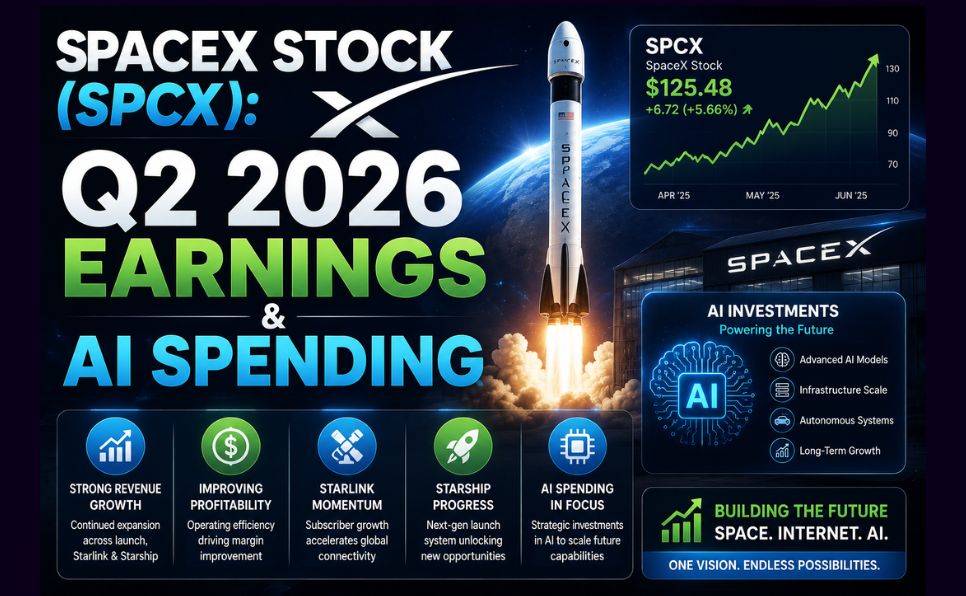
SpaceX’s first quarterly earnings report as a public company gave investors a mixed picture.
The company delivered stronger-than-expected revenue, reported strong growth across its Starlink and AI businesses, and continued investing aggressively in next-generation technology. However, SPCX stock came under pressure after investors focused on the company’s enormous capital spending and the risks associated with its AI expansion.
SpaceX’s Q2 results are important because they provide the market with its first detailed look at how the company is performing as a publicly traded business. The results also highlight a much bigger question: Can SpaceX turn its huge investments in Starlink, AI infrastructure, and space technology into sustainable long-term profits?
In this guide, we’ll break down SpaceX’s Q2 2026 earnings, Starlink growth, AI revenue, capital expenditures, Nvidia partnership, Starship strategy, valuation, and the key factors SPCX investors should watch next.
SpaceX Stock (SPCX): Quick Facts
| Detail | Information |
|---|---|
| Ticker | SPCX |
| Exchange | Nasdaq |
| IPO Date | June 12, 2026 |
| IPO Price | $135 per share |
| First Trade Price | $160.95 |
| CEO | Elon Musk |
| Company | Space Exploration Technologies Corp. |
SpaceX made its Nasdaq debut in June 2026. Nasdaq reported that the company priced its IPO at $135 per share and that shares initially traded around $160.95.
For investors who are new to the company, SpaceX is much more than a rocket manufacturer. Its business now spans launch services, Starlink connectivity, AI infrastructure, and emerging orbital-computing technology.
You can learn more about the company’s broader technology strategy on the official SpaceX website.
SpaceX Q2 2026 Earnings: Key Numbers
SpaceX’s first quarterly report as a public company showed strong top-line growth.
| Metric | Q2 2026 |
|---|---|
| Revenue | $7.81 billion |
| Loss per Share | -$0.09 |
| AI Revenue | $2.561 billion |
| Connectivity Revenue | $4.291 billion |
| Space Revenue | $962 million |
| AI Capital Expenditure | $15.8 billion |
| Total Capital Expenditure | $18.37 billion |
| Net Loss | $541 million |
The most important takeaway is that revenue growth was strong, but the company’s spending was also extremely aggressive.
Reuters reported that SpaceX’s Q2 revenue nearly doubled year over year, with Starlink and AI among the major growth drivers.
Why Did SpaceX Stock Fall After Strong Earnings?
This is one of the biggest questions surrounding SPCX stock.
Normally, a company beating revenue and earnings expectations would be viewed positively by investors. SpaceX’s situation is different because the market is also closely watching how much money the company is spending to support future growth.
SpaceX’s capital expenditure reached approximately $18.4 billion during Q2, compared with roughly $7.8 billion of quarterly revenue.
That means the company spent more than twice its quarterly revenue on capital investments.
The biggest portion of that spending was related to AI infrastructure.
Why does this matter?
High capital spending is not necessarily bad.
Companies often invest heavily when they are building new infrastructure, entering new markets, or preparing for future demand.
The real question is whether those investments eventually produce enough additional revenue and cash flow to justify the cost.
For SpaceX investors, this makes AI monetization and capital efficiency two of the most important metrics to watch.
SpaceX Revenue Breakdown
SpaceX’s business is becoming increasingly diversified.
The company’s traditional space business remains important, but Starlink and AI are becoming major parts of its growth strategy.
1. Starlink Connectivity Revenue
Starlink is one of SpaceX’s most important businesses.
The Connectivity segment generated approximately $4.291 billion in Q2 revenue, while Starlink’s subscriber base surpassed 12 million customers according to the figures discussed in the company’s quarterly results.
SpaceX describes Starlink as a satellite constellation designed to provide high-speed internet around the world.
Starlink is particularly important because subscription-based connectivity can provide SpaceX with recurring revenue.
The business also gives SpaceX an infrastructure platform that can potentially support future services beyond traditional internet access.
Related reading: If you’re interested in the infrastructure behind AI services, check out our guide to What Is Cloud Computing and How Does It Work?.
2. AI Revenue: $2.561 Billion
AI was one of the most interesting parts of SpaceX’s Q2 results.
The company’s AI segment generated approximately $2.561 billion in revenue, representing very rapid year-over-year growth.
That growth suggests SpaceX is attempting to move beyond traditional satellite connectivity and launch services into the much larger AI infrastructure market.
However, there is an important distinction between AI revenue growth and AI profitability.
SpaceX is spending enormous amounts of capital to build computing infrastructure. Investors therefore need to determine whether the revenue generated by the AI business can eventually justify that spending.
For readers who want a broader introduction to artificial intelligence, see our complete guide to artificial intelligence.
3. Space Segment Revenue
Space-related revenue reached approximately $962 million in Q2.
This part of SpaceX’s business includes launch services and other space-related activities.
SpaceX remains one of the world’s most important launch providers, and its long-term strategy is heavily connected to reusable launch technology.
The company’s official website describes Starship and Super Heavy as a fully reusable transportation system designed for missions to Earth orbit, the Moon, Mars, and beyond.
The Biggest Concern: SpaceX’s AI Spending
The most important part of the Q2 report may not have been revenue.
It was capital expenditure.
SpaceX spent approximately $18.4 billion on CapEx during the quarter, with approximately $15.8 billion directed toward AI-related investments.
To put that into perspective:
- Quarterly revenue: approximately $7.8 billion
- Total quarterly CapEx: approximately $18.4 billion
- AI-related CapEx: approximately $15.8 billion
- Total CapEx was more than 2× quarterly revenue
This is an exceptionally aggressive investment strategy.
SpaceX appears to be betting that demand for AI computing will remain strong enough to support the infrastructure it is building.
Why SpaceX Is Investing So Much in AI
The AI industry is going through a major infrastructure expansion.
Companies are investing heavily in:
- AI data centers
- GPUs and AI accelerators
- Cloud computing
- High-speed networking
- Energy infrastructure
- AI models
- Computing capacity
SpaceX is trying to participate in this market while continuing to expand Starlink and its space-launch operations.
That creates a potentially huge opportunity, but also a significant financial risk.
The basic investment question is simple:
Will SpaceX’s AI infrastructure generate enough revenue and profit to justify the billions being invested today?
Elon Musk’s $100 Billion Annualized Revenue Target
Elon Musk has expressed confidence in SpaceX’s ability to reach a $100 billion annualized revenue run rate.
SpaceX CFO Bret Johnsen has also discussed the company’s progress toward that target.
The company has indicated that it has contracted additional cloud-services revenue that is expected to begin ramping later in 2026.
However, investors should understand the difference between annual revenue and an annualized run rate.
An annualized run rate takes a current or expected revenue level and projects it over a full year. It does not necessarily mean the company will actually generate $100 billion in total revenue during calendar year 2026.
Therefore, investors should watch actual quarterly revenue growth rather than focusing only on the headline run-rate target.
SpaceX and Nvidia: The Starmind AI-1 Partnership
One of the most interesting developments in SpaceX’s AI strategy is Starmind.
SpaceX’s official Starmind page describes AI satellites designed to perform computing in orbit and send results back to Earth through high-bandwidth laser connections and the Starlink network.
The company says the AI1 system is designed around space-based computing, solar power, thermal management, and laser connectivity.
This is potentially significant because traditional AI data centers face major challenges involving:
- Electricity supply
- Land requirements
- Cooling
- Data-center construction
- Grid capacity
SpaceX is effectively exploring whether some of those limitations can be addressed by moving computing infrastructure into orbit.
The idea is highly ambitious, and its commercial viability remains something investors will need to watch over time.
Starship: Why It Matters to SPCX Investors
SpaceX’s future is not only about Starlink and AI.
Starship remains one of the company’s most important long-term projects.
The fully reusable Starship system could potentially reduce the cost of putting large payloads into orbit and increase the number of missions SpaceX can perform.
That matters for investors because cheaper and more frequent launches could support:
- Larger Starlink deployments
- Space-based AI infrastructure
- Commercial satellite launches
- Government missions
- Future lunar missions
- Mars-related development
SpaceX’s official overview describes Starship and Super Heavy as a fully reusable transportation system intended for Earth orbit and future deep-space missions.
SpaceX Stock and the Lockup Expiration
Another factor investors are watching is the expiration of the IPO lockup period.
When a lockup expires, shares previously restricted from being sold by insiders or early investors may become eligible for trading.
That can create additional selling pressure if a significant number of shareholders decide to sell.
However, investors should not automatically assume that all newly unlocked shares will be sold.
The more useful indicators will be:
- Trading volume
- Insider transactions
- Institutional activity
- Share-price reaction
- Changes in the public float
This is particularly important for a newly public company such as SpaceX because its stock has already experienced significant volatility.
SpaceX AI Spending vs. Big Tech
SpaceX is not the only company spending aggressively on AI infrastructure.
Major technology companies are also investing billions of dollars in:
- Data centers
- GPUs
- Cloud infrastructure
- AI models
- Networking
- Power capacity
The difference is the size of SpaceX’s spending relative to its current revenue.
Spending approximately $18.4 billion against quarterly revenue of approximately $7.8 billion represents an unusually aggressive investment ratio.
That creates a classic high-growth investment trade-off:
Bull Case
If AI demand continues expanding rapidly, SpaceX could build a valuable new business and potentially turn today’s infrastructure spending into significant future revenue.
Bear Case
If AI infrastructure becomes oversupplied or SpaceX cannot monetize its computing capacity efficiently, the company’s enormous capital requirements could hurt profitability and cash flow.
SPCX Stock Valuation: Is SpaceX Overvalued?
SpaceX’s valuation is one of the biggest issues investors need to consider.
A high-growth company can justify a high valuation if investors believe its future revenue and earnings will expand rapidly.
But a high valuation also means the market has already priced in significant future growth.
For SPCX, investors should monitor several factors.
1. Starlink Growth
Can Starlink continue adding subscribers while maintaining strong economics?
2. AI Revenue
Can SpaceX turn its AI infrastructure investments into rapidly growing revenue?
3. Capital Efficiency
Can the company eventually generate attractive returns on its AI spending?
4. Starship Progress
Can Starship reduce launch costs and increase capacity?
5. Cash Flow
Can SpaceX eventually convert its strong revenue growth into sustainable free cash flow?
These questions are more important than simply asking whether SPCX stock has gone up or down in the short term.
What Investors Should Watch Next
1. AI Capital Expenditure
The next earnings report should show whether SpaceX’s AI spending continues at an extremely high level.
If CapEx remains elevated, investors will want evidence that AI revenue is growing quickly enough to justify the investment.
2. Starlink Subscriber Growth
Starlink’s subscriber numbers are an important indicator of the strength of SpaceX’s recurring connectivity business.
Continued subscriber growth could support revenue expansion and improve the company’s overall financial profile.
3. AI Cloud Revenue
Investors should watch how quickly SpaceX’s contracted cloud-services business begins contributing to actual reported revenue.
This will help determine whether the company’s AI infrastructure investments are translating into commercial demand.
4. Starship Development
Successful Starship development could strengthen SpaceX’s long-term competitive position by increasing launch capacity and potentially lowering launch costs.
5. Stock Volatility After the Lockup
The market’s reaction to newly tradable shares will provide another important signal about investor demand for SPCX.
Bullish vs. Bearish Factors for SPCX
| Factor | Bullish Signal | Risk |
|---|---|---|
| Revenue | Strong Q2 growth | High expectations |
| Starlink | 12M+ subscribers | Requires continued expansion |
| AI Revenue | Rapid growth | High infrastructure costs |
| AI CapEx | Supports future expansion | Extremely capital intensive |
| Starship | Could transform launch economics | Development risk |
| Starmind | Potential new AI infrastructure business | Commercial model remains unproven |
| Cloud Services | Large potential revenue opportunity | Execution risk |
| Valuation | Reflects major growth potential | High expectations |
| Lockup Expiration | More market liquidity | Potential selling pressure |
Frequently Asked Questions
What is SpaceX’s stock ticker?
SpaceX trades on the Nasdaq under the ticker SPCX. Nasdaq officially announced SpaceX’s public-market debut in June 2026.
Why did SpaceX stock fall after strong earnings?
The primary concern was the company’s very high capital spending.
Although revenue growth was strong, investors were concerned about how much SpaceX is spending on AI infrastructure and whether those investments will generate sufficient future returns. Reuters also reported that AI costs and the upcoming unlocking of restricted shares were factors weighing on investor sentiment.
What was SpaceX’s Q2 2026 revenue?
SpaceX reported approximately $7.81 billion in Q2 2026 revenue.
How many Starlink subscribers does SpaceX have?
The Q2 figures discussed in this report put Starlink’s subscriber base above 12 million.
Is SpaceX profitable?
SpaceX reported a Q2 net loss of approximately $541 million in the figures covered by this report.
The company is investing heavily in AI infrastructure, Starlink expansion, and space technology, which makes profitability and cash-flow trends particularly important for future earnings reports.
Final Thoughts on SpaceX Stock
SpaceX’s Q2 2026 results highlight a company pursuing several enormous opportunities simultaneously.
Starlink continues to expand its connectivity business. AI is becoming an increasingly important source of growth. Starmind introduces the possibility of space-based computing, while Starship could transform the economics of launching payloads into orbit.
But all of these opportunities require significant investment.
That is the central issue for SPCX investors.
The question is not simply whether SpaceX can grow. It is whether the company can turn that growth into sustainable profits and attractive returns on capital.
Over the next several quarters, investors should pay particular attention to:
- AI revenue growth
- AI capital expenditure
- Starlink subscribers and revenue
- Cloud-services revenue
- Free cash flow
- Starship progress
- Share unlock activity
- Overall valuation
If SpaceX can successfully monetize its AI infrastructure while continuing to expand Starlink and improve its launch economics, the long-term opportunity could be substantial.
However, the company’s aggressive spending strategy also creates significant execution and valuation risks.
For that reason, SPCX should be viewed as a high-growth, high-expectation investment story, rather than simply another traditional technology stock.
Disclaimer: This article is for informational and educational purposes only and does not constitute financial or investment advice. Investors should conduct their own research and consider their individual financial circumstances before making investment decisions. Past performance does not guarantee future results.