Search has changed more in the last two years than in the previous decade. Instead of typing a keyword and scrolling through ten blue links, a growing number of users now ask Google a full question and get back a single, synthesized answer — complete with citations pulled from multiple websites at once. This is Google AI Mode, and understanding how to rank inside it is quickly becoming one of the most valuable skills in digital marketing.
This guide breaks down exactly what Google AI Mode is, how it decides what to cite, and the practical steps you can take to start showing up inside its answers.
New to this topic? Start with our guides on What Is Generative Engine Optimization (GEO)? and GEO vs SEO before diving into this Google-specific playbook.
What Is Google AI Mode?
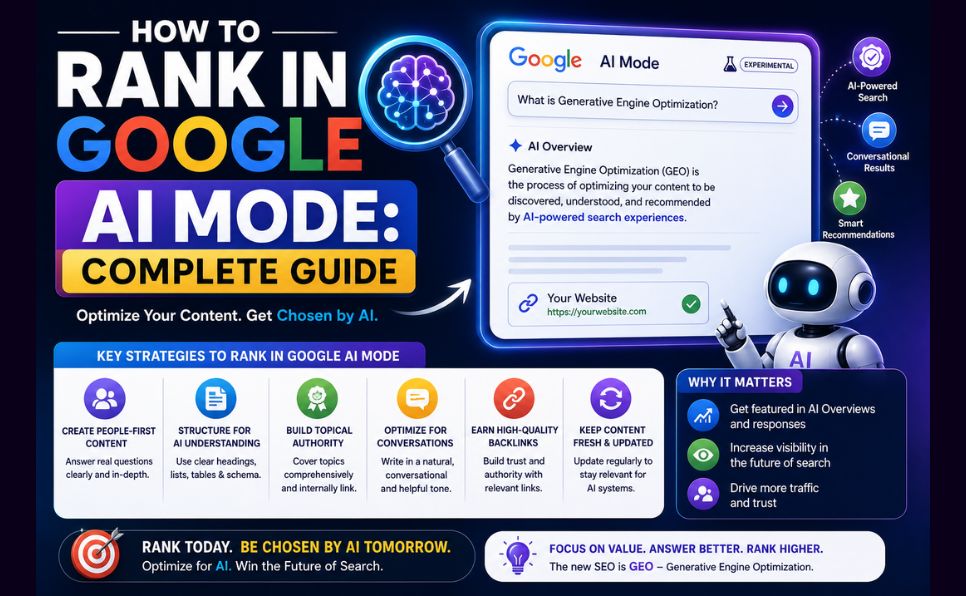
Google AI Mode is a conversational, AI-driven search experience built directly into Google Search. Instead of returning a ranked list of links, it generates a synthesized answer — powered by Google’s Gemini model — complete with inline citations, follow-up question support, and links to the sources it drew from.
Rather than matching your query to a single best page, Google AI Mode parses the query’s entities, constraints, and intent, then decomposes it into multiple sub-queries that run simultaneously across Google’s search index, retrieving and synthesizing information from many sources into one cited response.

How Google AI Mode Actually Works: Query Fan-Out
The single most important concept to understand about AI Mode is query fan-out. This technique issues multiple related searches concurrently across subtopics and data sources, then brings the results together into an easy-to-understand response, giving users more breadth and depth than a traditional single search. Google
In practice, this means a single question can trigger dozens of hidden sub-searches behind the scenes. If someone asks a complex question, the system breaks it into multiple sub-queries, runs them in parallel, and synthesizes the results — for example, a question comparing laptops for video editing might simultaneously trigger separate searches on processors, screen quality, battery life, and price before AI Mode weaves the findings into one answer. SearchAtlas
Why this matters for your strategy: you’re no longer just competing for one exact keyword. If your content thoroughly covers a topic, it can get pulled into AI Mode’s answer for related sub-queries you never explicitly targeted. Breadth of topic coverage now matters as much as precision keyword targeting.
How Google AI Mode Selects Sources
Unlike traditional rankings, which lean heavily on backlinks and domain authority, AI Mode selects sources based on perceived trust, relevance, and formatting — not just traditional rankings. According to industry analysis, source selection is driven by a combination of factors: entity authority, topical depth, semantic relevance, structured content clarity, EEAT signals, and information architecture that large language models can easily parse. W3eraWellows
One especially strong predictor of citation is extractability — how easily the AI can lift a fact or definition out of your page without needing extra context. Research analyzing AI Overview selection patterns found this to be the strongest predictor of selection, because AI systems prioritize content they can confidently extract and present without additional context. Digiday
Step-by-Step: How to Optimize for Google AI Mode
1. Audit Your Existing Content First
Before creating anything new, review what you already have. Industry guidance recommends starting with pages already ranking in positions 1–10 with high impressions but declining click-through rate — these are prime candidates for AI optimization. A high-ranking page with falling clicks often means it’s already being summarized inside AI Overviews without earning the click. W3era
2. Answer the Full Intent, Not Just the Keyword
Because of query fan-out, Google says AI Mode can search across related subtopics and data sources, which means pages should cover the full intent behind a topic, not only the exact keyword. Build your content to answer the primary question plus the natural follow-up questions a reader — or the AI — would ask next. Riya Web Technology
3. Write in Natural, Question-Based Language
People interact with AI Mode conversationally. Instead of a stiff query like “best SEO tools,” users now type full questions such as “what are the best SEO tools for a small e-commerce business on a tight budget.” Structure your headers as direct questions — Who, What, How, Why — and answer them plainly in the text that follows.
4. Lead With Extractable, Standalone Answers
Place your core definition or answer in the first sentence of a section, written so it makes complete sense on its own, without needing the surrounding paragraph for context. This is the single highest-leverage habit for AI citation, since extractability is the strongest known selection signal.
5. Strengthen Entity and Topical Authority
AI Mode leans on Google’s Knowledge Graph to understand who and what your brand actually is. Consistent naming, clear “About” pages, and deep — rather than scattered — coverage of your core topic all reinforce this. Publishing a focused cluster of related articles (the way you’d build out a full resource hub on one subject) signals topical authority far more effectively than isolated, unrelated posts.
6. Back Every Claim With Real Data
Vague, generic statements are far less likely to be cited than specific facts, statistics, or study results. Where possible, attribute data to a credible, named source.
7. Nail the Technical Fundamentals
AI Mode still cares about basic site health. Pages that load slowly or fail Core Web Vitals are unlikely to be selected as sources. As of 2026, the general benchmarks to hit are:
- Largest Contentful Paint (LCP): under 2.5 seconds
- Interaction to Next Paint (INP): under 200 milliseconds
- Cumulative Layout Shift (CLS): under 0.1
This is exactly why reliable web hosting matters so much for AI visibility — a slow or unstable server can quietly disqualify even your best-written content before Google’s systems ever get to evaluate it. If you’re unsure which hosting tier can support this kind of performance, our Shared vs VPS vs Cloud Hosting comparison breaks down which option fits different traffic and speed needs.
8. Use Structured Data and Clean Formatting
Schema markup, well-organized headings, short paragraphs, bullet points, and tables all make it easier for AI systems to parse and extract your content accurately — the same formatting habits that help human readers scan a page quickly also help the AI model process it.
9. Track Your AI Mode Visibility
Since June 2025, AI Mode appearance data has counted toward totals inside Google Search Console’s Performance report, so you can monitor how often your pages are being surfaced. Build a simple tracking sheet noting which of your pages appear for your target queries, and check regularly, since AI Overview source selection can change frequently as Google updates its underlying models. E2M
Why This Shift Matters More Than It Might Seem
The scale of this change is significant. By 2026, Google AI Overviews appear for roughly 47–64% of all queries, up from just 25–30% at their 2024 launch, and queries with AI Overviews now see a 30–50% average click-through-rate drop for top-ranking positions. In other words, ranking #1 the traditional way no longer guarantees the traffic it used to — a growing share of users now get their full answer before ever reaching a website. ZenX AcademyZenX Academy
That doesn’t mean traditional SEO is obsolete. As one industry analysis put it, your core SEO strategy should evolve to incorporate AI Overview optimization as an additional layer, rather than replace traditional best practices.
Common Mistakes to Avoid
- Chasing exact-match keywords only. Query fan-out rewards topical breadth, not narrow keyword targeting.
- Burying your answer in the third paragraph. If the AI can’t extract a clean, standalone statement, it will likely pull the answer from a competitor instead.
- Ignoring page speed. No amount of great writing helps if your hosting can’t deliver the page fast enough for Core Web Vitals thresholds.
- Treating this as a one-time project. AI Mode’s source selection shifts as Google updates its models — ongoing monitoring and updates matter more here than in traditional SEO.
Frequently Asked Questions
What is Google AI Mode?
Google AI Mode is a conversational, AI-driven search experience built into Google Search that replaces ranked links with a single synthesized answer, generated by Google’s Gemini model and backed by inline citations to the sources it drew from.
How is Google AI Mode different from AI Overviews?
AI Overviews appear as a summary box above traditional search results on a regular search page, while AI Mode is a fully separate, dedicated conversational tab where every response — not just the top of the page — is AI-generated. Both run on the same underlying Gemini technology and query fan-out system, so optimizing for one generally helps with the other.
What is query fan-out in Google AI Mode?
Query fan-out is the technique AI Mode uses to break a single user question into multiple related sub-queries, run them simultaneously across Google’s index, and synthesize the results into one combined answer — which is why content covering a topic broadly tends to get cited more often than content targeting one narrow keyword.
Do backlinks still matter for ranking in Google AI Mode?
Yes, but they’re no longer the dominant signal. AI Mode weighs backlinks alongside entity authority, topical depth, content structure, and extractability — meaning a page with fewer backlinks but clearer, more citable answers can still outperform a heavily-linked page that isn’t well-structured for extraction.
How long does it take to start appearing in Google AI Mode?
There’s no fixed timeline, since it depends on your site’s existing authority, technical health, and how much of your content is already structured for extraction. Sites with strong topical depth and solid Core Web Vitals scores tend to see AI citations develop faster than sites starting from scratch.
Can I track whether my site appears in Google AI Mode?
Yes. Since June 2025, AI Mode appearance data has been included in Google Search Console’s Performance report, so you can monitor how often and for which queries your pages are being surfaced.
Does page speed really affect AI Mode rankings?
Yes. AI Mode still filters out pages that fail Core Web Vitals thresholds (LCP under 2.5s, INP under 200ms, CLS under 0.1), since slow or unstable pages are unlikely to be selected as reliable sources — which is why solid web hosting is a technical prerequisite, not just a nice-to-have.
Final Thoughts
Ranking in Google AI Mode isn’t about abandoning everything you know about SEO — it’s about layering a new set of habits on top of a strong foundation: clear, extractable answers; deep topical authority; solid technical performance; and content genuinely built to answer real human questions. The websites investing in this now, while much of the competition is still catching up, are the ones building lasting visibility as search continues its shift toward AI-generated answers.
Related reading: What Is Generative Engine Optimization (GEO)? · GEO vs SEO · What Is Web Hosting · Shared vs VPS vs Cloud Hosting