If you’ve spent years building your website’s SEO — chasing backlinks, optimizing keywords, and climbing Google’s rankings — you may have recently noticed a new term circulating in marketing circles: GEO, or Generative Engine Optimization. Naturally, this raises a question every website owner is now asking: is GEO replacing SEO, or do you need both?
This guide breaks down exactly how GEO and SEO differ, where they overlap, and how to build a strategy that works for both traditional search engines and today’s AI-powered platforms.
New here? If you haven’t yet, read our full breakdown of What Is Generative Engine Optimization (GEO)? before diving into this comparison — it covers the core concept in depth.
Quick Definitions
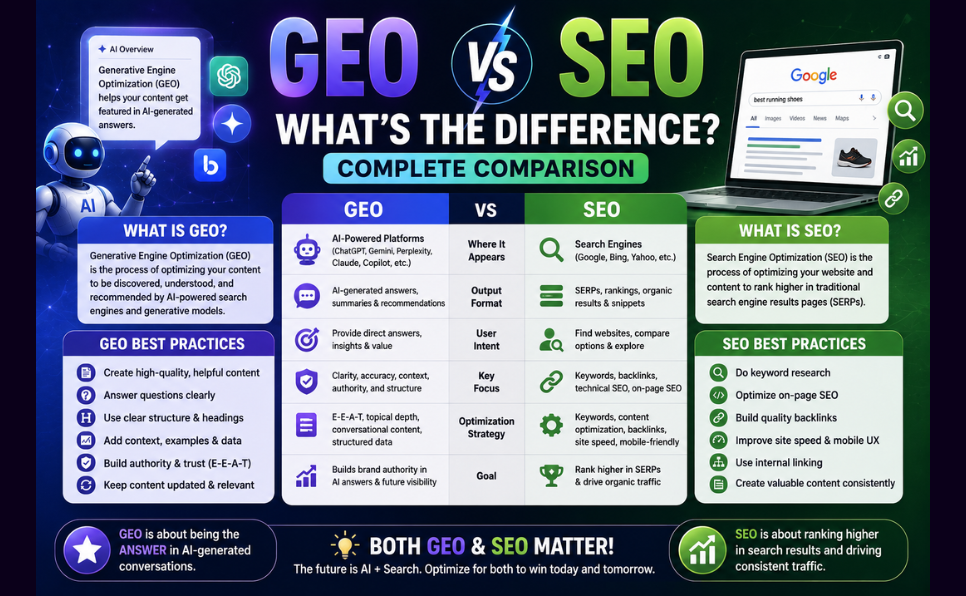
SEO (Search Engine Optimization) is the practice of optimizing your website so it ranks higher in traditional search engine results pages (SERPs) — the list of blue links you see after searching on Google or Bing. The goal is to earn a top position so users click through to your site.
GEO (Generative Engine Optimization) is the practice of structuring your content so AI-powered platforms — ChatGPT, Google AI Overviews, Perplexity, Gemini, and similar tools — cite, reference, or recommend your content when generating a direct answer to a user’s question. The goal is to be included in the AI’s synthesized response, whether or not the user ever clicks a link.
In short: SEO gets you a spot in the list. GEO gets you a mention in the answer.
GEO vs SEO: Side-by-Side Comparison
| SEO | GEO | |
|---|---|---|
| Optimizes for | Search engine ranking algorithms (Google, Bing) | AI language models (ChatGPT, Perplexity, Gemini, AI Overviews) |
| Output the user sees | A list of ranked links | A single synthesized, written answer |
| Success looks like | Ranking on page 1, ideally top 3 | Being one of the few sources cited in the AI’s answer |
| Core levers | Backlinks, keyword targeting, domain authority, site speed | Clear definitions, statistics, citations, structured content |
| Content depth focus | Whole-page optimization (title tags, headers, keyword density) | Fact-level optimization (each statement needs standalone clarity) |
| Measurement tools | Google Search Console, rank trackers, backlink analyzers | AI citation tracking, “Share of Model” tools, AI referral traffic |
| Traffic behavior | User clicks through to your site to read more | User may get a full answer without ever visiting your site |
Why This Distinction Actually Matters
The biggest practical difference between SEO and GEO isn’t really the tactics — it’s how success is measured and what it means for your traffic.
With SEO, a high ranking almost always translates into a click. Even if you rank third instead of first, you still get some share of the traffic, and a weak meta title or slow page can cost you visitors even at a good position.
With GEO, the dynamic changes entirely. If ChatGPT or an AI Overview answers a user’s question by mentioning your brand or citing your definition, you may build authority and recognition — but the user might never click through to your website. This is sometimes referred to as a “zero-click” outcome, and it means brand visibility and traffic no longer move in lockstep the way they used to with SEO alone.
Do You Need Both SEO and GEO?
Yes — and this is the most important takeaway. GEO is not a replacement for SEO; it’s an additional layer built on top of it. In practice, the two disciplines share a large amount of overlapping fundamentals:
- Both reward genuine authority. A well-established, credible website with strong topical focus tends to perform better in both search rankings and AI citations.
- Both require technical accessibility. If search engine crawlers or AI retrieval systems can’t access, load, or render your site properly, neither discipline will work — which is why reliable web hosting remains a foundational requirement, not just an SEO afterthought.
- Both benefit from clear structure. Descriptive headings, logical organization, and scannable formatting help human readers, search engines, and AI systems alike.
Where they diverge is in the finer details: SEO still leans heavily on backlinks and domain authority signals, while GEO places extra weight on how clearly individual facts, statistics, and definitions are presented, since AI systems often extract specific passages rather than evaluating a page as a whole.
How to Build a Strategy That Covers Both
- Keep your core SEO fundamentals strong. Fast-loading pages, mobile-friendliness, clean site structure, and quality backlinks remain essential. None of this becomes optional just because GEO exists.
- Add clear, standalone definitions near the top of key pages. Don’t make readers — or AI models — dig through several paragraphs to find your core point.
- Back up claims with real data. Statistics and specific figures are more citable, by both search engines and AI systems, than vague, generic statements.
- Structure content around real questions. Headings phrased the way people actually ask things (“What is…”, “How does… work”, “Which is better…”) help you show up in both SERPs and AI-generated answers.
- Monitor both traffic types. Keep tracking your Google Search Console rankings, but also start watching referral traffic that arrives from AI platforms, since this is a growing and still under-measured traffic source for most websites.
If you’re deciding what to build your website on in the first place, our comparison of Shared vs VPS vs Cloud Hosting can help ensure your technical foundation supports both traditional crawlers and AI retrieval systems without slowdowns or downtime getting in the way.
Final Thoughts
SEO and GEO aren’t competing strategies — they’re two layers of the same goal: making sure people, and the systems they use to find information, can discover, trust, and reference your content. Businesses that treat GEO as an extension of solid SEO, rather than a totally separate discipline, will be best positioned as more of the search landscape shifts toward AI-generated answers.
The websites investing in both today — while most competitors are still only focused on traditional SEO — are the ones building a real head start in AI visibility.
Related reading: What Is Generative Engine Optimization (GEO)? · What Is Web Hosting · Shared vs VPS vs Cloud Hosting