Every business with a website faces this question sooner or later: should I invest in SEO or PPC?
Both drive traffic. Both can generate leads and sales. But they work in fundamentally different ways — and choosing the wrong one for your situation can mean wasting months of effort or thousands of dollars.
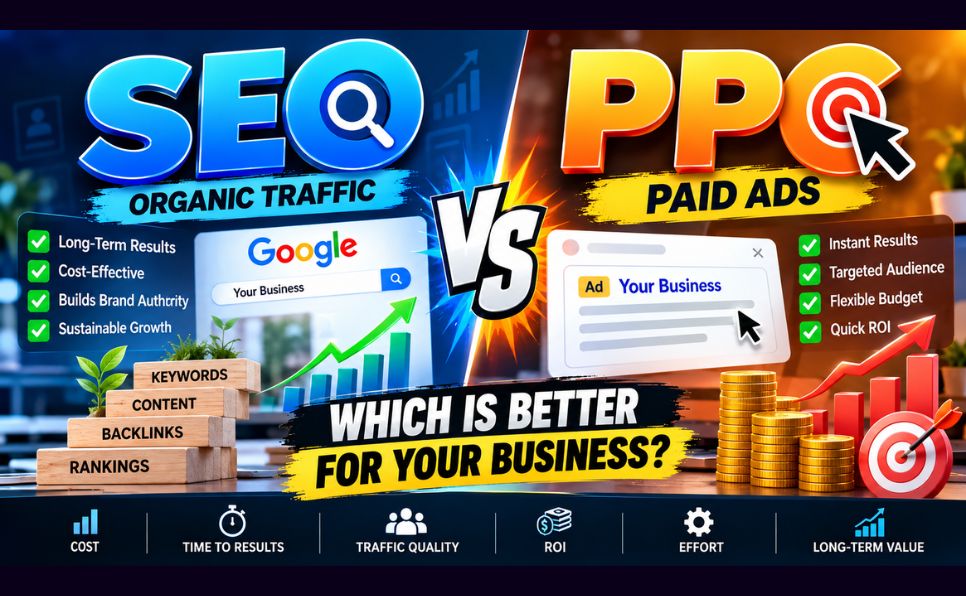
SEO (Search Engine Optimization) builds organic rankings over time — free clicks that compound as your authority grows.
PPC (Pay-Per-Click) buys traffic instantly — you pay every time someone clicks your ad.
Neither is universally better. The right choice depends entirely on your business stage, budget, goals, and timeline.
In this complete guide, you’ll learn:
- Exactly how SEO and PPC work
- Side-by-side comparison across 8 key factors
- When SEO beats PPC — and when PPC beats SEO
- How to use both together for maximum results
- A clear recommendation based on your situation
Let’s find the right strategy for your business. 👇
What Is SEO?
SEO is the practice of optimizing your website to rank higher in organic (unpaid) search results. When someone searches for a keyword related to your business and your page appears — that’s SEO at work.
How SEO generates traffic:
- You publish optimized content targeting relevant keywords
- Google crawls, indexes, and evaluates your content
- Over weeks and months, your pages begin ranking
- Users click your organic result — you pay nothing per click
- Rankings compound — more content + more links = more traffic
The core advantage of SEO: Once you rank, traffic is essentially free. A page ranking #1 for a high-volume keyword can drive thousands of monthly visitors at zero ongoing cost.
The core challenge: SEO takes time. Most new websites need 6–12 months before seeing meaningful organic traffic.
📖 For a complete overview of how SEO works: Complete SEO Guide 2026: Everything You Need to Rank on Google
What Is PPC?
PPC (Pay-Per-Click) advertising allows businesses to pay for top placement in search results. Google Ads is the dominant PPC platform — when you search on Google, the results marked “Sponsored” at the top are PPC ads.
How PPC generates traffic:
- You create ad campaigns targeting specific keywords
- You set a maximum bid — the most you’ll pay per click
- Google runs an auction — highest relevant bid wins the ad placement
- Users click your ad — you pay your bid amount
- Traffic stops immediately when you stop paying
The core advantage of PPC: Instant traffic. A new Google Ads campaign can generate clicks within hours of launch.
The core challenge: Every click costs money. Stop paying — traffic disappears immediately. Costs also increase as competition for keywords grows.
SEO vs PPC — Side-by-Side Comparison
| Factor | SEO | PPC |
|---|---|---|
| Cost per click | Free (after investment) | $0.50–$50+ per click |
| Time to traffic | 4–12 months | Hours to days |
| Traffic sustainability | Long-term — compounds | Stops when budget stops |
| Trust level | Higher — users trust organic | Lower — users know it’s an ad |
| Click-through rate | ~27% for #1 position | ~2–5% for top ads |
| Upfront investment | Content creation, links | Ad spend + management |
| Long-term ROI | Excellent | Moderate |
| Targeting precision | Keyword + intent | Keyword + demographic + intent |
| Testing speed | Slow — weeks to see results | Fast — immediate feedback |
| Competition impact | Relatively stable | More competition = higher costs |
| Brand building | Strong — ongoing visibility | Limited — disappears when stopped |
Factor 1: Cost Comparison
SEO Costs
SEO’s costs are primarily upfront — content creation, technical optimization, and link building.
| SEO Cost Item | Typical Range |
|---|---|
| Content creation | $50–$500 per article (or your time) |
| Link building | $100–$1,000+ per month |
| SEO tools | $0–$200/month (many free options) |
| Technical setup | One-time cost |
| Cost per organic click (long-term) | Near zero |
Once you rank, clicks are free. A page ranking #1 for a keyword with 1,000 monthly searches drives roughly 270 free visits per month — indefinitely.
PPC Costs
PPC costs are ongoing — you pay for every click, every day.
| Industry | Average Cost Per Click (Google Ads) |
|---|---|
| Legal | $6–$100+ |
| Insurance | $15–$55 |
| Finance | $10–$40 |
| eCommerce | $0.50–$3 |
| Technology | $3–$15 |
| Health | $2–$10 |
A modest Google Ads budget of $1,000/month might generate 200–2,000 clicks depending on your industry. Stop the budget — zero clicks the next day.
Winner on long-term cost: SEO ✅
Factor 2: Speed to Results
This is where PPC has a decisive advantage.
SEO timeline:
- Month 1–3: Technical setup, content creation, initial indexing
- Month 3–6: Pages begin appearing in search results
- Month 6–12: Meaningful traffic begins
- Month 12+: Significant, compounding organic traffic
PPC timeline:
- Day 1: Campaign created
- Day 2–3: Ad approved and running
- Day 3+: Traffic flowing, leads coming in
If you need traffic today — for a product launch, seasonal promotion, or new business — PPC is the only option. SEO simply cannot deliver results in days or weeks.
Winner on speed: PPC ✅
Factor 3: Click-Through Rate and Trust
Research consistently shows that users trust organic results more than paid ads.
According to SparkToro research, organic results receive significantly more clicks than paid ads for most query types:
| Position | Organic CTR | PPC CTR |
|---|---|---|
| Position 1 (organic) | ~27% | — |
| Top ad (PPC) | — | ~2–5% |
| Position 2–3 (organic) | 10–15% | — |
Users have learned to recognize and scroll past ads. Organic results carry an implicit trust signal — “Google thinks this is the best answer” — that paid results don’t.
However, for commercial and transactional queries (“buy X,” “X service near me”), PPC ads often achieve strong CTR because users in buying mode expect to see ads.
Winner on trust and CTR: SEO ✅ (for most query types)
Factor 4: Long-Term ROI
This is where SEO’s compounding nature becomes most apparent.
SEO ROI scenario:
Imagine you invest $500/month for 12 months in SEO ($6,000 total). By month 12, your site ranks for 50 keywords driving 5,000 monthly organic visitors. In month 13, you stop investing. Traffic continues. Month 24, traffic has grown to 8,000 visitors/month from new articles indexing.
Your $6,000 investment continues generating traffic years later.
PPC ROI scenario:
You spend $1,000/month on Google Ads — generating 500 visitors/month at $2 cost-per-click. In month 13, you stop the budget. Traffic drops to zero immediately. Total spend: $12,000. Total lasting asset: zero.
However, PPC’s ROI is immediate and measurable from day one — making it easier to calculate and justify.
Winner on long-term ROI: SEO ✅ Winner on measurable short-term ROI: PPC ✅
Factor 5: Targeting and Flexibility
PPC offers targeting capabilities that SEO simply cannot match.
PPC targeting options:
- Keywords (same as SEO)
- Location — target specific cities, zip codes, or radius
- Demographics — age, gender, household income
- Device — mobile vs desktop
- Time of day — show ads only during business hours
- Audience — retarget past website visitors
- Competitor keywords — appear when users search your competitors
SEO targeting:
- Keywords and search intent
- Location (via local SEO)
- Device (via mobile optimization)
If you need to reach a very specific audience — say, women aged 35–55 in London searching for luxury spa services — PPC can target this precisely. SEO cannot.
Winner on targeting precision: PPC ✅
Factor 6: Testing and Optimization Speed
PPC is a testing machine. You can:
- Launch a campaign today
- See click and conversion data tomorrow
- Test 5 different ad headlines simultaneously
- Know which message resonates within days
- Scale the winner immediately
SEO testing is glacially slow by comparison. Changing a title tag might take 4–6 weeks before you can measure the impact on rankings. Testing two different content approaches might require 3–6 months of observation.
For businesses that need rapid iteration — new product launches, conversion rate optimization, market testing — PPC is invaluable as a research tool.
Winner on testing speed: PPC ✅
Factor 7: Competitive Landscape
Both SEO and PPC are affected by competition — but differently.
SEO competition: Dominated by domain authority and content quality. New sites can outrank established competitors with better, more targeted content on specific long-tail keywords — even without matching their overall domain authority.
PPC competition: Dominated by budget. A competitor with a larger ad budget can outbid you for your target keywords — pushing your ads to lower positions or making campaigns unprofitable. In some industries (legal, insurance, finance), click costs are so high that small businesses simply cannot compete.
📖 Learn how to analyze and outrank your competition: How to Do Competitor Analysis for SEO
Winner for small businesses: SEO ✅ — budget doesn’t directly determine rankings
Factor 8: Brand Building
Organic search presence builds brand recognition over time in a way PPC cannot replicate.
When your content appears consistently for searches related to your industry — tutorials, guides, comparisons, answers — users encounter your brand repeatedly. This builds familiarity, trust, and authority.
PPC ads are transactional — they appear, get clicked or ignored, and disappear. They don’t build the same sustained brand recognition that consistent organic presence creates.
Winner on brand building: SEO ✅
When to Choose SEO
SEO is the better primary strategy when:
✅ You have time, not immediate budget pressure — willing to invest 6–12 months before seeing results
✅ You’re building a content-driven business — blog, media site, educational platform
✅ You target informational queries — “how to,” “what is,” “guide to” — where organic results dominate
✅ Long-term ROI matters more than immediate returns — you’re building an asset, not buying traffic
✅ Your industry has high PPC costs — legal, insurance, finance — where organic traffic is far more cost-effective
✅ You want to build brand authority — consistently appearing in your niche builds credibility over time
✅ Evergreen content fits your business — content that remains relevant for years, not just during campaigns
📖 Start your SEO foundation with keyword research: Keyword Research for Beginners: Step-by-Step Complete Guide
When to Choose PPC
PPC is the better primary strategy when:
✅ You need traffic immediately — new business launch, time-sensitive promotion, seasonal campaign
✅ You’re testing a new product or market — validate demand before investing in long-term SEO
✅ You have a high customer lifetime value — one customer worth $5,000+ justifies expensive clicks
✅ Your keywords have clear commercial intent — users searching to buy, not to learn
✅ You need precise geographic or demographic targeting — local service businesses, specialized B2B
✅ You’re in a competitive market with established SEO players — it may take years to compete organically
✅ You have the budget and want predictable, scalable traffic — spend $X, get Y visitors reliably
The Smartest Strategy: SEO + PPC Together
The most effective digital marketing strategies in 2026 don’t choose between SEO and PPC — they use both strategically.
How They Complement Each Other:
Use PPC to fund SEO: PPC generates immediate revenue. Use that revenue to fund content creation and link building that builds long-term SEO traffic. As organic traffic grows, reduce PPC spend.
Use PPC data to improve SEO: PPC campaigns reveal exactly which keywords convert — not just which ones drive traffic. Use this data to prioritize SEO content creation for high-converting keywords.
Cover the full SERP: For your most important commercial keywords, appearing in both paid ads AND organic results doubles your visibility — increasing total click share and brand trust.
Use PPC while SEO builds: New businesses can’t afford to wait 12 months for SEO to kick in. Run PPC campaigns for immediate traffic while simultaneously building SEO for long-term cost reduction.
Retarget organic visitors with PPC: Use Google Ads to retarget users who visited your site through organic search but didn’t convert. This combines SEO’s reach with PPC’s precision.
The Ideal Budget Split (for most businesses):
| Business Stage | SEO Investment | PPC Investment |
|---|---|---|
| New (0–6 months) | 40% | 60% |
| Growing (6–18 months) | 60% | 40% |
| Established (18+ months) | 75% | 25% |
| Mature brand | 85% | 15% |
As organic traffic grows, shift budget from PPC to SEO — reducing cost per acquisition over time.
SEO vs PPC: Which Should YOU Choose?
You’re a new business with limited budget:
Start with SEO. PPC can drain a limited budget quickly. Invest in content and technical SEO — it takes time but builds a lasting asset. Use a small PPC budget only for your most important commercial keywords.
You’re an established business launching a new product:
Start with PPC. Test the market, validate messaging, and generate immediate sales while your SEO strategy builds in parallel.
You run a local service business (plumber, dentist, lawyer):
Use both. Local SEO for organic visibility + Google Local Service Ads for immediate leads. Local PPC is often more affordable than national campaigns.
You run an eCommerce store:
Use both. SEO for informational content (buying guides, product comparisons) that builds organic traffic + Google Shopping ads for direct product visibility to high-intent buyers.
You run a content or media site:
Focus on SEO. PPC rarely makes economic sense for ad-supported content sites where revenue per visitor is low. Organic traffic at scale is the only viable model.
You’re in legal, insurance, or finance:
Prioritize SEO. Click costs in these industries can exceed $50–$100. A single organic ranking for a high-volume keyword is worth far more than PPC could ever deliver at that cost.
Complete Decision Checklist
Choose SEO as primary if:
- You can wait 6–12 months for results
- Budget is limited — you can’t afford $1,000+/month in ad spend
- You’re building informational or educational content
- You want a long-term asset, not rented traffic
- Your industry has high PPC costs
Choose PPC as primary if:
- You need traffic within days or weeks
- You’re testing a new product or market
- You have a high-value product or service (high LTV)
- You need precise geographic or demographic targeting
- You have budget for ongoing ad spend
Use both if:
- You have budget for both channels
- You want to cover all stages of the buyer journey
- You want to use PPC data to inform SEO strategy
- You’re in a competitive market where one channel alone isn’t enough
Conclusion — The Right Answer Is “It Depends”
SEO and PPC are not rivals — they’re complementary tools that serve different purposes at different stages of business growth.
The honest summary:
- SEO is better long-term — free traffic that compounds, builds brand authority, and creates a lasting digital asset
- PPC is better short-term — instant traffic, precise targeting, and rapid testing for immediate results
Most successful businesses in 2026 use both — starting with PPC for immediate traction while building SEO for long-term cost reduction.
If you can only choose one: choose SEO if you have time and limited budget. Choose PPC if you have budget and need immediate results.
But start building your SEO foundation today — because the 12 months it takes to rank is going to pass whether you start now or not.

Frequently Asked Questions (FAQ)
Is SEO or PPC better for small businesses?
For most small businesses with limited budgets, SEO offers better long-term value. PPC can deplete a small budget quickly, especially in competitive industries. However, small businesses that need immediate leads — like local service providers — often benefit from a combination of local SEO and targeted PPC.
How much does PPC cost per month?
PPC costs vary enormously by industry and competition. Small businesses might spend $500–$2,000/month on Google Ads. Medium businesses typically spend $2,000–$10,000/month. Enterprise companies spend $10,000–$100,000+/month. The key metric is cost-per-acquisition — not total spend.
Can SEO replace PPC completely?
Eventually, yes — for many businesses. As organic traffic grows and costs per visitor approach zero, the need for paid traffic diminishes. However, PPC still serves specific purposes that SEO can’t replace: instant traffic for time-sensitive campaigns, precise demographic targeting, and retargeting existing visitors.
Which is faster — SEO or PPC?
PPC is dramatically faster. A Google Ads campaign can generate clicks within 24–48 hours of launch. SEO typically requires 4–6 months before meaningful traffic appears and 12+ months for significant results.
Does PPC help SEO rankings?
No — PPC spending does not directly affect organic rankings. Google has confirmed this explicitly. However, PPC indirectly helps SEO by revealing high-converting keywords, driving brand awareness, and generating data about what messaging resonates with your audience.
What is a good SEO vs PPC budget split?
For new businesses, a 40/60 split favoring PPC makes sense — immediate traffic while SEO builds. For established businesses with strong organic presence, 75/25 favoring SEO is typical. Adjust based on your specific results and ROI from each channel.
Found this guide helpful? Share it with someone deciding between SEO and PPC. Questions? Drop them in the comments — we answer every one!