Intermittent fasting has gone from a niche biohacking practice to one of the most searched health topics in the world — and for good reason.
Unlike traditional diets that focus on what you eat, intermittent fasting focuses on when you eat. It doesn’t require counting calories, eliminating food groups, or buying special products. Yet the science behind it is compelling — with research linking it to weight loss, improved metabolic health, better brain function, and even increased longevity.
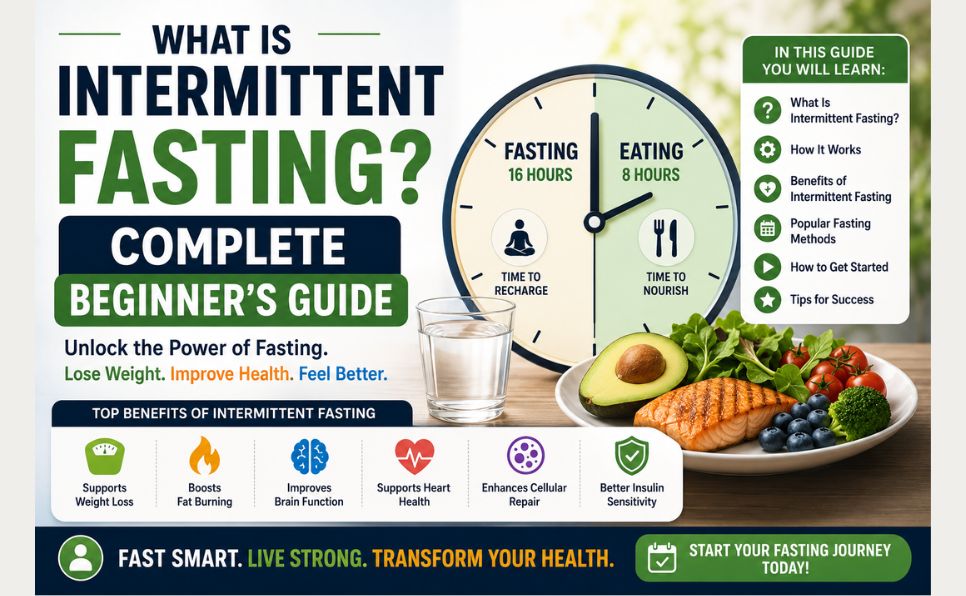
In this complete beginner’s guide, you’ll learn:
- What intermittent fasting actually is
- How it works in your body
- The most popular IF methods explained
- Science-backed benefits
- Potential side effects and who should avoid it
- How to start safely as a complete beginner
What Is Intermittent Fasting? (Simple Definition)
Intermittent fasting (IF) is an eating pattern that cycles between periods of fasting and eating. It doesn’t prescribe specific foods — it prescribes when you should eat them.
The core principle: by extending the natural overnight fast, you give your body time in a fasted state where it shifts from burning glucose (sugar) to burning stored fat — and triggers several other beneficial metabolic and cellular processes.
How Does Intermittent Fasting Work?
What Happens in Your Body:
| Hours Fasted | What Happens |
|---|---|
| 0–4 hours | Fed state — insulin high, fat burning minimal |
| 4–12 hours | Insulin drops, body draws on glycogen stores |
| 12–16 hours | Fat burning increases significantly |
| 16–24 hours | Autophagy peaks — cellular cleanup process |
| 24+ hours | Growth hormone increases (muscle preservation) |

What Is Autophagy?
Autophagy is your body’s internal cellular cleaning process — breaking down and recycling damaged cell components. Research that earned a Nobel Prize in Physiology in 2016 links autophagy activation to reduced inflammation, cancer prevention, slowed aging, and improved brain function.
Fasting is one of the most powerful ways to trigger autophagy.
The Most Popular Intermittent Fasting Methods
Method 1: 16:8 (Most Popular for Beginners)
Fast 16 hours, eat within an 8-hour window daily.
Example: Eat 12pm–8pm, fast 8pm–12pm next day (skip breakfast)
- Difficulty: Easy
- Best for: Beginners, sustainable daily practice
- Why: Most research uses 16:8. Easiest to maintain long-term.
Method 2: 5:2 Diet
Eat normally 5 days. Eat only 500–600 calories on 2 non-consecutive days.
- Difficulty: Moderate
- Best for: People who prefer not to fast daily
Method 3: Eat Stop Eat
Complete 24-hour fasts 1–2 times per week.
- Difficulty: Hard
- Best for: Experienced fasters wanting weekly resets
Method 4: Alternate Day Fasting (ADF)
Alternate between normal eating days and fasting/low-calorie days.
- Difficulty: Very Hard
- Best for: Aggressive goals, medical supervision recommended
Method 5: OMAD (One Meal a Day)
Eat all daily calories in one 1-hour window.
- Difficulty: Extreme
- Best for: Advanced practitioners only
Quick Comparison:
| Method | Fasting Period | Difficulty | Best For |
|---|---|---|---|
| 16:8 | 16 hours daily | Easy | Beginners |
| 5:2 | 2 days/week (low cal) | Moderate | Flexible approach |
| Eat Stop Eat | 24 hours, 1-2x/week | Hard | Experienced fasters |
| ADF | Every other day | Very Hard | Medical supervision |
| OMAD | 23 hours daily | Extreme | Advanced only |
Recommendation: Start with 16:8 — most sustainable and most researched.
Science-Backed Benefits of Intermittent Fasting
1. Weight Loss and Fat Burning
According to a review published in the New England Journal of Medicine, intermittent fasting produces weight loss comparable to continuous calorie restriction — with additional metabolic advantages including:
- Lower insulin levels unlock fat stores
- Increased norepinephrine (fat-burning hormone)
- Reduced calorie intake from smaller eating window
- Better muscle mass preservation vs. continuous restriction
2. Improved Insulin Sensitivity
Research shows IF reduces:
- Fasting insulin: 20–31%
- Blood sugar: 3–6%
- Insulin resistance: significant improvement
This dramatically reduces risk of type 2 diabetes and metabolic syndrome.
3. Cardiovascular Health
Studies show IF improves:
- Lower LDL cholesterol
- Reduced triglycerides
- Decreased blood pressure
- Reduced inflammatory markers
4. Brain Health
Fasting triggers Brain-Derived Neurotrophic Factor (BDNF) — supporting new neuron growth and protecting brain cells. Research from the National Institute on Aging suggests IF may reduce risk of Alzheimer’s and Parkinson’s disease.
5. Cellular Repair and Longevity
Autophagy activation during fasting is linked to:
- Reduced cancer risk
- Slowed aging processes
- Improved immune function
- Neuroprotection
Potential Side Effects
Common (First 1–2 Weeks):
| Side Effect | Why It Happens | How to Manage |
|---|---|---|
| Hunger | Ghrelin hormone spikes | Drink water, black coffee, or tea |
| Headaches | Dehydration, electrolyte changes | Increase water and salt intake |
| Fatigue | Blood sugar adjustment | Reduce workout intensity temporarily |
| Irritability | Low blood sugar adaptation | Normal — resolves within 1–2 weeks |
| Difficulty concentrating | Glucose adjustment | Improves significantly after adaptation |
Most side effects resolve within 1–2 weeks as your body adapts.
📖 If fasting is disrupting your sleep, read: How to Improve Sleep Quality: 15 Proven Tips
Who Should NOT Practice IF Without Medical Supervision:
- Pregnant or breastfeeding women
- People with a history of eating disorders
- People with type 1 diabetes
- People on certain medications
- Children and teenagers
- Underweight individuals
Always consult your doctor before starting intermittent fasting.
What You Can Consume During Fasting
| Allowed (Won’t Break Fast) | Not Allowed (Breaks Fast) |
|---|---|
| Water | Any food |
| Black coffee (no sugar/milk) | Juice |
| Plain herbal tea | Smoothies |
| Sparkling water | Milk or cream |
| Zero-calorie electrolytes | Caloric supplements |
How to Start Intermittent Fasting — Step by Step
Step 1: Choose 16:8
Skip breakfast. Eat 12pm–8pm. Fast 8pm–12pm.
Step 2: Survive the First Week
The first 3–7 days are hardest. Strategies:
- Drink water throughout the morning
- Black coffee or green tea suppresses hunger
- Keep busy during peak hunger times
- Plan your first meal in advance — don’t break fast with junk food
Step 3: Break Your Fast Wisely
Best first meals after fasting:
- Eggs with vegetables
- Greek yogurt with nuts and berries
- Salad with protein and olive oil
- Avocado with eggs
Avoid: Large refined carbohydrate meals as your first food (causes rapid blood sugar spike)
Step 4: Commit to 2 Full Weeks
Most people feel worse before they feel better. By week 2–3, most people report:
- Reduced morning hunger
- More stable energy
- Better mental clarity
- Improved sleep
📖 Managing stress during the adaptation period helps significantly: How to Reduce Stress and Anxiety: 15 Proven Techniques
Intermittent Fasting vs. Calorie Counting
| Factor | Intermittent Fasting | Calorie Counting |
|---|---|---|
| Focus | When you eat | What and how much |
| Flexibility | Eat what you want (within reason) | Strict tracking required |
| Sustainability | High — simple rules | Lower — tracking fatigue |
| Additional benefits | Autophagy, insulin sensitivity | Primarily weight loss |
| Learning curve | Low | Medium-High |
Intermittent Fasting and Exercise
Fasted exercise benefits:
- May increase fat oxidation
- Works well for low-to-moderate intensity (walking, yoga, light cardio)
For intense training:
- Time workouts near end of fasting window
- Eat shortly after high-intensity sessions
- Stay well hydrated throughout
Beginner Checklist
- Chose 16:8 method
- Set eating window (12pm–8pm recommended)
- Stocked water, black coffee, herbal tea
- Planned nutritious first meal
- Consulted doctor if health conditions present
- Committed to 2-week trial
- Not combining with other extreme dietary restrictions
- Adjusted workout timing if needed
Conclusion — Is Intermittent Fasting Right for You?
Intermittent fasting is one of the most researched dietary interventions of the past decade. The science is compelling — for weight management, metabolic health, brain function, and cellular repair.
Who IF works best for:
- People who aren’t hungry in the morning
- Those wanting a simple, rule-based approach
- People wanting metabolic benefits beyond weight loss
- Anyone who finds calorie counting unsustainable
Your action plan:
- Start 16:8 — skip breakfast, eat 12pm–8pm
- Drink water, black coffee, and tea during the morning fast
- Commit to 2 weeks of consistency
- Break your fast with protein-rich, nutritious food
- Consult your doctor if you have any health conditions
Frequently Asked Questions (FAQ)
Does intermittent fasting work for weight loss?
Yes — multiple meta-analyses confirm IF produces significant weight loss, comparable to continuous caloric restriction, with additional metabolic benefits.
Can I drink coffee during intermittent fasting?
Black coffee (no sugar, milk, or cream) is generally acceptable during a fast and doesn’t significantly break the fast for most people.
Will intermittent fasting cause muscle loss?
When done correctly with adequate protein intake and resistance training, IF preserves muscle mass better than traditional calorie restriction due to growth hormone increases during fasting.
What is the best IF schedule for beginners?
16:8 — fasting 16 hours, eating 12pm–8pm. Most sustainable and most research-supported method for beginners.
How long until I see results?
Initial changes (reduced morning hunger, stable energy) within 1–2 weeks. Weight loss noticeable after 3–4 weeks. Significant metabolic improvements after 8–12 weeks of consistent practice.
Is it safe to exercise while fasting?
For most healthy adults, moderate exercise during fasting is safe. High-intensity training is better timed near end of fasting window so you can eat shortly after.
This article is for informational purposes only and is not a substitute for professional medical or nutritional advice. Consult a healthcare professional before starting intermittent fasting, especially if you have existing health conditions or take medications.
Found this guide helpful? Share it with someone curious about IF. Questions? Drop them in comments — we answer every one!