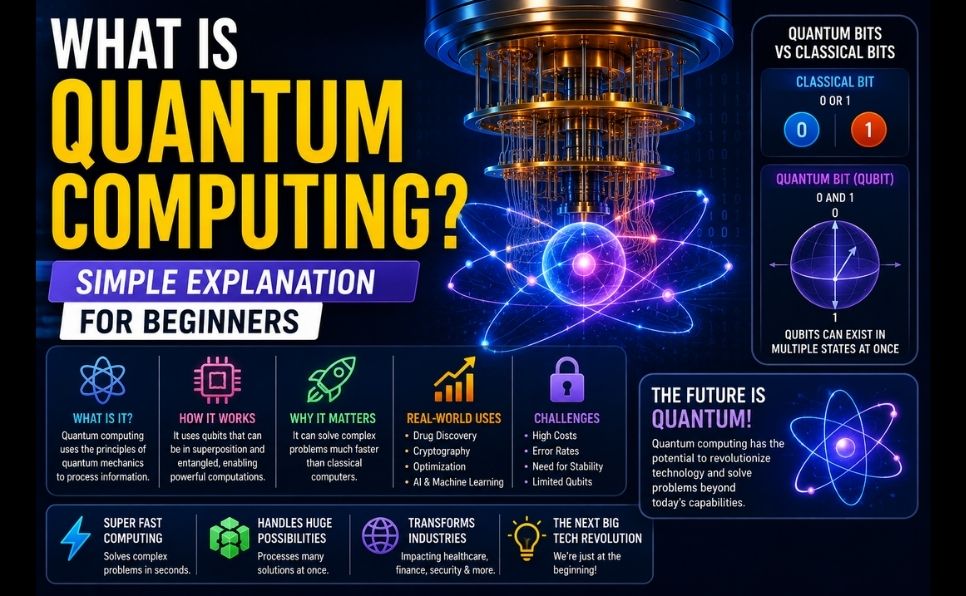
Quantum computing is one of the most talked-about — and least understood — technologies of our time.
Google claimed “quantum supremacy” in 2019. IBM releases new quantum processors every year. Governments are investing billions in quantum research. And experts say quantum computers could eventually break every encryption system protecting the internet.
But what actually is quantum computing? How is it different from the computer or phone you’re using right now? And why does it matter to you?
In this complete beginner’s guide, you’ll learn:
- What quantum computing is in plain English
- How quantum computers actually work
- The key concepts — qubits, superposition, and entanglement — explained simply
- How quantum computing differs from classical computing
- Real-world applications and industries being transformed
- The biggest challenges quantum computing still faces
- Where quantum computing stands in 2026
No physics degree required. Let’s dive in. 👇
What Is Quantum Computing? (Simple Definition)
Quantum computing is a type of computing that uses the principles of quantum mechanics — the physics of subatomic particles — to process information in fundamentally different ways than traditional computers.
While classical computers process information as bits (0s and 1s), quantum computers use qubits (quantum bits) that can represent 0, 1, or both simultaneously — allowing them to perform certain calculations exponentially faster than any classical computer.
The Key Difference in One Sentence:
A classical computer tries every possible solution one at a time. A quantum computer can explore many possible solutions simultaneously.
Classical Computing vs. Quantum Computing
To understand quantum computing, you first need to understand how regular computers work — and where they hit their limits.
How Classical Computers Work:
Every classical computer — from your smartphone to the world’s fastest supercomputer — processes information using bits.
A bit is the smallest unit of information. It has exactly two possible states:
- 0 (off)
- 1 (on)
Everything your computer does — displaying text, playing video, running apps — is ultimately a series of 0s and 1s being processed by billions of transistors on a chip.
Classical computers are incredibly powerful for most tasks. But for certain problems — particularly those involving enormous numbers of variables and possibilities — they face fundamental limitations.
Example: Finding the optimal route between 10 cities. A classical computer can calculate this reasonably fast. But increase it to 50 cities — and the number of possible routes exceeds the number of atoms in the observable universe. Even the world’s fastest supercomputer would take billions of years.
How Quantum Computers Work Differently:
Quantum computers use qubits instead of bits. And qubits behave very differently — governed by the strange laws of quantum mechanics.

The Three Key Concepts of Quantum Computing
1. Qubits — The Building Block
A qubit (quantum bit) is the quantum equivalent of a classical bit — but with superpowers.
While a classical bit must be either 0 or 1, a qubit can be:
- 0
- 1
- Both 0 and 1 at the same time (while unmeasured)
This “both at once” property is called superposition — and it’s what makes quantum computers fundamentally different.
Physical qubits can be made from:
- Superconducting circuits (used by IBM and Google)
- Trapped ions (used by IonQ and Honeywell)
- Photons (light particles)
- Topological qubits (Microsoft’s approach)
2. Superposition — Being in Multiple States at Once
Superposition is the quantum property that allows a qubit to exist in multiple states simultaneously — until it’s measured.
The classic analogy — a coin:
| Classical Bit | Qubit | |
|---|---|---|
| Like a coin lying flat | Heads (1) or Tails (0) — definite state | — |
| Like a spinning coin | — | Both heads AND tails simultaneously |
| When you stop it | Already fixed | Collapses to heads OR tails |
A spinning coin is in a “superposition” of heads and tails. The moment you observe it (it stops spinning), it becomes one definite state.
Similarly, a qubit is in superposition until measured — then it “collapses” to either 0 or 1.
Why this matters:
- 1 qubit = 2 possible states (0 or 1)
- 2 qubits = 4 possible states simultaneously
- 10 qubits = 1,024 possible states simultaneously
- 300 qubits = more states than atoms in the observable universe
This exponential scaling is why quantum computers can potentially solve certain problems that are completely impossible for classical computers.
3. Entanglement — Quantum Connections
Quantum entanglement is a phenomenon where two qubits become linked — so that the state of one instantly affects the state of the other, regardless of the distance between them.
Einstein famously called this “spooky action at a distance” — because it seems to violate the rule that nothing travels faster than light.
What entanglement does for computing:
- Entangled qubits share information instantaneously
- Measuring one immediately tells you something about the other
- Allows quantum computers to coordinate calculations across multiple qubits simultaneously
- Exponentially increases computational power when combined with superposition
4. Quantum Interference — Amplifying Right Answers
Quantum interference is used to amplify the probability of correct answers and cancel out incorrect ones.
Quantum algorithms are designed to use interference like waves:
- Constructive interference — amplifies paths leading to correct solutions
- Destructive interference — cancels paths leading to wrong solutions
This allows quantum computers to efficiently “steer” toward the right answer without checking every possibility individually.
Classical vs. Quantum Computing: Full Comparison
| Feature | Classical Computing | Quantum Computing |
|---|---|---|
| Basic unit | Bit (0 or 1) | Qubit (0, 1, or both) |
| Processing | Sequential — one state at a time | Parallel — multiple states simultaneously |
| Scaling | Linear improvement | Exponential improvement for certain problems |
| Error rate | Very low | Currently high (main challenge) |
| Temperature | Room temperature | Near absolute zero (-273°C) |
| Best for | General computing, everyday tasks | Optimization, simulation, cryptography |
| Current state | Mature, ubiquitous | Early stage, experimental |
| Who has them | Everyone | IBM, Google, select researchers |
| Cost | $500 laptop to $1M supercomputer | $10M–$15M per quantum computer |
How Quantum Computers Are Built
Building a quantum computer is extraordinarily difficult. Here’s why:
The Temperature Problem
Most quantum computers need to operate at temperatures close to absolute zero (-273.15°C or -459.67°F) — colder than outer space.
At room temperature, thermal vibrations destroy the delicate quantum states of qubits — a problem called decoherence.
This is why quantum computers require enormous cooling systems and cannot currently be miniaturized into laptops or phones.
The Error Problem
Quantum computers are extremely error-prone. Qubits are fragile — any interaction with the environment can corrupt their quantum state.
Current quantum computers use quantum error correction — using many physical qubits to represent one reliable “logical qubit.” IBM’s goal is to achieve 100,000 physical qubits to represent ~100 reliable logical qubits.
Qubit Count Progress:
| Year | IBM Quantum Processor | Qubits |
|---|---|---|
| 2016 | IBM Q 5 | 5 qubits |
| 2019 | IBM Q System One | 27 qubits |
| 2021 | IBM Eagle | 127 qubits |
| 2022 | IBM Osprey | 433 qubits |
| 2023 | IBM Condor | 1,121 qubits |
| 2024 | IBM Heron | 133 qubits (higher quality) |
| 2026 | IBM (roadmap) | 4,000+ qubits |
Note: More qubits doesn’t always mean more powerful — qubit quality and error rates matter enormously.
Real-World Applications of Quantum Computing
Quantum computing isn’t just theoretical — it’s already being applied in specific areas where it offers clear advantages over classical computing.
1. Drug Discovery and Healthcare
The problem: Simulating molecular interactions to discover new drugs is computationally impossible for classical computers — molecules with just 50 atoms involve more quantum states than classical computers can simulate.
Quantum solution: Quantum computers can simulate molecular behavior at the quantum level — dramatically accelerating drug discovery.
Real impact:
- IBM and pharmaceutical companies are using quantum simulations to model protein folding
- Could reduce drug development from 10+ years to 2–3 years
- Potential to find cures for diseases like Alzheimer’s and cancer
2. Cryptography and Cybersecurity
The threat: A sufficiently powerful quantum computer could break RSA encryption — the system protecting most internet communications, banking, and sensitive data.
Why: RSA encryption relies on the fact that factoring very large numbers is practically impossible for classical computers. Quantum computers using Shor’s algorithm could factor these numbers exponentially faster.
What’s being done:
- NIST (National Institute of Standards and Technology) finalized the first post-quantum cryptography standards in 2024
- Organizations are beginning the transition to quantum-resistant encryption
- “Harvest now, decrypt later” attacks — adversaries are collecting encrypted data today to decrypt when quantum computers arrive
📖 Understand current encryption and cybersecurity threats: What Is Cybersecurity? Complete Beginner’s Guide
3. Financial Services
Applications:
- Portfolio optimization — finding the optimal investment strategy across thousands of assets simultaneously
- Risk analysis — modeling complex financial scenarios with many interdependent variables
- Fraud detection — identifying patterns in massive transaction datasets
- Options pricing — calculating complex derivative values faster
Who’s investing: JPMorgan Chase, Goldman Sachs, and BBVA are all actively running quantum computing research programs.
4. Logistics and Supply Chain Optimization
The problem: Optimizing delivery routes, supply chains, and logistics networks involves combinatorial problems with billions of possible solutions.
Quantum solution: Quantum optimization algorithms can find near-optimal solutions to these problems exponentially faster.
Real examples:
- Volkswagen used quantum computing to optimize traffic flow in Lisbon
- Airbus is researching quantum algorithms for aircraft loading optimization
- DHL is exploring quantum optimization for delivery routing
5. Artificial Intelligence and Machine Learning
Applications:
- Training AI models faster on larger datasets
- Quantum machine learning algorithms for pattern recognition
- Optimization of neural network architectures
- Solving optimization problems in AI training
Relationship: AI and quantum computing are increasingly intertwined — quantum computers could dramatically accelerate AI capabilities.
📖 Learn how AI currently works: What Is Artificial Intelligence? Complete Beginner’s Guide
6. Climate Science and Materials Discovery
Applications:
- Simulating complex climate models with more variables and higher accuracy
- Discovering new materials for solar cells, batteries, and superconductors
- Optimizing carbon capture processes
- Modeling chemical reactions for new fertilizers (reducing energy consumption of current methods by 1–2% of global energy use)
7. Cryptography and Secure Communications
Quantum Key Distribution (QKD):
- Uses quantum mechanics to distribute encryption keys
- Any interception attempt physically disturbs the quantum state — making eavesdropping detectable
- China has already deployed a 2,000km quantum communication network
Quantum Computing in 2026 — Where Things Stand
Current State:
We are in the NISQ era — Noisy Intermediate-Scale Quantum (NISQ) — meaning:
- Quantum computers exist and are accessible (via cloud)
- They have enough qubits for some experimental applications
- But they’re still too error-prone for most practical applications
- “Quantum advantage” (definitively outperforming classical computers on useful problems) has been demonstrated for specific narrow tasks
Who Leads in Quantum Computing (2026):
| Company/Country | Approach | Status |
|---|---|---|
| IBM | Superconducting qubits | 1,000+ qubit processors, cloud access |
| Superconducting qubits | Claimed quantum supremacy 2019 | |
| Microsoft | Topological qubits | Announced topological qubit breakthrough 2025 |
| IonQ | Trapped ions | High-quality qubits, publicly traded |
| China | Multiple approaches | Heavy government investment, rapid progress |
| USA | Government + private | $1.8 billion National Quantum Initiative |
| EU | Quantum Flagship | €1 billion investment program |
Access Quantum Computing Today (Free):
You can run quantum programs on real quantum computers right now:
- IBM Quantum — quantum.ibm.com — free cloud access to IBM quantum processors
- Google Quantum AI — research access available
- Amazon Braket — pay-per-use cloud quantum computing
Quantum Computing Myths — Busted
❌ Myth 1: “Quantum computers are just faster regular computers”
Truth: Quantum computers are not universally faster. They’re better for specific problem types (optimization, simulation, factoring). For everyday tasks like browsing, gaming, or word processing — classical computers are better.
❌ Myth 2: “Quantum computers will replace regular computers”
Truth: Quantum and classical computers are complementary — not competitors. Quantum computers will handle specific complex calculations; classical computers will continue doing everything else.
❌ Myth 3: “Quantum supremacy means quantum computers won”
Truth: “Quantum supremacy” or “quantum advantage” means a quantum computer performed ONE specific task faster than a classical computer — not that it’s better overall.
❌ Myth 4: “Quantum computers will break all encryption immediately”
Truth: Breaking RSA encryption requires millions of stable, error-corrected qubits. Current machines have hundreds to thousands of noisy qubits. This threat is real but likely 10–20 years away.
❌ Myth 5: “Quantum computing is science fiction”
Truth: Real quantum computers exist today and are accessible via cloud services. IBM, Google, IonQ, and others are operating real quantum hardware right now.
Quantum Computing Timeline — What to Expect
| Timeframe | Expected Milestone |
|---|---|
| 2026–2028 | 10,000+ qubit processors; quantum advantage on more practical problems |
| 2028–2032 | Fault-tolerant quantum computing begins; pharmaceutical breakthroughs |
| 2030–2035 | Post-quantum cryptography fully deployed; quantum internet experiments |
| 2035–2040 | Large-scale quantum computers solving previously impossible problems |
| 2040+ | Potential quantum advantage in AI training, materials science, and more |
How Quantum Computing Relates to Other Technologies
Quantum computing doesn’t exist in isolation — it intersects with many other technologies:
- AI + Quantum = Quantum machine learning — training AI models exponentially faster
- Blockchain + Quantum = Quantum computers threaten current blockchain encryption — quantum-resistant blockchains are being developed
- Cloud + Quantum = Quantum computing is already delivered via cloud (IBM Quantum, Amazon Braket)
- Cybersecurity + Quantum = Both the biggest threat (breaking encryption) and solution (quantum cryptography)
📖 Understand how blockchain technology works: What Is Blockchain Technology?
📖 Learn about the cloud infrastructure that delivers quantum computing: What Is Cloud Computing?
Complete Quantum Computing Checklist — What You’ve Learned
- Quantum computers use qubits instead of classical bits
- Superposition allows qubits to be 0, 1, or both simultaneously
- Entanglement links qubits so they share information instantly
- Quantum interference amplifies correct answers, cancels wrong ones
- Quantum computers excel at optimization, simulation, and factoring
- Current quantum computers are noisy and error-prone (NISQ era)
- Applications: drug discovery, cryptography, finance, logistics, AI
- Biggest threat: breaking RSA encryption (still 10–20 years away)
- Post-quantum cryptography standards finalized by NIST in 2024
- You can access real quantum computers free via IBM Quantum cloud
Conclusion — Quantum Computing Is Coming. Are You Ready?
Quantum computing is not a distant fantasy — it’s a rapidly advancing reality that will transform industries, redefine security, and unlock scientific discoveries that classical computers could never achieve.
We are still in the early stages. The quantum computers of today are like the room-sized mainframes of the 1950s — powerful for their time, but a fraction of what’s coming.
The key takeaways:
- Quantum computers use qubits, superposition, and entanglement
- They’re not replacements for classical computers — they’re specialized tools
- Real quantum computers exist today and are accessible via cloud
- The biggest near-term application is optimization and drug discovery
- The biggest long-term concern is quantum computers breaking encryption
- Post-quantum cryptography is already being developed and deployed
You don’t need to become a quantum physicist. But understanding what quantum computing is — and why it matters — puts you ahead of most people in a world where this technology will increasingly shape our future.
Frequently Asked Questions (FAQ)
How is quantum computing different from regular computing?
Classical computers use bits that are either 0 or 1. Quantum computers use qubits that can be 0, 1, or both simultaneously (superposition). This allows quantum computers to process many possibilities at once — making them exponentially faster for specific types of problems like optimization and simulation.
Will quantum computers replace regular computers?
No. Quantum and classical computers are complementary technologies. Quantum computers excel at specific problem types — optimization, simulation, cryptography. Classical computers are better for everyday tasks. The future involves both working together, not one replacing the other.
When will quantum computers be powerful enough to break encryption?
Most experts estimate that breaking RSA-2048 encryption would require millions of stable, error-corrected qubits. Current machines have hundreds to thousands of noisy qubits. This capability is likely 10–20 years away — giving organizations time to transition to post-quantum cryptography.
Can I use a quantum computer today?
Yes — IBM offers free cloud access to real quantum computers at quantum.ibm.com. You can write and run quantum programs using IBM’s Qiskit framework. Amazon Braket and other cloud platforms also offer pay-per-use quantum computing access.
What programming language do quantum computers use?
Quantum computers use specialized quantum programming languages and frameworks including Qiskit (IBM), Cirq (Google), PennyLane (Xanadu), and Q# (Microsoft). Most are based on Python, making them accessible to developers already familiar with classical programming.
Is quantum computing dangerous?
The primary concern is that sufficiently powerful quantum computers could break current encryption systems — potentially exposing financial systems, communications, and national security infrastructure. However, post-quantum cryptography standards are being developed and deployed to address this threat before quantum computers reach that capability.
Found this guide helpful? Share it with someone curious about quantum computing. Have a question? Drop it in the comments — we answer every one!