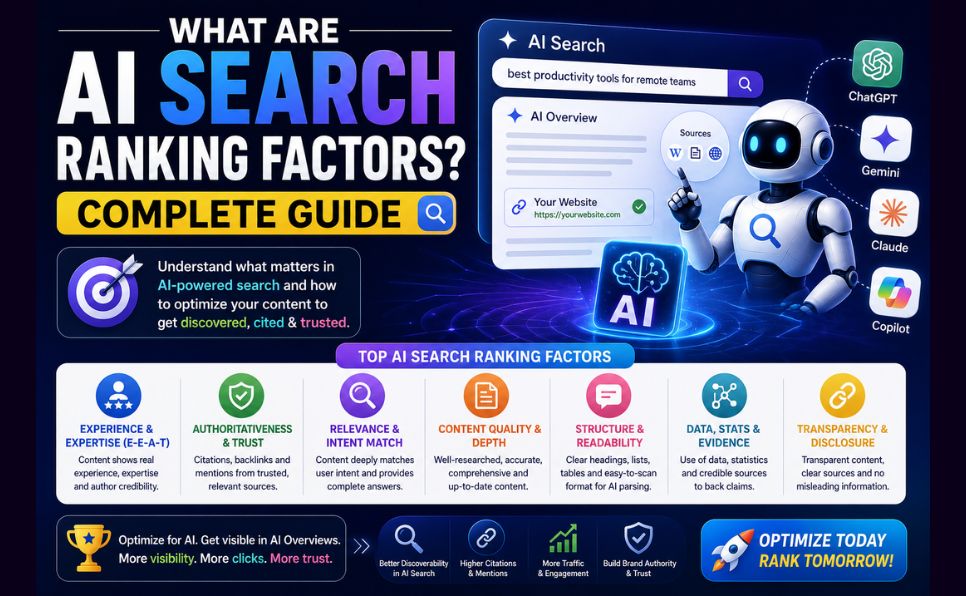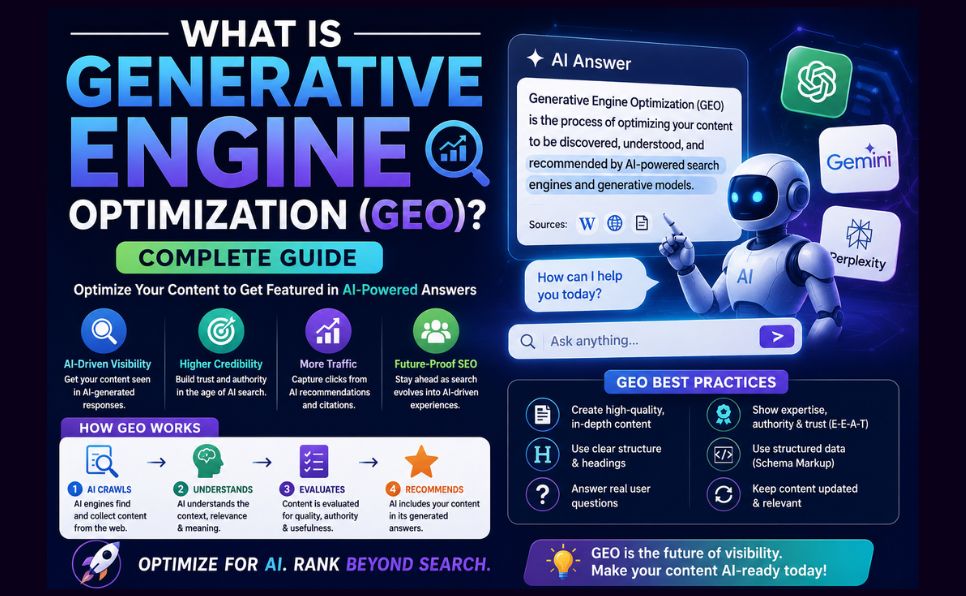
For the last two decades, ranking on Google’s first page was the ultimate goal of digital marketing. But in 2026, a growing share of searches never produce a list of blue links at all — they produce a single, synthesized answer from ChatGPT, Google AI Overviews, Perplexity, or Gemini. This shift has given rise to a new discipline that every website owner, blogger, and business needs to understand: Generative Engine Optimization (GEO).
If you’ve been optimizing your website for years and still feel unsure why your traffic patterns are changing, this guide will walk you through exactly what GEO is, how it works, why it matters, and how you can start optimizing for it today.
What Is Generative Engine Optimization (GEO)?
Generative Engine Optimization (GEO) is the practice of structuring your content, brand information, and online presence so that AI-powered platforms — such as ChatGPT, Google AI Overviews, Perplexity, Gemini, and Claude — can easily find, understand, cite, and recommend it when answering user questions.
In simple terms: traditional SEO helps you earn a spot among ten search result links. GEO helps you earn a mention inside the AI-generated answer itself — often among just two to seven sources the AI chooses to cite in a single response.
The term was originally introduced in 2023 by researchers at Princeton, and by 2026 it has become one of the fastest-growing areas of digital marketing, as AI-powered search and conversational assistants increasingly become the first place people go for answers.

Why GEO Matters in 2026
The way people search for information has fundamentally changed. Instead of typing a query into Google and scrolling through links, millions of users now ask ChatGPT, Perplexity, or an AI assistant directly — and act on whatever answer they receive, often without ever clicking through to a website.
A few data points make the shift clear:
- Industry researchers have observed AI-referred website sessions increasing dramatically year-over-year as more users shift from typed searches to conversational AI queries.
- Major analyst firms have projected that a substantial share of global searches will be handled by AI assistants within the next few years, with that share expected to keep climbing.
- Academic researchers from Princeton, Georgia Tech, and IIT Delhi studied which content strategies made websites more likely to be cited by generative engines, and found that certain optimization techniques significantly improved visibility inside AI-generated answers.
This means a business that ranks well on Google but ignores GEO could still become effectively invisible to the growing number of users who rely on AI systems for answers — even if their traditional rankings remain strong.
GEO vs. SEO vs. AEO: What’s the Difference?
These three acronyms get used interchangeably, but they represent different (if overlapping) goals.
| SEO | AEO | GEO | |
|---|---|---|---|
| Full Name | Search Engine Optimization | Answer Engine Optimization | Generative Engine Optimization |
| Goal | Rank high in search results (blue links) | Get featured in direct answer boxes/voice search | Get cited inside AI-generated, synthesized answers |
| Main Levers | Backlinks, keywords, site speed, domain authority | Structured data, concise answers, FAQ formatting | Clear definitions, statistics, citations, entity clarity |
| Success Metric | Rankings, organic clicks | Featured snippet appearances | Citation frequency, “Share of Model” |
Importantly, GEO is not a replacement for SEO — it’s an additional layer built on top of it. Many of the fundamentals (fast-loading pages, clear structure, credible content, mobile-friendliness) still matter for both. GEO simply adds new requirements around how clearly and citably your information is presented. AEO, meanwhile, is increasingly considered part of GEO, since most voice search and answer-box queries are now processed by the same generative AI systems.
If you’re still building your foundational SEO knowledge, our guide on What Is Web Hosting covers how the technical side of your website — speed, uptime, and reliability — plays a supporting role in both SEO and GEO, since AI crawlers need to access and load your site just like search engines do.
How Do AI Engines Decide What to Cite?
Generative engines don’t rank pages the way Google’s algorithm does. Instead, most rely on a process similar to retrieval-augmented generation (RAG) — the AI searches its available sources, retrieves the passages most relevant to the user’s question, and synthesizes them into a single answer, often with citations linking back to the original sources.
This means the AI isn’t just looking at your whole page — it’s evaluating individual passages, facts, and definitions for how clearly and directly they answer a specific question. A page can rank well on Google due to strong overall authority, yet still get skipped by an AI engine if its key facts aren’t stated clearly enough to extract on their own.
Proven GEO Strategies That Actually Work
Based on the academic research and industry data available so far, these are the tactics most consistently linked to better AI citation rates:
1. Lead With Clear, Standalone Definitions
Don’t bury your core definition in the fourth paragraph. State it plainly near the top, in a single well-formed sentence an AI can lift out cleanly — much like the definition given earlier in this article.
2. Add Statistics and Data
Content backed by specific numbers, percentages, or study results is significantly more likely to be cited than vague, generic claims. AI systems favor concrete, verifiable data points over opinion-based statements.
3. Cite Credible Sources
Referencing reputable studies, official documentation, or recognized industry sources adds credibility signals that generative engines look for when deciding what to trust and repeat.
4. Structure Content for Easy Extraction
Use descriptive headings that mirror how people actually phrase questions (“What is…”, “How does… work”, “Why does… matter”). Short paragraphs, bullet points, and tables make it easier for AI systems to isolate and reuse specific facts.
5. Build Topical and Entity Clarity
Generative engines rely heavily on understanding what your brand actually is and what topics you’re a genuine authority on. Consistent naming, clear “About” information, and focused topic coverage (rather than spreading thin across unrelated subjects) all help reinforce this.
6. Keep Content Technically Accessible
If AI crawlers can’t access or properly render your pages, none of the above matters. This is where reliable hosting becomes directly relevant — slow servers, frequent downtime, or blocked crawlers can prevent your content from being indexed and retrieved at all. Choosing a fast, reliable host — something we cover in our Shared vs VPS vs Cloud Hosting comparison — is a foundational (and often overlooked) part of any GEO strategy.
Which Industries Benefit Most from GEO?
GEO tends to deliver the strongest results for industries where people frequently ask informational questions — technology, SaaS, healthcare, finance, legal, education, and professional services. These are the categories where users regularly turn to AI assistants for definitions, comparisons, and how-to explanations, rather than purely transactional queries. E-commerce and local service businesses benefit more indirectly, typically by publishing educational content that builds category authority over time.
How to Measure GEO Success
Traditional SEO tools track rankings and organic clicks — but GEO requires different metrics, since the AI often gives an answer without sending a click to your site at all. Common ways businesses are starting to measure GEO performance include:
- Citation frequency — how often your brand or content is cited across AI platforms for relevant queries
- Share of Model — how often your brand appears compared to competitors when the same set of questions is asked across multiple AI engines
- AI-referred traffic — sessions that do arrive on your site via a link clicked from an AI-generated answer, trackable through standard analytics referral data
Common GEO Myths to Avoid
- “GEO replaces SEO.” False — the two disciplines overlap heavily, and a weak SEO foundation makes GEO significantly harder to achieve.
- “Stuffing keywords works for GEO.” No — generative engines reward conceptual clarity and well-supported facts, not keyword repetition.
- “GEO results happen overnight.” Like SEO, most practitioners report it takes a consistent, sustained effort over several months to see meaningful shifts in citation visibility.
Final Thoughts
Generative Engine Optimization represents one of the biggest shifts in digital visibility since the early days of search engines. As more of the buyer journey moves into AI-generated conversations, businesses that treat GEO as an extension of good SEO — rather than a separate, disconnected discipline — will be the ones who stay visible as the search landscape continues to evolve.
The good news: the businesses investing in GEO right now are still operating in a relatively low-competition environment, since most websites haven’t adapted their content yet. Getting started early with clear definitions, strong data, and technically reliable hosting gives you a meaningful head start.
Related reading: What Is Web Hosting · Domain Name vs Web Hosting · Shared vs VPS vs Cloud Hosting