What Is Answer Engine Optimization (AEO)? Complete Guide for 2026
Search is changing. People still use traditional search engines, but many now ask questions through AI-powered experiences such as ChatGPT, Perplexity, Google AI Overviews, Google AI Mode, and Microsoft Copilot.
Instead of reviewing a list of websites, users can receive a synthesized answer that sometimes includes links to supporting sources.
This development has increased interest in Answer Engine Optimization (AEO).
But does AEO require a completely different SEO strategy? Can adding FAQ schema make ChatGPT cite your website? And how can publishers measure visibility in AI-generated answers?
This updated 2026 guide explains what AEO means, how it relates to traditional SEO and Generative Engine Optimization (GEO), and how to prepare useful website content for AI-powered search experiences.
You’ll learn:
- What Answer Engine Optimization means.
- How AEO, SEO, and GEO compare.
- How AI-powered search systems use website content.
- Ten practical content optimization strategies.
- How to configure WordPress with All in One SEO.
- How to monitor AI visibility in Google Search Console.
- Common AEO myths and mistakes.
- A practical implementation checklist.
1. What Is Answer Engine Optimization (AEO)?
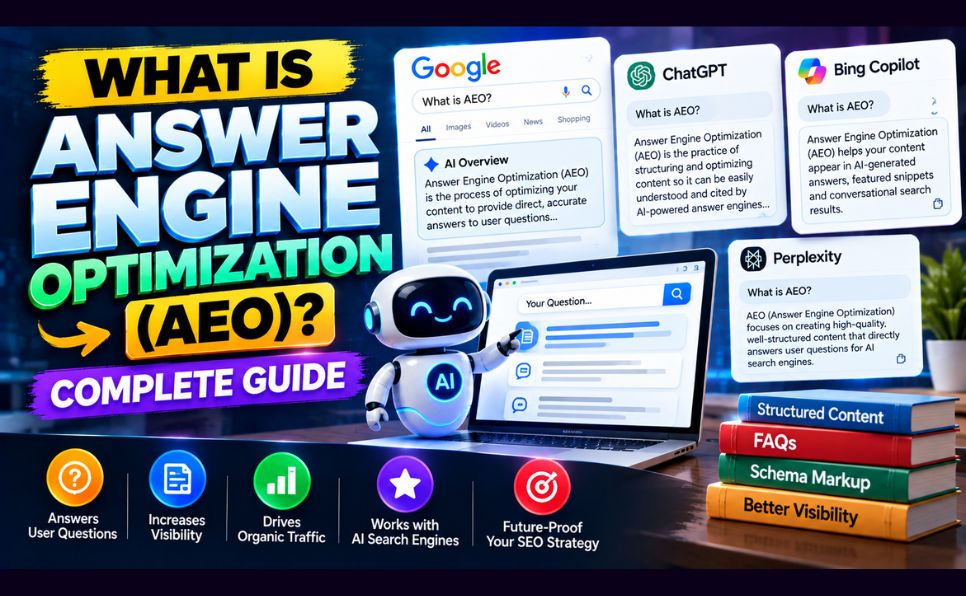
Answer Engine Optimization (AEO) is a term used to describe practices intended to make content easier to discover, understand, and reference in systems that provide direct answers to user questions.
These systems may include traditional search features, AI-generated search summaries, and conversational assistants with access to web information.
AEO focuses on making information accurate, useful, accessible, and clearly organized.
Unlike conventional search result optimization, which often emphasizes rankings and website visits, AEO also considers whether a website is referenced or linked within generated answers.
However, appearing in AI-generated responses cannot be guaranteed.
A simple example
Imagine someone asks:
“What is the difference between SEO and AEO?”
A website could answer:
“SEO improves a website’s visibility in search engines. AEO focuses on making information useful and discoverable in systems that provide direct answers, including AI-powered search experiences.”
This explanation provides a direct answer without unnecessary introductory material.
It may be useful to readers and answer systems, but its format alone does not guarantee that an AI platform will select or cite it.
2. AEO vs. SEO vs. GEO: What’s the Difference?
Search Engine Optimization, Answer Engine Optimization, and Generative Engine Optimization overlap considerably.
They are commonly used marketing terms rather than three completely separate technical systems.
| Feature | SEO | AEO | GEO |
|---|---|---|---|
| Full name | Search Engine Optimization | Answer Engine Optimization | Generative Engine Optimization |
| Main emphasis | Search visibility | Direct-answer visibility | Generative AI visibility |
| Typical platforms | Google, Bing | AI search and answer interfaces | Generative AI platforms |
| Content priorities | Relevance, usefulness, accessibility | Clear answers, reliable information | Useful, credible, referenceable content |
| Measurement | Clicks, impressions, rankings | Answer appearances, citations | AI mentions, citations, referrals |
Does AEO replace SEO?
No.
SEO fundamentals remain important for AI-powered search.
Google has explicitly stated that its generative search features rely on its core search and quality systems.
A useful strategy therefore begins with traditional SEO fundamentals and adds attention to the ways information is presented and referenced.
For the foundations, read our Complete SEO Guide 2026.
3. Which AI Answer Engines Matter in 2026?
Several major platforms provide AI-generated responses.
Google AI Overviews
Google AI Overviews presents AI-generated summaries for eligible searches.
These summaries can include links to supporting webpages.
Visibility depends on Google’s search systems, the query, and other factors.
Google AI Mode
Google AI Mode supports more conversational and exploratory search experiences.
It can provide synthesized responses and links to relevant sources.
ChatGPT
ChatGPT can answer questions using its trained knowledge and, when available and appropriate, information retrieved from the web.
Some responses include citations or links to sources.
However, not every ChatGPT response involves live web retrieval, and not every answer includes citations.
Perplexity
Perplexity is an AI-powered answer and research platform that commonly presents references alongside its responses.
Publishers may receive visibility when their content is selected as a relevant source.
Microsoft Copilot
Microsoft Copilot provides AI-assisted experiences across supported Microsoft products and services.
Some experiences use web information and include references.
Traditional answer features
Featured snippets and other direct-answer features remain relevant to search optimization.
They are not identical to generative AI systems, but they demonstrate the value of providing clear and useful information.
For related research, explore What Are AI Search Ranking Factors?.
4. Why Does AEO Matter in 2026?
AI-powered search experiences provide another way for people to discover information and brands.
They can change how users interact with search results.
Some users may receive enough information from a generated answer without visiting the original source.
Others may click through to learn more, compare alternatives, verify claims, or complete a task.
Potential benefits for publishers
Additional visibility: A website may appear as a linked source within an AI-generated answer.
Brand discovery: Users may encounter a publisher or business they had not previously considered.
Relevant visitors: People seeking deeper explanations may visit the original website.
Content differentiation: Original research, practical tools, and useful examples can provide value beyond short summaries.
Important limitation
AEO does not guarantee more traffic.
An AI citation may produce awareness without generating a click.
Publishers should therefore evaluate both visibility and meaningful business outcomes.
5. How Do AI Answer Engines Select Sources?
Different AI systems use different retrieval, ranking, and response-generation processes.
Their complete internal algorithms are not publicly documented.
Therefore, no publisher can identify a universal list of guaranteed AI citation factors.
Nevertheless, several established content practices can improve usefulness and discoverability.
5.1 Accessible content
Search systems need appropriate access to content before they can retrieve or evaluate it.
Important considerations include:
- Publicly accessible webpages.
- Correct HTTP responses.
- Appropriate indexing settings.
- Crawlable links.
- Clear canonical URLs.
- Content that renders correctly.
Different AI services may have different crawling and retrieval methods.
5.2 Relevant information
Content should directly address the user’s question.
For example, an article about WordPress indexing should explain the actual indexing process rather than repeating general marketing advice.
5.3 Accurate information
Technical claims should be supported by reliable sources.
For rapidly changing topics, publishers should verify current product features and documentation.
5.4 Original value
Useful original contributions may include:
- Firsthand testing.
- Real case studies.
- Original research.
- Practical examples.
- Unique tools.
- Expert explanations.
Avoid fabricating data or claiming experience that did not occur.
5.5 Clear organization
Descriptive headings, logical paragraphs, useful tables, and well-written explanations can help people navigate content.
There is no universal requirement to divide every article into short answer blocks.
5.6 Trust and transparency
Clear authorship, accurate sourcing, and transparent business information can help readers assess credibility.
Google’s E-E-A-T framework is relevant to understanding content quality, but it is not a single numerical ranking score or a guaranteed AI citation mechanism.
6. Ten Practical AEO Strategies for 2026
Strategy 1: Answer Important Questions Clearly
Provide a direct answer when a question calls for one.
For example:
Question: What is VPS hosting?
“VPS hosting uses virtualization to provide separate server environments with allocated resources on shared physical infrastructure.”
You can then explain the advantages, limitations, and use cases.
A clear answer improves usability, but it is not a guaranteed AI citation technique.
Strategy 2: Add Helpful FAQ Sections
Frequently asked questions can help readers find specific information.
Choose questions based on genuine user needs.
Useful sources include:
- Customer questions.
- Search Console query data.
- Search suggestions.
- Support requests.
- Related search topics.
There is no mandatory number of FAQs or universal answer length.
Important FAQ schema update
Google discontinued FAQ rich results in May 2026.
Adding FAQ structured data does not restore those search features or guarantee AI citations.
Publish FAQs because they help readers, not because a particular markup promises special AI visibility.
Read our Schema Markup Complete Guide.
Strategy 3: Use Appropriate Structured Data
Structured data can describe eligible website content in a machine-readable format.
For informational WordPress articles, relevant types may include:
- Article
- BlogPosting
- BreadcrumbList
- Organization
- Person
Structured data should accurately represent the visible content.
It does not guarantee inclusion in AI answers.
How to configure structured data with AIOSEO
- Open the WordPress post editor.
- Locate the All in One SEO settings.
- Review the schema already generated.
- Confirm that the article type and publisher information are accurate.
- Avoid unnecessary duplicate schema markup.
- Validate supported structured data.
Some AIOSEO features may depend on the installed version and subscription.
Strategy 4: Build Relevant Topic Clusters
A topic cluster connects related content through useful internal links.
For example:
Main topic: Complete SEO Guide
Supporting articles:
- Domain Authority Guide
- On-Page SEO Guide
- Internal Linking Strategy
- Schema Markup Guide
- AI Search Ranking Factors
This structure can help readers explore related subjects and support website navigation.
There is no requirement to create exactly 8–15 supporting articles.
Learn more in the Internal Linking Strategy for SEO Guide.
Strategy 5: Organize Content Around User Needs
A practical article structure is:
- Explain the main concept.
- Answer the reader’s immediate question.
- Provide relevant details.
- Demonstrate with examples.
- Explain limitations.
- Link to supporting resources.
This is a useful editorial approach, not a special format required by Google or other AI platforms.
Avoid restructuring every paragraph solely for machine extraction.
Strategy 6: Provide Transparent Author Information
Readers benefit from knowing who created a resource.
Where appropriate, include:
- Author name.
- Relevant expertise.
- Professional background.
- Editorial responsibilities.
- Supporting references.
Do not invent credentials or experience.
Accurate author information improves transparency but does not guarantee citation by an AI system.
Strategy 7: Reference Reliable Sources
Technical articles should support important claims with relevant documentation.
For example, an article about Google indexing should reference Google Search Central.
A guide about WordPress should use current WordPress or plugin documentation where appropriate.
There is no universal requirement to include exactly three to six external links.
Choose sources based on relevance and reliability.
Strategy 8: Understand the Limitations of llms.txt
An llms.txt file is a proposed way to provide AI-oriented information about a website.
Some publishers and tools experiment with this format.
However, Google Search does not use llms.txt to determine visibility or rankings, including its generative search features.
Creating this file is not required for AEO.
It may be maintained for other systems that support it, but publishers should not assume that it increases AI citations.
Focus first on accessible pages, accurate content, and useful navigation.
Strategy 9: Address Conversational Search Queries
People often ask complete questions rather than entering short keyword phrases.
For example:
Traditional query:
“WordPress indexing problems”
Conversational query:
“Why has Google crawled my WordPress article but not indexed it?”
An article addressing the second question should explain possible causes, diagnostic steps, and relevant limitations.
Use natural language and avoid stuffing pages with artificial question variations.
Strategy 10: Keep Important Information Accurate
Content maintenance matters when information changes.
For example:
- Search engine documentation changes.
- Software interfaces are updated.
- Product features are discontinued.
- Statistics become outdated.
- External references stop working.
Update content when meaningful improvements are needed.
Changing the publication date without updating the substance does not guarantee better visibility.
7. How to Measure AEO Performance
AEO measurement requires care because different platforms provide different levels of reporting.
Google Search Console: Generative AI performance
As of August 31, 2026, Google has rolled out its Generative AI performance reporting globally.
This report provides information about website impressions in supported generative AI features, including AI Overviews and AI Mode.
Depending on available data, publishers can review dimensions such as:
- Pages.
- Countries.
- Dates.
- Devices.
The dedicated report focuses on impressions rather than providing complete query-level citation and click analytics.
How to check the report
- Open Google Search Console.
- Select your verified property.
- Navigate to the Generative AI performance report.
- Review available impressions.
- Identify pages receiving visibility.
- Compare trends over time.
If the report is not visible, the website may not have sufficient eligible impressions.
Google Search generative AI inclusion control
Google also provides a Search generative AI control under Search Console settings.
This allows eligible site owners to manage whether their content can appear in supported generative AI Search features.
Publishers should review this setting according to their own content distribution preferences.
Other AI platforms
For ChatGPT, Perplexity, Gemini, and other platforms, measurement capabilities vary.
A practical manual approach is to:
- Select a consistent set of relevant questions.
- Test them periodically.
- Record whether your website appears as a source.
- Note the date and platform.
- Monitor changes without assuming that a single result represents overall visibility.
AI responses may vary by user, context, model, location, and time.
Referral traffic
Analytics tools may identify visits referred from some AI platforms.
However, not every AI-related visit can be reliably attributed.
Use referral information as supporting evidence rather than a complete measurement of AI visibility.
Suggested AEO measurement dashboard
| Metric | Purpose |
|---|---|
| Google generative AI impressions | Measure visibility in supported Google AI features |
| Referenced pages | Identify content appearing in AI experiences |
| AI referral sessions | Monitor identifiable incoming visits |
| Branded searches | Observe brand search interest |
| Organic clicks | Track conventional search traffic |
| Conversions | Evaluate meaningful business outcomes |
8. Common AEO Mistakes to Avoid
Mistake 1: Treating AI citations as guaranteed
No content format, schema type, or plugin can guarantee citation by an AI platform.
Mistake 2: Ignoring traditional SEO
Accessible, useful, well-organized content remains important.
AEO should complement foundational SEO work.
Mistake 3: Publishing unnecessary FAQ content
Adding repetitive questions to every article can reduce usefulness.
Only include FAQs that genuinely help readers.
Mistake 4: Using outdated structured data advice
Google no longer supports FAQ rich results.
Avoid following tutorials that promise those discontinued features.
Mistake 5: Treating llms.txt as a ranking requirement
Google Search does not use llms.txt as a special AI visibility mechanism.
Mistake 6: Publishing unsupported statistics
Avoid repeating market-growth figures or citation correlations without checking their methodology and original sources.
Mistake 7: Creating content only for AI systems
Google recommends creating people-first content rather than rewriting pages solely to satisfy assumed AI extraction patterns.
Mistake 8: Ignoring measurement limitations
A manual AI citation check does not represent every possible AI response.
Use consistent monitoring methods and interpret results carefully.
9. AEO for WordPress Websites Using All in One SEO
WordPress publishers can apply many AEO-related best practices without installing a dedicated AI optimization plugin.
Step 1: Review indexing settings
Ensure important public pages are accessible and not unintentionally marked noindex.
Step 2: Verify the XML sitemap
Confirm that important canonical pages are included in the existing sitemap.
See our XML Sitemap Complete Guide.
Step 3: Improve article quality
Review titles, explanations, examples, references, and content organization.
Step 4: Configure AIOSEO
Check:
- SEO title.
- Meta description.
- Focus keyphrase.
- Canonical URL.
- Robots settings.
- Supported structured data.
Step 5: Review internal links
Connect relevant supporting articles.
Step 6: Test the published page
Check mobile usability, content rendering, and important links.
Step 7: Monitor Google Search Console
Review indexing and generative AI visibility separately.
Step 8: Avoid unnecessary technical changes
Do not install multiple overlapping SEO plugins or change working sitemap settings without identifying a specific issue.
10. Does AEO Help Google Indexing?
AEO and indexing are related but separate.
Google must discover and evaluate content before it can appear in relevant search experiences.
However, optimizing a page for direct answers does not automatically resolve indexing problems.
For a URL marked Crawled – currently not indexed, investigate:
- Actual indexing status.
- Google-selected canonical.
- Indexing directives.
- Page accessibility.
- Content usefulness.
- Significant duplication.
- Internal linking.
Adding FAQs, Article schema, or an llms.txt file does not guarantee that Google will index the page.
Use the Google Search Console Complete Guide to understand the diagnostic process.
11. The Future of AEO Beyond 2026
AI-powered discovery continues to evolve.
Several developments are worth monitoring.
Multimodal search
Search experiences increasingly combine text, images, and other media.
Publishers should provide accessible descriptions and useful supporting content where appropriate.
Conversational research
Users can ask follow-up questions rather than starting a completely new search.
Clear explanations and comprehensive resources remain valuable.
AI-assisted tasks
Some AI systems can help users research options or complete supported tasks.
Website owners may need to consider how their content, products, and services are represented in these experiences.
Publisher controls
Search platforms are introducing additional controls and reporting capabilities.
Website owners should monitor official documentation rather than relying on speculative optimization tactics.
The exact direction of AI search cannot be predicted with certainty.
12. Complete AEO Checklist for 2026
Content quality
-
Main topic is clearly explained.
-
Important questions receive useful answers.
-
Technical information is accurate.
-
Original value is provided where possible.
-
Unsupported claims are removed.
-
Relevant sources are cited.
-
Content is updated when necessary.
On-page optimization
-
SEO title describes the article.
-
Meta description is useful.
-
Headings follow a logical structure.
-
Internal links are relevant.
-
Images have appropriate alternative text.
-
Mobile presentation works correctly.
Technical configuration
-
Important pages are accessible.
-
No unintended noindex directive exists.
-
Canonical URLs are appropriate.
-
XML sitemap is working.
-
Structured data is accurate.
-
Duplicate schema is avoided.
-
No unnecessary AEO plugins are installed.
Measurement
-
Search Console indexing status is reviewed.
-
Generative AI performance is monitored when available.
-
AI referrals are tracked where possible.
-
Manual citation checks use consistent questions.
-
Organic search performance is evaluated separately.
-
Business outcomes remain a priority.
13. Frequently Asked Questions
What does AEO stand for?
AEO stands for Answer Engine Optimization. It describes practices intended to improve how information is discovered, understood, and referenced in systems that provide direct answers.
Is AEO different from SEO?
AEO emphasizes direct-answer visibility, while SEO broadly focuses on search engine visibility. Both share important content and technical foundations.
Does AEO replace SEO?
No. Traditional SEO remains relevant, including for Google’s generative search experiences.
Can ChatGPT cite my website?
ChatGPT may cite webpages when a response uses supported web retrieval and the content is relevant. Website owners cannot guarantee inclusion.
Does FAQ schema improve AI rankings?
There is no established guarantee that FAQ schema improves AI citations. Google discontinued FAQ rich results in May 2026.
Is llms.txt required for AEO?
No. Google Search does not use llms.txt as a special visibility or ranking signal.
Can small websites appear in AI answers?
Yes, smaller websites may appear as sources, but no particular site size or content structure guarantees selection.
How can I track AI search visibility?
Use Google Search Console’s Generative AI performance report where data is available, review identifiable AI referrals, and conduct consistent manual source checks.
Does AEO guarantee more website traffic?
No. AI visibility may generate awareness without producing clicks.
Which WordPress plugin is best for AEO?
There is no universally required AEO plugin. Existing SEO plugins such as All in One SEO can help manage metadata, sitemaps, and supported structured data.
Conclusion: Build Useful Content for Search and AI Discovery
Answer Engine Optimization reflects a broader change in how people discover and consume information.
However, sustainable AEO does not require abandoning traditional SEO or following unverified technical shortcuts.
Focus on useful content, accurate explanations, accessible webpages, relevant internal links, and transparent sourcing.
Use appropriate structured data where it serves a real purpose, and monitor AI visibility using available reporting tools.
Most importantly, remember that AI citations, indexing, and rankings are not guaranteed outcomes of any single optimization technique.
A strong content strategy should serve readers first while remaining accessible to traditional search engines and emerging AI-powered experiences.
Additional Resources
- Google Search Central
- Google AI Optimization Guidance
- Google Search Console
- Schema Markup Complete Guide
- Internal Linking Strategy for SEO
- Domain Authority Guide
- What Are AI Search Ranking Factors?
- What Is Generative Engine Optimization (GEO)?
- GEO vs SEO: Complete Comparison
- Complete SEO Guide 2026
Have questions about AEO, AI search visibility, or WordPress SEO? Share them in the comments below.