What Is Answer Engine Optimization (AEO)? Complete Guide for 2026
Search is changing faster than at any point in the last 20 years — and most website owners don’t know it yet.
For decades, SEO meant one thing: get your page to rank at the top of Google’s blue links. That model still works. But alongside it, an entirely new search behavior has emerged — and it demands a different strategy.
People are no longer just searching. They’re asking. They type full questions into ChatGPT, Perplexity, Google AI Overviews, Gemini, and Bing Copilot — and they expect a direct answer, not a list of links to browse.
This shift from search engines to answer engines is why Answer Engine Optimization (AEO) has grown 99x in searches and become one of the most important digital marketing skills of 2026.
According to Semrush’s 2026 AI Visibility Index, AI-sourced traffic to US retail sites climbed 1,324% between October 2024 and May 2026. Travel sites saw 2,215% growth. The answer engine era is not coming — it’s already here.
In this complete guide, you’ll learn:
- What AEO actually is — in plain English
- How AEO differs from SEO and GEO
- Which answer engines matter in 2026
- How AI answer engines choose which sources to cite
- 10 proven AEO tactics you can implement today
- How to measure AEO success
- The future of search beyond 2026
Let’s get into it. 👇
What Is Answer Engine Optimization (AEO)?
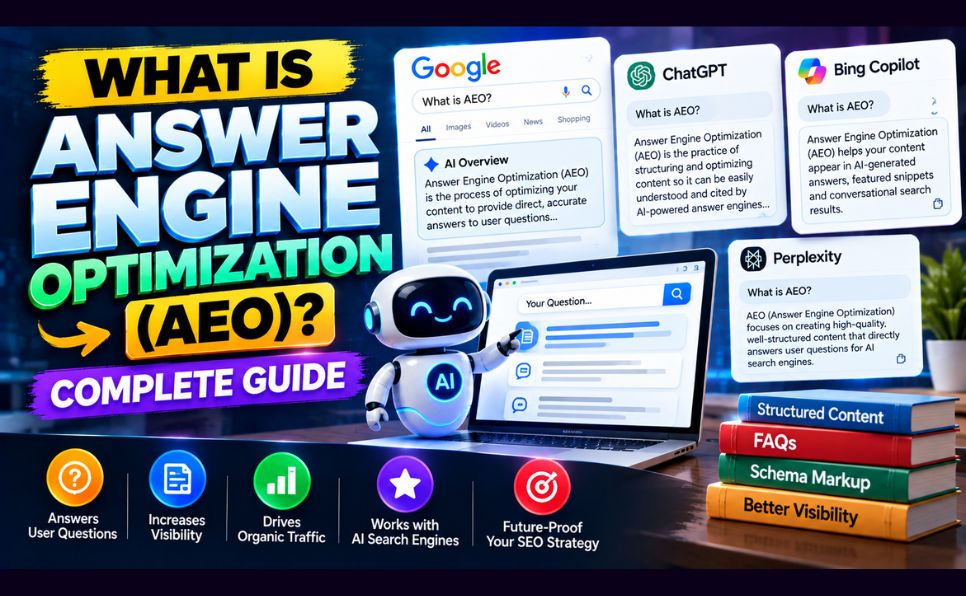
Answer Engine Optimization (AEO) is the practice of structuring and optimizing your content so that AI-powered answer engines — like ChatGPT, Perplexity, Google AI Overviews, Gemini, and Bing Copilot — select it as the source of their direct answers and cite your brand.
The simplest definition: AEO is about becoming the answer, not just ranking for the question.
Traditional SEO gets your page into a list of results. AEO gets your content quoted, cited, and attributed inside the answer itself — without the user needing to click through to your site.
One Sentence Definitions:
| Term | One-Line Definition |
|---|---|
| SEO | Optimize your pages to rank high in search results and earn clicks |
| AEO | Optimize your content to be cited as the answer by AI systems |
| GEO | Optimize your brand to appear across all generative AI experiences |
AEO is the answer-shaped subset of the broader generative AI optimization discipline.
AEO vs SEO vs GEO — What’s the Difference?
This is the question most marketers ask first — and the answer matters for how you prioritize your strategy.
| Dimension | SEO | AEO | GEO |
|---|---|---|---|
| Goal | Rank in blue link results | Be cited inside AI answers | Appear across all AI experiences |
| Target surface | Google SERP blue links | AI Overviews, Perplexity, ChatGPT | All generative AI platforms |
| Unit of optimization | The page | The answer block or passage | The brand entity |
| Success metric | Rankings, clicks, traffic | AI citations, brand mentions in answers | AI visibility share of voice |
| Domain authority weight | High (r ≈ 0.45) | Lower (r ≈ 0.18 in 2026) | Expertise signals |
| Content format | Full articles | Answer-first, structured Q&A | Authoritative, comprehensive |
Critical insight from 2026 data: Domain authority’s correlation with AI citations dropped from 0.23 to 0.18 in a single year. This means a new or lower-authority site can earn AI citations by writing better-structured, more answer-ready content — a significant opportunity for growing websites.
AEO will not replace SEO. Answer engines still depend on crawlable, indexed, authoritative web content — which is SEO’s foundation. The winning strategy in 2026 is one content stack that targets both surfaces simultaneously.
📖 Master the SEO foundation first: Complete SEO Guide 2026: Everything You Need to Rank on Google
What Are Answer Engines?
An answer engine is any AI-powered platform that provides direct answers to questions — rather than a list of links — often with citations to source material.
The 4 Major Answer Engines in 2026:
1. Google AI Overviews (formerly SGE) Google’s AI-generated summary that appears at the top of search results for many queries. Cites multiple sources below the answer. Reaches billions of users daily. This is the highest-volume answer engine surface globally.
2. Perplexity AI A dedicated answer engine — searches the web in real time and provides answers with clear, numbered citations. Growing rapidly — over 780 million monthly queries by mid-2025. Every answer shows exactly which sources were used.
3. ChatGPT with Browse Mode OpenAI’s ChatGPT can browse the web and cite sources when answering questions. With over 200 million weekly users, ChatGPT’s answer citations represent massive potential visibility.
4. Google Gemini / Bing Copilot Both provide AI-generated answers with source citations across web and mobile. Microsoft’s Copilot integration into Windows gives Bing Copilot enormous reach beyond just search.
Also important: Featured Snippets and People Also Ask boxes — Google’s original answer engine formats, still driving significant zero-click traffic.
📖 Understand how AI is already changing your search rankings: What Are AI Search Ranking Factors? Complete Guide
Why AEO Matters Now — The Numbers
The data makes the urgency clear:
- AI-sourced traffic to retail sites grew 1,324% in 18 months (Semrush, 2026)
- 40%+ of searches now trigger some form of AI-generated answer in Google
- Perplexity grew from 230 million to 780 million monthly queries in 12 months
- ChatGPT processes over 1 billion messages per day — many of them product and service questions
- Zero-click searches continue rising — more users get answers without ever clicking a link
- AEO search volume has grown 99x — from a niche term to mainstream marketing strategy
For businesses that depend on organic visibility, the message is clear: optimizing only for traditional search rankings leaves an increasingly large share of AI-answer traffic on the table.
How AI Answer Engines Decide What to Cite
Understanding this is the core of AEO strategy. Each answer engine has its own evaluation model, but several signals apply universally.
Signal 1: Extractability — Can the AI Lift a Clear Answer?
Answer engines want content they can quote directly without paraphrasing. A page that answers a question in one clear paragraph — starting with the direct answer — is far more likely to be cited than a page that buries the answer in paragraphs of preamble.
What this means: Lead with the answer. Put the direct response in the first sentence of each section.
Signal 2: Topical Authority — Do You Own This Topic?
Sites with deep, comprehensive coverage of a topic are cited more frequently than sites with single isolated articles. An answer engine evaluating “what is VPS hosting” is more likely to cite a site with 10 interconnected hosting articles than one with a single post.
What this means: Build topic clusters — a pillar article linking to comprehensive cluster articles covering every aspect of your topic.
Signal 3: E-E-A-T — Does a Real Expert Write This?
Answer engines evaluate Experience, Expertise, Authoritativeness, and Trustworthiness. Named authors with credentials, cited sources, first-hand examples, and accurate information all signal genuine expertise.
What this means: Add author bios with credentials, cite authoritative sources, include original examples and data.
Signal 4: Structured Content — Is It Easy to Parse?
AI systems process structured content more reliably than dense prose. Clear headings (H1, H2, H3), FAQ sections, tables, bullet points, and schema markup all make content easier for AI to extract and cite.
What this means: Use clear heading hierarchies, add FAQ sections, implement FAQ schema markup.
Signal 5: Freshness — Is the Information Current?
Stale information creates an avoidable reason for an answer engine to prefer another source. Regularly updated content signals active maintenance and current accuracy.
What this means: Review and update key articles every 6–12 months. Update statistics, add new sections, reflect recent developments.
Signal 6: Brand Entity Clarity — Who Are You?
Answer engines build a model of your brand as an entity. Consistent brand information across your site, social profiles, Google Business Profile, and third-party mentions helps AI systems understand and trust your brand.
What this means: Ensure your brand name, description, and expertise are consistent across all online touchpoints.
10 Proven AEO Tactics for 2026
Tactic 1: Lead Every Section With a Direct Answer
The most impactful single AEO change you can make: start each H2 or H3 section with a direct, self-contained answer to the question the heading asks.
Before (SEO-style):
## What Is VPS Hosting?

VPS hosting has been around since the early 2000s and has evolved
significantly. There are many types of hosting to consider...
After (AEO-style):
## What Is VPS Hosting?

VPS (Virtual Private Server) hosting is a type of web hosting where
a physical server is divided into isolated virtual servers, each with
dedicated resources not shared with other users.
The AEO version can be extracted and quoted directly. The SEO version cannot.
Tactic 2: Add a Comprehensive FAQ Section
FAQ sections are the single highest-yield AEO element — directly matching the question-answer format answer engines are designed to extract.
Best practices:
- 6–8 questions per article
- Each answer under 60 words — concise and direct
- Questions match real search queries (use Google Autocomplete and People Also Ask)
- Implement FAQ schema markup so Google can display FAQs as rich results
📖 Learn how schema markup improves both SEO and AEO: Schema Markup: What It Is and How to Add It
Tactic 3: Implement FAQ Schema Markup
Schema markup is the technical layer that explicitly tells AI systems your content contains questions and answers.
RankMath implementation (WordPress):
RankMath → Edit Post →
Schema → FAQ →
Add each question + answer
Manual JSON-LD (any platform):
{
  "@context": "https://schema.org",
  "@type": "FAQPage",
  "mainEntity": [{
    "@type": "Question",
    "name": "What is Answer Engine Optimization?",
    "acceptedAnswer": {
      "@type": "Answer",
      "text": "AEO is the practice of structuring content so AI-powered answer engines cite it as the source of their direct answers."
    }
  }]
}
Tactic 4: Build Topic Clusters for Topical Authority
Single articles rarely earn consistent AI citations. Sites with comprehensive topic coverage — a pillar article linking to 8–15 cluster articles covering every subtopic — are recognized by AI systems as authoritative sources.
Your existing topic cluster example (SEO):
PILLAR: Complete SEO Guide 2026
    ↓
├── Keyword Research Guide ✅
├── On-Page SEO Guide ✅
├── Technical SEO Checklist ✅
├── Backlinks Guide ✅
├── AI Search Ranking Factors ✅
└── Answer Engine Optimization ← (This article)
This architecture signals deep topical authority — exactly what answer engines reward.
📖 Build proper topic clusters: Internal Linking Strategy for SEO: Complete Guide
Tactic 5: Use the Answer-First Content Structure
Restructure your content using the BLUF (Bottom Line Up Front) approach — give the complete answer immediately, then provide supporting detail.
The AEO content template:
H2: [Question as heading]
→ Direct answer (1–3 sentences)
→ Supporting explanation
→ Example or evidence
→ Related consideration
This structure ensures every section is independently extractable as an answer.
Tactic 6: Add Named Author Bios With Credentials
Answer engines use author information as an E-E-A-T signal. Pages with named, credentialed authors are cited more frequently than anonymous content.
Implement:
- Author bio on every article (name, role, expertise)
- Author schema markup (Person schema)
- Consistent author presence across articles
- Link to author’s LinkedIn or other credentials where appropriate
Tactic 7: Cite Your Sources With Outbound Links
Content that cites authoritative external sources scores higher on trustworthiness signals — a key factor in AEO citation eligibility.
Best practice: Include 3–6 outbound links to high-authority sources (government sites, university research, major publications) per article. Cite specific statistics and claims with their source.
Tactic 8: Create an llms.txt File
A new 2026 standard emerging for AEO: the llms.txt file — similar to robots.txt but designed to communicate with AI crawlers rather than search engine bots.
/llms.txt file tells AI systems:
- Which pages are most important
- What your site is about
- Which content is best for AI citation
- Author and expertise information
Implementation: Create a plain text file at yourdomain.com/llms.txt with structured information about your site, its purpose, and key content. This is an emerging standard — early adopters gain an advantage.
Tactic 9: Optimize for Conversational Queries
Answer engines process natural language questions — not keyword strings. Your content should naturally contain and answer conversational queries.
Keyword approach (SEO): “VPS hosting benefits” Conversational approach (AEO): “What are the benefits of VPS hosting compared to shared hosting?”
Use Google’s People Also Ask boxes and AnswerThePublic to find the exact conversational questions your audience asks — then answer them directly in your content.
Tactic 10: Maintain Content Freshness
Answer engines penalize stale content by preferring fresher, more current sources. A simple freshness maintenance schedule:
| Content Type | Review Frequency |
|---|---|
| News / trending topics | As events develop |
| Technical guides | Every 6 months |
| Evergreen educational content | Every 12 months |
| Statistics and data | When new data is published |
When you update content, add a “Last updated: [date]” line at the top — answer engines often display this information in citations.
AEO Measurement — How to Track AI Visibility
Traditional analytics tools don’t capture AEO impact directly. You need a parallel measurement approach.
What to Track:
1. Brand Mentions in AI Answers Manually query your target keywords in ChatGPT, Perplexity, Gemini, and Google AI Overviews. Track whether your brand or content is cited. Do this monthly for your top 10–20 keywords.
2. Google Search Console — AI Overview Data GSC now includes data on AI Overview appearances. Check:
GSC → Search Type → AI Overviews →
See which queries trigger AI Overview citations
3. Branded Search Volume Growth As your AEO improves, users who encounter your brand in AI answers often search for you directly. Monitor branded keyword growth in GSC as a proxy for AI visibility growth.
4. Zero-Click Impression Growth In GSC, high impressions with lower CTR can indicate AI Overview appearances — users see your content cited but don’t need to click.
5. Direct Traffic Growth Brand citations in AI answers drive direct traffic — users typing your URL directly after seeing it cited. Monitor direct traffic trends alongside AEO efforts.
AEO Common Mistakes to Avoid
❌ Mistake 1: Writing for Keywords, Not Questions
AEO content must answer questions — not just include keywords. If your content doesn’t contain a direct answer to the question someone is asking, it won’t be cited.
❌ Mistake 2: Burying the Answer
Long introductions, excessive context, and preamble before the actual answer reduce extractability. Get to the answer in the first sentence after each heading.
❌ Mistake 3: No FAQ Section
This is the highest-yield AEO element and one of the easiest to add. Every article should have a FAQ section with 6–8 direct question-answer pairs.
❌ Mistake 4: Ignoring Schema Markup
FAQ schema explicitly marks your content as question-answer pairs — directly communicating with AI systems. Not implementing it is leaving AEO visibility on the table.
❌ Mistake 5: Treating AEO and SEO as Separate Strategies
The best content in 2026 serves both — ranking in traditional search while also being cited in AI answers. The same content foundation (quality, expertise, structure) supports both.
❌ Mistake 6: Not Updating Content
Stale content is actively disadvantaged in AI citation. Answer engines prefer fresh, current information. Regular content updates are essential for sustained AEO visibility.
The Future of AEO Beyond 2026
AEO is not a temporary trend — it reflects a fundamental shift in how people find information.
What’s coming:
Voice Search Integration: As AI assistants become more capable, voice queries will increasingly be answered by the same answer engines. AEO content optimized for text questions also performs well for voice.
Multimodal Answer Engines: AI systems that process images, videos, and text simultaneously. Content with well-described images and video transcripts will have AEO advantages.
Personalized AI Answers: Answer engines will increasingly tailor answers based on user history and preferences. Brand familiarity — built through consistent AEO visibility — will become a personalization signal.
Agent-Based AI: AI agents that complete tasks on behalf of users will cite trusted sources when making recommendations. Brand authority built through AEO today positions you for this next wave.
The teams winning in search in 2026 and beyond are those building content that earns visibility across all surfaces — traditional blue links, AI overview citations, answer engine quotes, and voice responses — from a single, high-quality content foundation.
Complete AEO Implementation Checklist
Content Structure:
- Every section starts with a direct answer (1–3 sentences)
- FAQ section added with 6–8 questions
- Conversational queries used as headings and subheadings
- BLUF (answer-first) format applied throughout
- Content updated with “Last updated” date
Technical Implementation:
- FAQ schema markup implemented
- Article schema with author information
- Named author bio with credentials added
- llms.txt file created
- Internal links building topic cluster
Authority Signals:
- 3–6 outbound links to authoritative sources
- Statistics cited with specific sources
- First-hand examples or original data included
- Consistent brand information across site
Measurement Setup:
- Monthly AI answer engine manual checks scheduled
- GSC AI Overview data monitored
- Branded search volume baseline recorded
- Direct traffic baseline recorded
Conclusion — AEO Is SEO’s Evolution, Not Its Replacement
Answer Engine Optimization is not a replacement for traditional SEO — it’s its natural evolution.
The same fundamentals apply: create genuinely helpful content, demonstrate real expertise, earn trust from credible sources, and maintain technical health. What changes is the optimization layer on top — structuring content to be answer-ready, implementing FAQ schema, leading with direct answers, and measuring AI visibility alongside traditional rankings.
The opportunity right now is significant. Most websites haven’t optimized for AEO yet. Domain authority’s influence on AI citations is declining — meaning a well-structured, expert article from a growing website can outperform established competitors in AI answer surfaces.
Your AEO starting point today:
- Add a FAQ section to your top 10 articles
- Restructure those articles to lead with direct answers
- Implement FAQ schema markup via RankMath
- Check whether your content appears in ChatGPT or Perplexity answers for your target keywords
- Build your topic cluster to deepen topical authority
The answer engines are already deciding who to cite. Make sure it’s you.
Frequently Asked Questions (FAQ)
What does AEO stand for?
AEO stands for Answer Engine Optimization — the practice of structuring and optimizing content so AI-powered answer engines like ChatGPT, Perplexity, Google AI Overviews, and Gemini select it as the source of their direct answers and cite your brand.
How is AEO different from SEO?
SEO optimizes your pages to rank in traditional search results and earn clicks. AEO optimizes your content to be cited as the answer inside AI-generated responses — often without requiring the user to click through to your site. Both strategies share the same content foundation but differ in optimization focus and measurement.
Does AEO replace SEO in 2026?
No — AEO and SEO complement each other. Answer engines still depend on crawlable, indexed, authoritative web content — which is SEO’s foundation. The winning strategy builds content that ranks in traditional search AND earns AI citations simultaneously. AEO is SEO’s evolution, not its replacement.
What are the best AEO tactics for beginners?
Start with the highest-yield tactics: add FAQ sections to your articles (6–8 questions with concise answers), restructure content to lead with direct answers, and implement FAQ schema markup. These three changes can improve AI citation likelihood significantly with minimal effort.
How do I know if my content is being cited in AI answers?
Manually query your target keywords in ChatGPT, Perplexity, Google AI Overviews, and Gemini, and check whether your content or brand is cited. Google Search Console now includes AI Overview data showing which queries trigger your content’s appearance. Do this monthly for your most important keywords.
Is AEO only relevant for large websites?
No — this is one of AEO’s most important advantages. Domain authority’s correlation with AI citations has dropped to 0.18 in 2026 data — lower than traditional SEO. A smaller website with well-structured, expert content can earn AI citations that out-compete larger sites with poor AEO optimization.
This guide reflects the AEO landscape as of October 2026. The field is evolving rapidly — bookmark this page for updates as answer engine algorithms continue to develop.
Found this guide helpful? Share it with your SEO team. Questions about AEO? Drop them in the comments — we answer every one!